
Casa Batllo: Gaudi’s living facade on Passeig de Gracia
Published on 09/08/2026 at 07:03 | Editorial responsibility: Rafael Müller, Editor-in-Chief AD HOC NEWS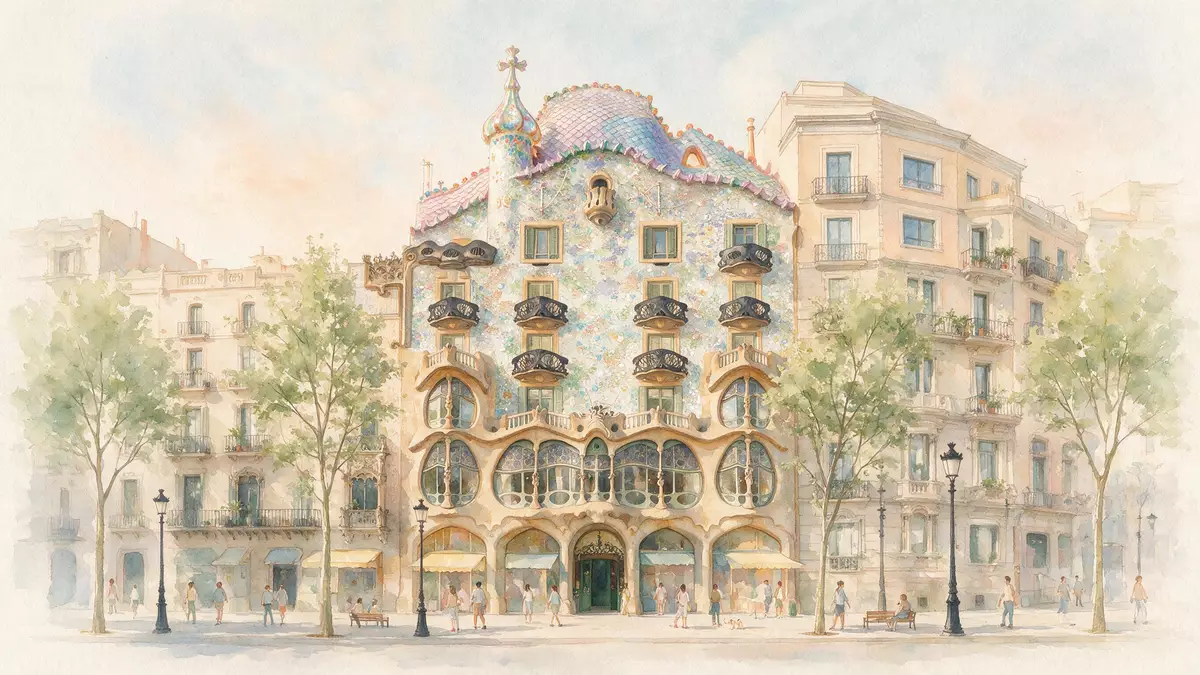
Casa Batllo on Barcelona’s Passeig de Gracia is one of Antoni Gaudi’s most theatrical transformations: an ordinary nineteenth-century apartment block recast between 1904 and 1906 as a flowing modernisme facade and fantastical rooftop landscape.Casa Batllo
A modernisme townhouse turned into a living facade
The story of Casa Batllo begins with a conventional block built in 1877 for the expanding Eixample district, later acquired by textile businessman Josep Batllo i Casanovas.The history of the building In 1904 Batllo commissioned Antoni Gaudi, already established as a leading figure of Catalan modernisme, to remodel the property as a prestigious residence rather than demolishing it.
Gaudi’s intervention between 1904 and 1906 reshaped the entire facade, reworked the interior layout and extended the upper levels, turning the townhouse into a highly expressive example of Catalan modernisme.Construction period and modernisme context The building stands at number 43 Passeig de Gracia, on a stretch long known for the stylistic rivalry between several modernist houses.
From bone-like columns to a dragon-backed roof
Casa Batllo’s street facade is the clearest expression of the building as a “living” surface, with slender stone elements and balcony supports shaped in a way that has prompted the nickname “House of Bones”.Organic modernisme description The wall behind these sculpted pieces is covered with mosaics of coloured ceramic fragments, giving the impression of a shimmering skin that changes with the light.
Above, the roofline rises in a series of curved forms tiled in graded colours, an arrangement frequently read as evoking the back of a reptile. Gaudi added an extra storey and a set of rooftop structures to the original block, creating a sequence of chimneys and ventilation elements whose shapes and finishes stand out sharply against the more rectilinear neighbours along Passeig de Gracia.Facade and roof transformation
Interior light, colour and UNESCO recognition
Inside, Casa Batllo continues the organic language of the exterior, with structural supports and staircases treated as sculptural elements and surfaces finished in a restricted palette that reinforces the sense of a continuous environment.Interior modernisme details Gaudi worked with glass, timber and glazed ceramic to frame a central light well, distributing daylight through the apartment levels and allowing internal spaces to be ventilated while remaining visually connected.
The architectural and artistic qualities of Casa Batllo led to its designation as a Historic-Artistic Monument in 1969 and its inclusion in the group of “Works of Antoni Gaudi” inscribed on the UNESCO World Heritage List in 1984, with Casa Batllo added in 2005.Historic monument and UNESCO listing These recognitions underline the building’s role as a concentrated statement of Gaudi’s mature modernisme, where structure, decoration and everyday domestic functions are woven into a single expressive whole.
Visiting Casa Batllo: what travellers from Western Europe should know
- Casa Batllo stands at Passeig de Gracia 43 in Barcelona’s Eixample district, along one of the city’s principal avenues served by metro and mainline rail stations.
- The visit involves moving through several floors linked by staircases and internal routes, with a further ascent to the rooftop where surfaces are uneven underfoot.
- English is widely used for visitor information, while the official languages are Catalan and Spanish and the currency is the euro.
Searching for Casa Batllo on social platforms
These links open searches for Casa Batllo on each platform.Frequently asked questions about Casa Batllo
Where is Casa Batllo located in Barcelona?
Casa Batllo stands on Passeig de Gracia in the Eixample district, at number 43 on a stretch known for its concentration of modernist townhouses.
What can visitors expect inside Casa Batllo?
A visit leads through remodelled interiors with sculpted structural elements, stained glass, ceramic finishes and a central light well, ending on a rooftop marked by distinctive chimneys.
What makes Casa Batllo distinctive among Gaudi’s works?
Casa Batllo is distinctive for turning an existing townhouse into a coherent modernisme composition, where the expressive facade and roof are integrated with domestic spaces throughout.


