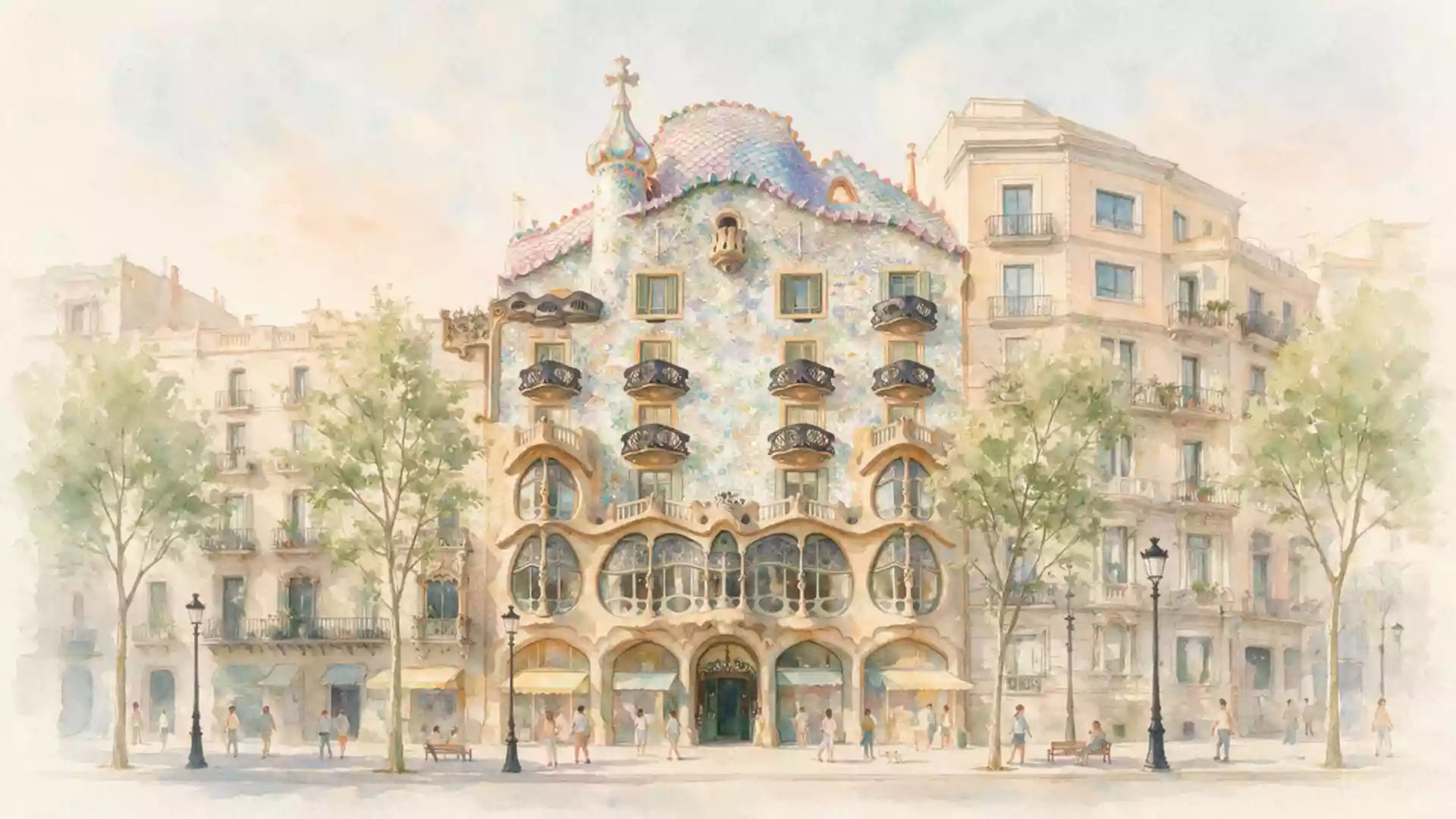
Casa Batllo and the dragon-backed facade of Passeig de Gracia
Published on 09/05/2026 at 06:44 | Editorial responsibility: Rafael Müller, Editor-in-Chief AD HOC NEWS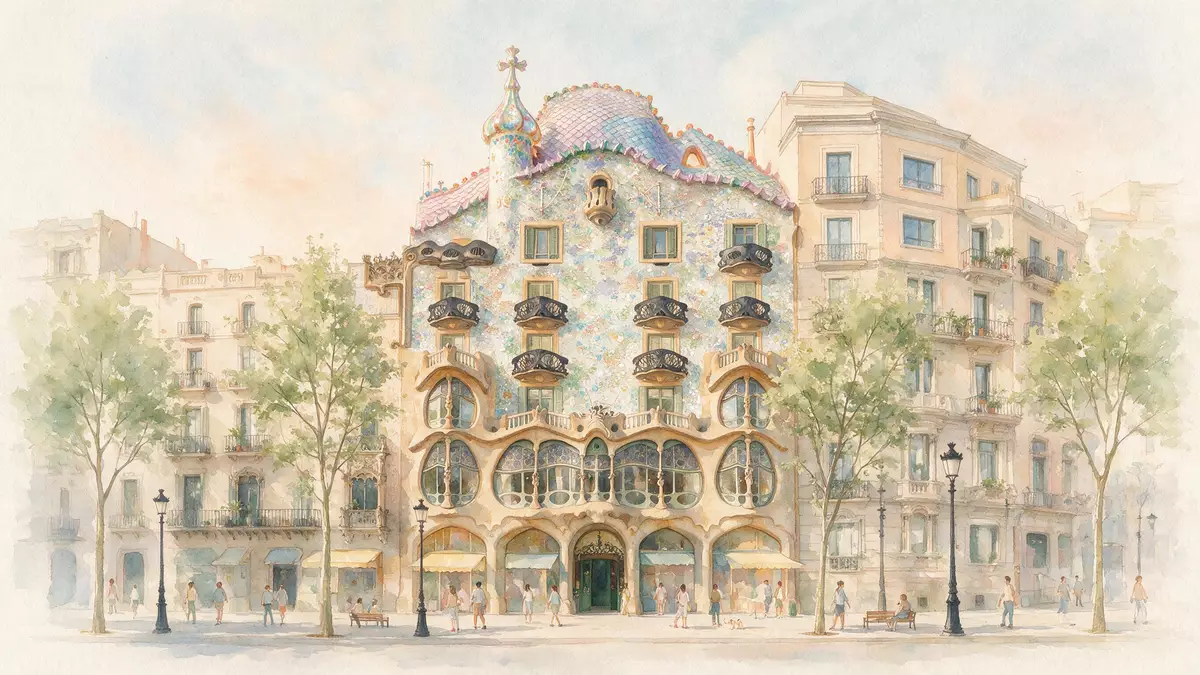
Casa Batllo is a residential building on Passeig de Gracia in Barcelona where Antoni Gaudi transformed a nineteenth-century townhouse into a fantastical modernista facade that seems to ripple like a living creature. Completed in the first decade of the twentieth century, it stands on a prominent city avenue in the Eixample district and has been recognised as a UNESCO World Heritage Site for its innovative architecture.
A Gaudi remodel on Passeig de Gracia
Casa Batllo occupies number 43 Passeig de Gracia, a broad boulevard laid out in the Eixample grid between the historic centre and the former town of Gracia.number 43 Passeig de Gracia The original house on the plot was constructed in 1877 by architect Emili Sala Cortes, a teacher of Gaudi, at a time when Barcelona had not yet introduced electric street lighting.constructed in 1877 by Emili Sala Cortes
In 1903 textile industrialist Josep Batllo i Casanovas bought the building and commissioned Antoni Gaudi to reimagine it as his family residence.Josep Batllo i Casanovas Gaudi carried out a full renovation between 1904 and 1906, refitting the structure and enveloping it in a Modernisme skin of sculpted stone, ceramic and ironwork.between 1904 and 1906 The building forms part of the Illa de la Discordia, a block of contrasting modernist houses by leading architects along this stretch of the avenue.Illa de la Discordia
The dragon-backed roof and marine facade
Gaudi’s intervention is most immediately visible on the facade, where undulating stone balconies and a patterned surface of ceramic discs and glass fragments create a shimmering, almost marine effect.colours and shapes found in marine life The colour palette draws on hues associated with coral and underwater light, while the lower levels of the facade are broken up by free-form openings and slender columns that resemble bones. Above them, the rhythm of the balconies produces a vertical pattern against the mosaic surface.
The roof is one of the building’s defining features: a curved profile clad in ceramic pieces that recall the scaled back of a dragon arched above the street.roof in the form of a dragon's back This silhouette contributes to the building’s association with the legend of Sant Jordi, Catalonia’s patron saint, and has led to the nickname “House of the Dragon”.House of the Dragon The combination of dragon-like roof, skeletal stonework and iridescent facade materials gives Casa Batllo a theatrical presence among its neighbours on Passeig de Gracia.
Interior light, structure and modernista detail
Behind the facade, Gaudi reshaped the interior with a focus on circulation, light and fluid forms that run from the main staircase to the roof. The central stair hall uses sweeping timber handrails, carved newel posts and sculpted walls to create a continuous organic line between floors, with glazed openings bringing light into the core from the street and inner courtyard.
Structural elements are articulated as part of the decorative scheme, from the timber framing in ceilings to the arching forms in key rooms. Ceramic tiles in graded blue tones line the light well, intensifying towards the upper floors to balance the distribution of daylight. Leaded glass doors with irregular panes and custom ironwork separate rooms while maintaining visual connections. Collectively, these details demonstrate Gaudi’s approach to modernista architecture in the early twentieth century, where structure, decoration and everyday domestic functions are woven into a single spatial composition.a building in the center of Barcelona
Visiting Casa Batllo: what travellers from Western Europe should know
- Casa Batllo stands on Passeig de Gracia in Barcelona’s Eixample district, with the nearest metro and suburban rail connections at Passeig de Gracia station.
- The visit involves moving through several storeys of a historic townhouse, including staircases between levels and passages that can feel narrow when groups pass.
- Passeig de Gracia is a major avenue lined with other modernista buildings, so Casa Batllo can be combined with walks past Casa Amatller and Casa Lleo Morera on the same block.
- The official language is Spanish and the currency is the euro.
Searching for Casa Batllo on social platforms
These links open searches for Casa Batllo on each platform.
Frequently asked questions about Casa Batllo
Where is Casa Batllo in Barcelona?
Casa Batllo is on Passeig de Gracia in the Eixample district of Barcelona, at number 43 on the avenue between Placa de Catalunya and the former town of Gracia.
What should visitors expect inside Casa Batllo?
A visit leads through the main floors, stair hall and roof of a remodelled early twentieth-century townhouse, with Gaudi’s flowing timber, ceramic and glass details visible throughout.
What makes Casa Batllo distinctive among Gaudi’s works?
The combination of dragon-backed roof, coral-coloured facade surface and bone-like stone balconies gives Casa Batllo a sculptural presence that stands out along Passeig de Gracia.