
Casa Batllo and the colours of Gaudí’s Barcelona
Published on 09/23/2026 at 19:01 | Editorial responsibility: Rafael Müller, Editor-in-Chief AD HOC NEWS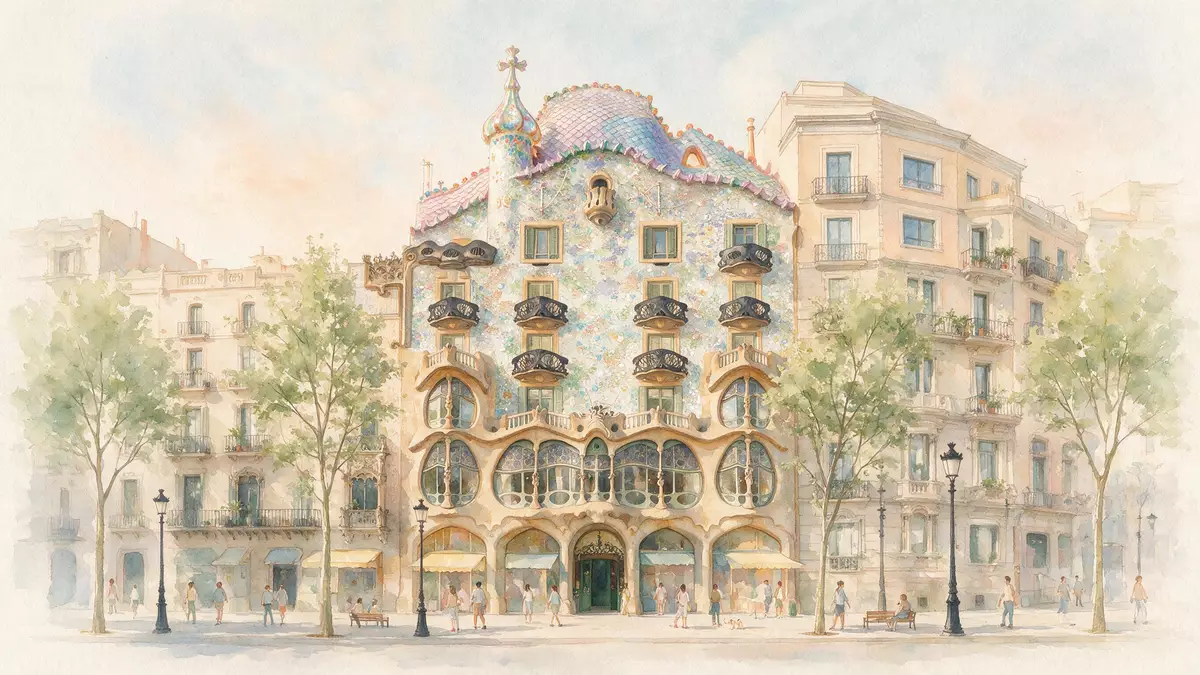
Casa Batllo rises at Passeig de Gràcia 43 in Barcelona as a residential building transformed into a composition of ceramic, glass, iron and carved stone. Antoni Gaudí remodelled it between 1904 and 1906 for the industrialist Josep Batlló, giving the façade a flowing surface and the roof a tiled profile associated with a dragon’s back.
Casa Batllo on Passeig de Gràcia
The building belongs to Barcelona’s Eixample district, where Passeig de Gràcia crosses Carrer d’Aragó. Its address places it among the city’s principal modernist buildings, with the façade facing one of Barcelona’s best-known urban avenues. The house presents no plain rectangular wall to the street. Balconies, stonework, ceramic fragments and irregular openings form a continuous architectural surface.
Josep Batlló entrusted the transformation to Antoni Gaudí’s remodelling. The work retained the building while altering its façade, interior arrangement and central light well. Gaudí worked with craftsmen across materials, joining structural elements and decoration into a single design.
Antoni Gaudí’s ceramic façade
Casa Batllo’s façade combines sandstone, wrought iron, glass and ceramic fragments. The broken-tile technique known as trencadís gives the surface a varied colour field, with blues, greens and other tones distributed across the balconies and upper levels. The stone columns at the lower façade have rounded, organic profiles.
The balconies project from the wall in sculpted forms. Their iron railings curve across the façade, while the stone elements around them create a skeletal visual language. The building’s local nickname, Casa dels Ossos, refers to the bone-like appearance associated with parts of this exterior.
The roof is covered with coloured tiles arranged in overlapping forms. Its ridged profile is linked to the familiar expression “dragon’s back”, while the roof terrace contains decorated chimneys and ventilation structures. The upper outline gives Casa Batllo a recognisable silhouette from Passeig de Gràcia.
Courtyard, rooms and World Heritage status
Inside, the central light well is lined with ceramic tiles whose colours change across its levels. The windows and tile surfaces form a vertical sequence around the courtyard. A staircase rises beside this internal space, with curved woodwork, ceramic details and sculpted fittings continuing Gaudí’s language into the interior.
The main rooms include the noble floor, where large windows face Passeig de Gràcia, and private residential areas arranged above it. Wavy partitions, decorated ceilings, stained glass and built-in furniture connect the rooms with the building’s exterior vocabulary. The attic contains a series of parabolic arches, creating a strong rhythm beneath the roof.
Casa Batllo forms part of the Works of Antoni Gaudí, inscribed on the UNESCO World Heritage List in 2005. The designation also includes other Gaudí buildings in Barcelona and Catalonia, recognising their architectural and artistic contribution.
The building’s significance rests in the relationship between its parts. Ceramic fragments cover the exterior, ironwork defines the balconies, stone shapes the lower façade, and the roof tiles form a coloured crest. Inside, the courtyard, rooms, arches and staircases carry the same material vocabulary into a residential setting.
Visiting Casa Batllo: what travellers from Western Europe should know
- Casa Batllo is at Passeig de Gràcia 43 in Barcelona’s Eixample district. Passeig de Gràcia metro station serves lines L2, L3 and L4, while regional rail also reaches the station.
- The approach is urban and paved, but the interior includes staircases, changing floor levels and narrow passages around the courtyard and attic arches.
- The official language is Catalan and Spanish, and the currency is the euro.
- Nearby Passeig de Gràcia contains Casa Mila, while Carrer d’Aragó meets the avenue beside Casa Batllo.
Searching for Casa Batllo on social platforms
These links open searches for Casa Batllo on each platform.Frequently asked questions about Casa Batllo
Where is Casa Batllo?
Casa Batllo is at Passeig de Gràcia 43 in Barcelona’s Eixample district. The building stands beside Carrer d’Aragó and Passeig de Gràcia metro station.
What can visitors expect inside?
The interior contains the noble floor, a tiled central light well, curved staircases, residential rooms and an attic formed by parabolic arches. Ceramic, wood, glass and iron appear throughout the rooms.
What makes Casa Batllo distinctive?
Its façade combines trencadís ceramic, sculpted stone and wrought iron, while the coloured roof creates the profile known as the dragon’s back. Antoni Gaudí remodelled the building between 1904 and 1906.


