
Carthage: layered ruins above the Gulf of Tunis
Published on 09/16/2026 at 08:41 | Editorial responsibility: Rafael Müller, Editor-in-Chief AD HOC NEWS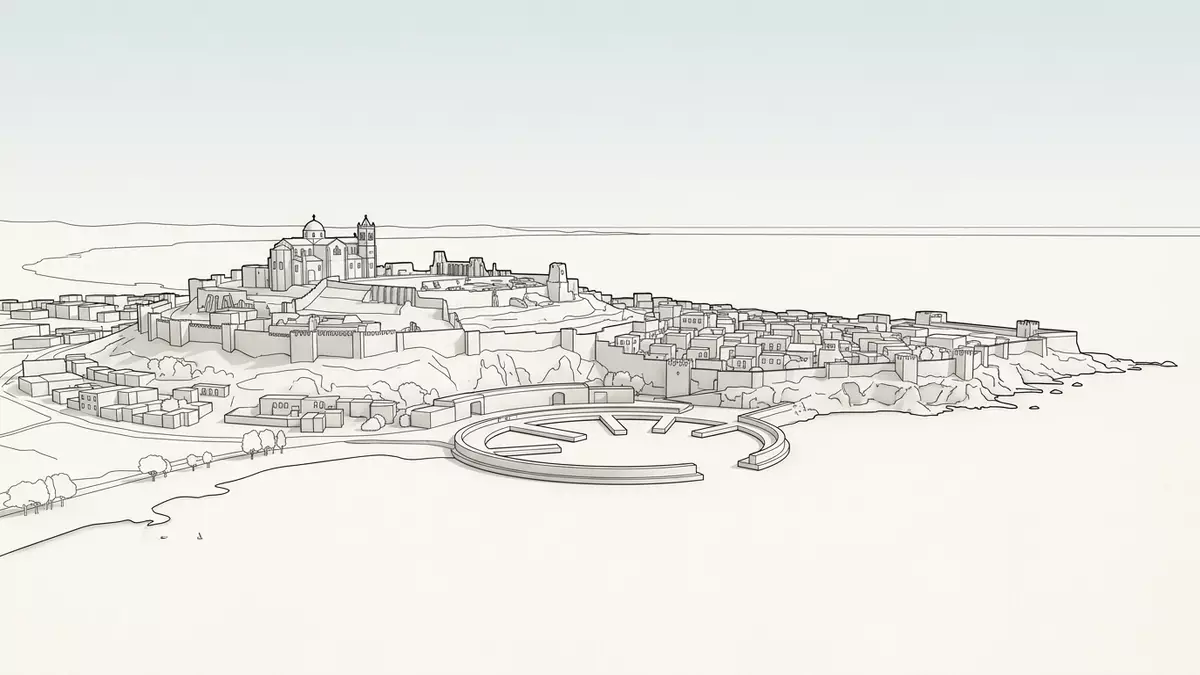
Carthage on the Gulf of Tunis is an ancient city whose ruins lie among villas and streets on the northern edge of Tunis, forming an archaeological landscape within a modern suburb. Founded by Phoenician settlers in the first millennium BC and later rebuilt as a Roman colony, it presents layers of Punic, Roman and early Christian remains on and around the hill of Byrsa.
From Phoenician foundation to Roman capital
Carthage was founded by Phoenicians on a promontory above the Gulf of Tunis in the ninth century BC, a position that linked the city to maritime routes across the central Mediterranean.Founded by the Phoenicians in the ninth century BC The traditional foundation date of 814 BC appears in Greek chronographic tradition and connects Carthage to the wider story of Mediterranean colonisation.Founded around 814 BC
Across its history Carthage moved from a Punic maritime power to a Roman provincial capital, with Imperial Roman Carthage serving as the centre of the province of Africa Proconsularis under Augustus.Augustus built Carthage as the capital of proconsular Africa Later the city became an important early Christian centre associated with figures such as Augustine of Hippo, before passing under Vandal, Byzantine and Umayyad control in late antiquity.Christian, Vandal, Byzantine and Arab periods
An archaeological site woven into a suburb
The archaeological site of Carthage lies within the Tunis Governorate and is dispersed through the present-day residential area that carries the same name, creating a patchwork of excavated remains among houses and gardens.An archaeological site within a residential suburb The ruins occupy a broad promontory which overlooks the Gulf of Tunis and the surrounding coastal plain, with views towards central Tunis and the wider bay.A promontory above the Gulf of Tunis
UNESCO inscribed the Archaeological Site of Carthage on the World Heritage List in 1979 for its cultural value, citing criteria that reflect the city’s role in Mediterranean history and early Christianity.World Heritage inscription in 1979 The protected area covers multiple sectors, including Punic quarters, Roman public buildings, religious complexes and water infrastructure, spread across several hundred hectares beside the Gulf.Archaeological sectors across the suburb
Byrsa hill, ports and monumental remains
At the centre of ancient Carthage stands Byrsa hill, identified as the site of the Punic citadel and later the core of the Roman colony, with a museum and a church now occupying its summit.Byrsa hill as citadel and museum site Excavations on and around the hill have revealed foundations of Punic houses, Roman forums and other structures that show how the town plan changed between the Punic and Roman periods.Foundations of Punic houses on Byrsa hill
Beyond Byrsa, visitors encounter remains that range from the lagoons of the Punic ports to the Antonine Baths, a large Roman seaside bath complex, as well as cisterns, aqueduct sections, amphitheatre ruins and early Christian basilicas scattered through the landscape.Punic ports, baths, cisterns and basilicas Together these structures give a sense of a city that once controlled sea lanes between Sicily and Africa and later became a major Roman urban centre on the North African coast.Control of the narrows between Sicily and Africa
Visiting Carthage: what travellers from Western Europe should know
- Carthage lies north-east of central Tunis, on a coastal promontory above the Gulf of Tunis, and is reached by suburban rail and local roads from the capital.
- The archaeological sectors are spread across low hills and streets, with uneven ground and stairways on sites such as Byrsa hill and the Antonine Baths.
- Nearby, the Medina of Tunis and other World Heritage sites in Tunisia, including Dougga and the Amphitheatre of El Jem, form a wider circuit of historic towns and monuments.
- The official language is Arabic and the currency is the Tunisian dinar.
- Entry requirements depend on your nationality; UK travellers can check the FCDO travel advice at gov.uk/foreign-travel-advice, Irish travellers the Department of Foreign Affairs at ireland.ie.
Searching for Carthage on social platforms
These links open searches for Carthage on each platform.
Frequently asked questions about Carthage
Where is Carthage in relation to Tunis?
Carthage stands north-east of central Tunis on a coastal promontory above the Gulf of Tunis, forming part of the Tunis Governorate.
What can visitors expect to see at Carthage?
Visitors encounter dispersed archaeological sectors, including Punic house foundations, Roman bath complexes, amphitheatre remains, cisterns, aqueduct sections and early Christian basilicas among modern streets.
What makes Carthage distinctive among ancient Mediterranean cities?
Carthage combines Punic, Roman and early Christian layers on one site, recognised by UNESCO since 1979, with ruins integrated into a living suburb overlooking a major Mediterranean gulf.


