
Carthage between sea and hill above Tunis
Published on 08/27/2026 at 08:55 | Editorial responsibility: Rafael Müller, Editor-in-Chief AD HOC NEWS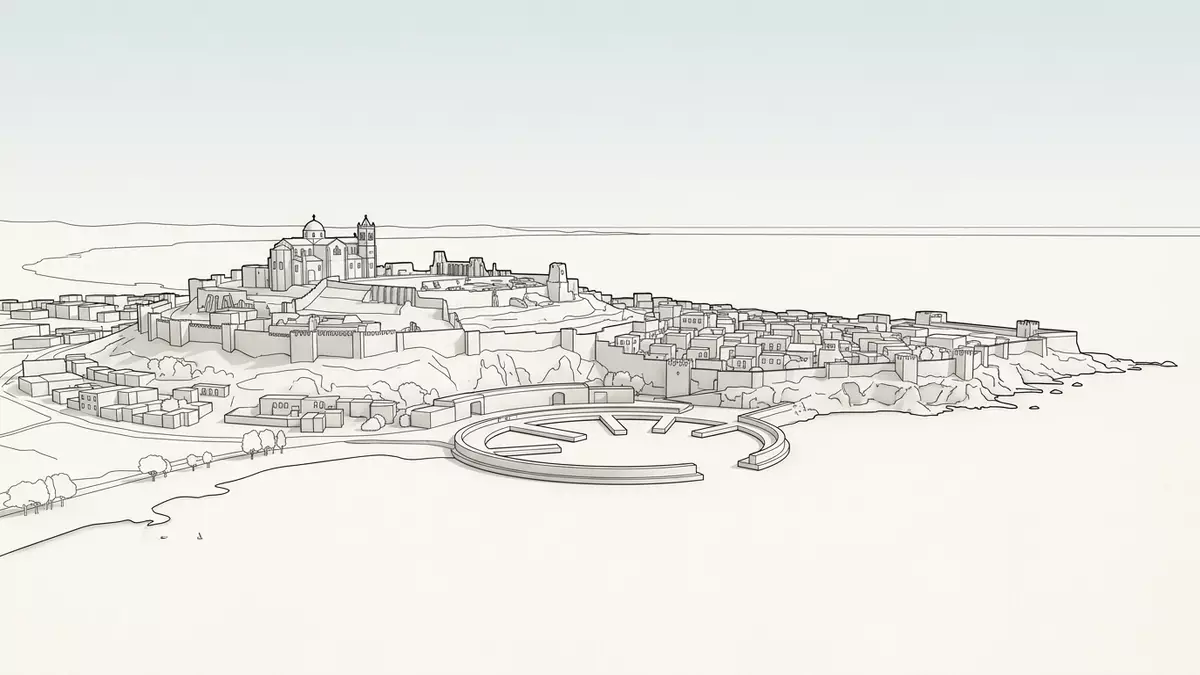
Carthage on the Gulf of Tunis is both an archaeological landscape and a modern suburb of Tunis, where Punic foundations, Roman monuments and white villas share the same low hills. The ruins trace a trajectory from a Phoenician trading colony in the ninth century BC to a Roman provincial capital and later Christian centre, all within sight of the water that first drew settlers from Tyre.
Punic foundations on the Gulf of Tunis
The city of Carthage was founded by Phoenician settlers from the Levant, linked in later tradition to Tyre on the eastern Mediterranean coast.Phoenician settlers from Tyre The foundation is placed in the ninth century BC, a period when Phoenician traders established a chain of coastal settlements across the western Mediterranean.founded in the ninth century BC From early on, Carthage occupied ground that still shapes a visit: gently rising terrain above the Gulf of Tunis and the low surrounding plain.
Classical accounts give the city a Punic name meaning “New City”, and later Latin authors described its growth into a powerful maritime and commercial centre along the North African coast.New City on the North African coast Its position near what is now Lake Tunis and the open gulf offered anchorages and access inland, elements still visible in the way the archaeological zones follow both shoreline and ridge.
From Punic metropolis to Roman provincial capital
Carthage became the centre of a Punic civilisation whose influence reached across North Africa, Sicily and parts of Iberia, drawing wealth from trade and agriculture.centre of Punic civilisation For visitors walking between the scattered sites around modern Carthage, this layered power is represented in remains ranging from Punic quarter excavations to massive Roman public buildings.
The most dramatic break in that story came in 146 BC, when Roman forces under Scipio Aemilianus captured and destroyed the Punic city at the end of the Third Punic War.destroyed in 146 BC A later Roman foundation on the same headland turned Carthage into the capital of the province of Africa, and the remains of that era dominate many of the ruins visible around Tunis today.capital of the Roman province of Africa
The archaeological site within modern Carthage
The archaeological site of Carthage is not a single fenced park but a collection of zones spread through the present-day Carthage district, a residential suburb of Tunis with streets, embassies and villas between the ruins.site dispersed in the current city The whole ensemble is recognised as the Archaeological Site of Carthage, inscribed on the UNESCO World Heritage List as a cultural property since 1979.World Heritage inscription in 1979
Across these zones, Punic house foundations, Roman baths, a theatre and early Christian basilicas reflect successive phases of the city’s life under different empires.Roman baths and theatre among the ruins The terrain ranges from the prominent hill of Byrsa, long identified as the ancient citadel, down towards the sea, where parts of the Punic harbours and shore installations can still be traced.dominated by the hill of Byrsa
Visiting Carthage: what travellers from Western Europe should know
- Carthage lies north-east of central Tunis on the Gulf of Tunis and functions as a suburb; it is reachable by road and by local rail running between Tunis and the coastal settlements.
- Exploring the archaeological site involves walking between separate zones on undulating ground, with paths, steps and exposed stone surfaces on the hill of Byrsa and near the harbour remains.
- The archaeological zones of Carthage stand close to the shoreline of the Gulf of Tunis, with views across the water and towards other suburbs of Tunis.
- The official language is Arabic and the currency is the Tunisian dinar. Entry requirements depend on your nationality; UK travellers can check the FCDO travel advice at gov.uk/foreign-travel-advice, Irish travellers the Department of Foreign Affairs at ireland.ie.
Searching for Carthage on social platforms
These links open searches for Carthage on each platform.
Frequently asked questions about Carthage
Where is Carthage in relation to Tunis?
Carthage stands on the north-eastern side of the Tunis urban area, on low hills beside the Gulf of Tunis, and forms a coastal suburb of the capital.
What should visitors expect when exploring Carthage?
Visitors encounter a series of archaeological zones interwoven with residential streets, from the hill of Byrsa to harbour remains and Roman public buildings close to the shoreline.
What makes Carthage distinctive among ancient Mediterranean sites?
Carthage combines Punic origins, destruction by Rome in 146 BC, later Roman and Christian phases and a modern suburb, all recognised together as a UNESCO World Heritage archaeological site.


