
Carlsbad Caverns National Park and the stone underworld of New Mexico
Published on 08/29/2026 at 21:33 | Editorial responsibility: Rafael Müller, Editor-in-Chief AD HOC NEWS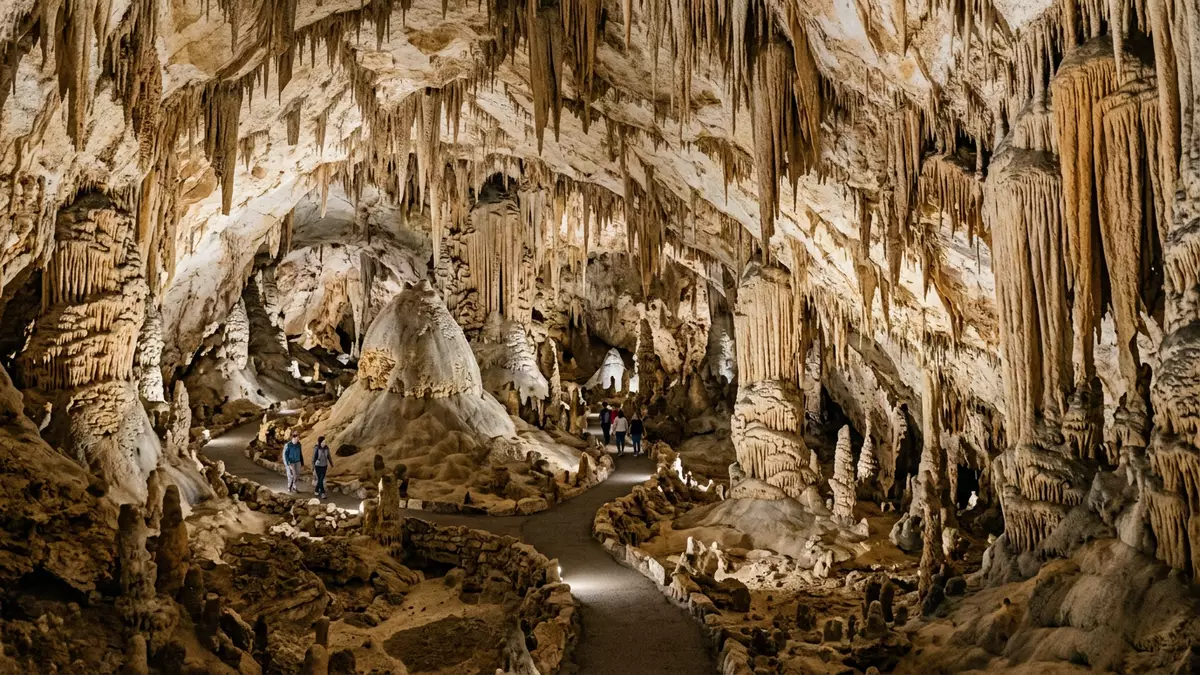
Carlsbad Caverns National Park in New Mexico brings an unusual pairing into one landscape: the sunlit Chihuahuan Desert above and an immense limestone underworld beneath. Set in the Guadalupe Mountains near the town of Carlsbad in the south-east of the state, the park protects a network of caves carved into an ancient reef that dates back to the Permian period, giving visitors a direct encounter with deep geological time as well as with the scale of its main cavern.
Desert plateau above, cavern chambers below
The first impression of Carlsbad Caverns National Park is of a high desert plateau, with ancient sea ledges and rocky canyons cut into the flanks of the Guadalupe Mountains. The bedrock here belongs to the Capitan Limestone, part of the Capitan Reef that formed roughly 260 to 270 million years ago when the area was covered by a shallow inland sea.Capitan Reef in the Permian period This fossil reef now stands as a limestone and dolomite escarpment, its cliffs and slopes holding both the desert ecosystems at the surface and the cave systems within.
Hidden beneath the desert plants are more than 100 known caves, including Carlsbad Cavern and Lechuguilla Cave, both formed within the Permian-age reef complex.caves in a Permian fossil reef The caverns lie within a mass of limestone above the regional groundwater level, but their initial enlargement took place while the rock was within the groundwater zone. Deep below the limestone, petroleum reserves of the Permian Basin add another layer of geology to the setting, tying the subterranean landscape to the broader basin that stretches across parts of New Mexico and Texas.limestone above groundwater and underlying petroleum
An ancient reef hollowed by sulfuric acid
The caves of Carlsbad Caverns National Park were produced in a way that differs from many limestone caves worldwide. Instead of being carved mainly by weak carbonic acid from surface water, the large chambers here were dissolved largely by sulfuric acid formed when hydrogen sulfide gas rose from deeper petroleum deposits and reacted with oxygen in the groundwater.sulfuric acid cave formation This process converted much of the limestone to gypsum, leaving behind vast voids that later became decorated by familiar speleothems such as stalactites and stalagmites.
Geologists place the formation of the reef in the late Palaeozoic era and the main phase of cave dissolution in a much later part of the Cenozoic era, tying the cavern’s story to multiple geological periods.reef and cave development over geological eras Inside the caverns, the presence of gypsum deposits and the relative lack of stream-borne sediments support the interpretation that hydrogen sulfide-derived sulfuric acid was the dominant dissolving agent.gypsum as evidence of sulfuric acid dissolution Later, when the large voids were already open, water containing carbonic acid dripping from the cave roof contributed to the growth of familiar formations, building stalagmites from the floor and stalactites from the ceiling over long spans of time.stalactites and stalagmites in the caverns
Carlsbad Cavern, bats and the wider park landscape
Within the park, Carlsbad Cavern is the most visited cave and one of the largest chambers discovered in the region’s Permian reef complex.Carlsbad Cavern within the reef complex The route through the cavern passes through rooms with substantial ceiling heights and extensive speleothem displays, where flowstone, draperies and columns show the variety of calcite forms produced by slow dripping and evaporation. Elsewhere in the park, Lechuguilla Cave extends to considerable depths and lengths, although access to it is limited and its formations are recognised in geological literature for their variety and preservation.
Above ground, the park lies within the Chihuahuan Desert and shows typical desert vegetation, including cactus and shrubs adapted to arid conditions.desert terrain and cactus Carlsbad Caverns National Park is also known in scientific descriptions for its bat populations, which use some of the cave entrances as roosts.bat colonies in the park The contrast between the dry desert surface and the cool, mineral-rich interior of the caverns, together with the presence of both geological and biological features, makes the park an important site for the study of cave and karst environments.
Visiting Carlsbad Caverns National Park: what travellers from Western Europe should know
- Carlsbad Caverns National Park lies in south-eastern New Mexico, near the city of Carlsbad, and is reached by road via Carlsbad Caverns Highway, which branches from US Highway 62/180 at White’s City.
- The surface terrain in the park is high desert with rocky slopes and canyon edges, and access to the main cavern involves descending and ascending pathways that cover a notable vertical range.
- The park sits within the Guadalupe Mountains in New Mexico, and the wider area is part of the Permian Basin, so journeys often involve long stretches of open road through desert and low mountain scenery.
- The official language is English and the currency is the United States dollar.
- Entry requirements depend on your nationality; UK travellers can check the FCDO travel advice at gov.uk/foreign-travel-advice, Irish travellers the Department of Foreign Affairs at ireland.ie.
Searching for Carlsbad Caverns National Park on social platforms
These links open searches for Carlsbad Caverns National Park on each platform.
Frequently asked questions about Carlsbad Caverns National Park
Where is Carlsbad Caverns National Park located?
Carlsbad Caverns National Park is in south-eastern New Mexico, United States, in the Guadalupe Mountains near the town of Carlsbad.
What can visitors expect on a visit to Carlsbad Caverns National Park?
Visitors encounter a high desert landscape at the surface and extensive limestone caverns below, with large chambers, speleothems and a marked contrast between light and underground spaces.
What makes Carlsbad Caverns National Park distinctive among cave parks?
The park preserves caves formed largely by sulfuric acid in a Permian fossil reef, together with desert terrain and notable bat populations, making it a significant site for both geology and ecology.


