
Carlsbad Caverns National Park and its underground reef
Published on 09/24/2026 at 07:41 | Editorial responsibility: Rafael Müller, Editor-in-Chief AD HOC NEWS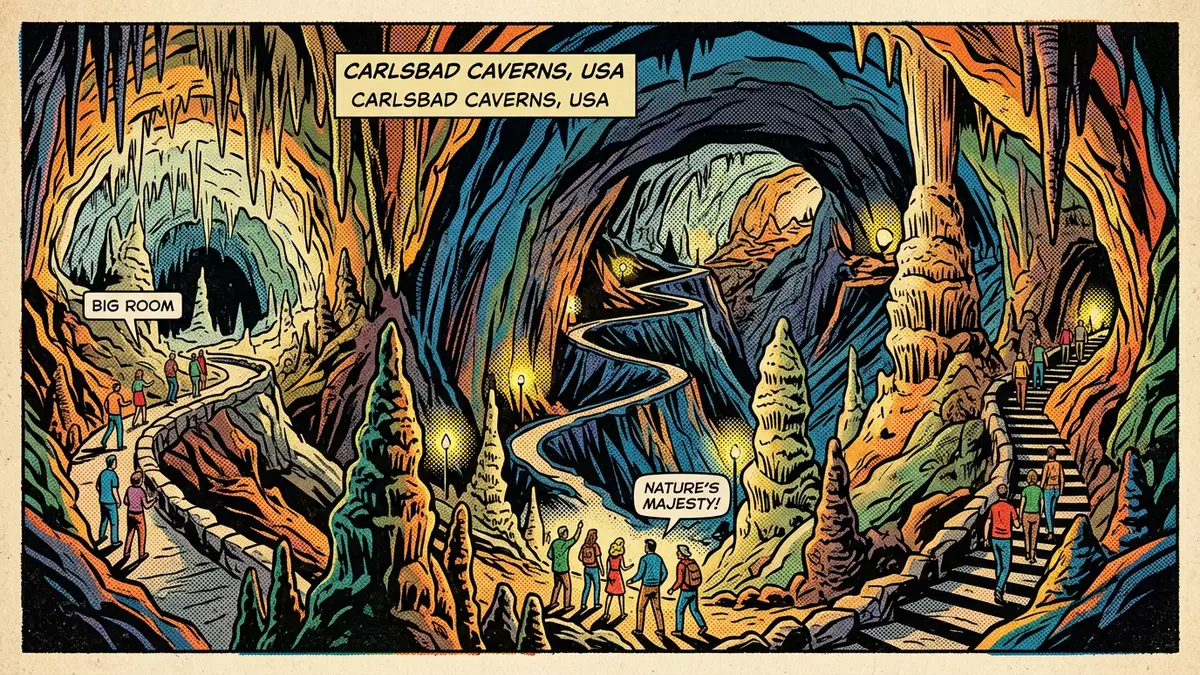
Carlsbad Caverns National Park extends from the Chihuahuan Desert into an underground landscape formed inside an ancient limestone reef. Near Carlsbad in southeastern New Mexico, the park combines desert mountains above ground with vast chambers, delicate mineral deposits and passages below it.
Carlsbad Caverns National Park: a reef beneath the desert
The rock beneath the park began as part of the Capitan Reef, which grew beside an inland sea during the Permian period. Marine organisms contributed to the reef, and its preserved limestone later became part of the Guadalupe Mountains.
That geological history remains visible in the caves. Most of the park lies within the Capitan Limestone formation, a layer about 750 feet thick. Capitan Limestone formation gives the underground landscape its principal material.
How sulphuric acid shaped the cave system
Carlsbad Cavern differs from the familiar model of a cave formed mainly by weak carbonic acid in rainwater. Sulphuric acid dissolved parts of the limestone, producing chambers and passages from within the ancient reef.
Water later deposited calcium carbonate across the cave surfaces. Stalactites, stalagmites and other speleothems cover sections of the limestone, adding mineral textures to the broad spaces.
The park protects more than 120 known caves, including Lechuguilla Cave. Carlsbad Cavern remains the named centre of the park, while the wider network extends through the Guadalupe Mountains.
From national monument to World Heritage site
Carlsbad Cavern entered documented public history through exploration and guano mining. In 1923, President Calvin Coolidge established Carlsbad Cave National Monument by proclamation.
Congress designated Carlsbad Caverns National Park on 14 May 1930. The park became a World Heritage site in 1995, recognising its cave system, geological formation and mineral decoration. World Heritage designation connects the site with the wider history of the Permian reef.
Above ground, the park covers desert terrain and mountain slopes. Elevation ranges from 1,036 m to 1,941 m, placing the caverns within a landscape that changes from lower desert surfaces to the Guadalupe Mountains.
Visiting Carlsbad Caverns National Park: what travellers from Western Europe should know
- Carlsbad Caverns National Park lies in southeastern New Mexico, near the city of Carlsbad and the Guadalupe Mountains. Road travel from Carlsbad reaches the park through the desert landscape.
- The natural entrance descends into Carlsbad Cavern through a long underground route. The cavern environment includes steep gradients, uneven rock and extensive walking.
- The park lies in the Chihuahuan Desert and includes limestone mountain terrain. Underground conditions differ from the exposed desert surface.
- The official language is English and the currency is the US dollar.
- Entry requirements depend on your nationality; UK travellers can check the FCDO travel advice at gov.uk/foreign-travel-advice, Irish travellers the Department of Foreign Affairs at ireland.ie.
Searching for Carlsbad Caverns National Park on social platforms
These links open searches for Carlsbad Caverns National Park on each platform.Frequently asked questions about Carlsbad Caverns National Park
Where is Carlsbad Caverns National Park?
Carlsbad Caverns National Park is in southeastern New Mexico, near Carlsbad and the Guadalupe Mountains. The park lies within the Chihuahuan Desert.
What can visitors expect underground?
Visitors encounter steep passages, large chambers, limestone surfaces and mineral formations. The underground environment includes stalactites, stalagmites and extensive cave routes.
What makes Carlsbad Caverns distinctive?
The caves occupy an ancient Permian fossil reef, and sulphuric acid played a major role in dissolving the limestone. The park also combines this underground system with desert and mountain terrain.


