
Carlsbad Caverns National Park and its ancient reef beneath New Mexico
Published on 09/12/2026 at 19:32 | Editorial responsibility: Rafael Müller, Editor-in-Chief AD HOC NEWS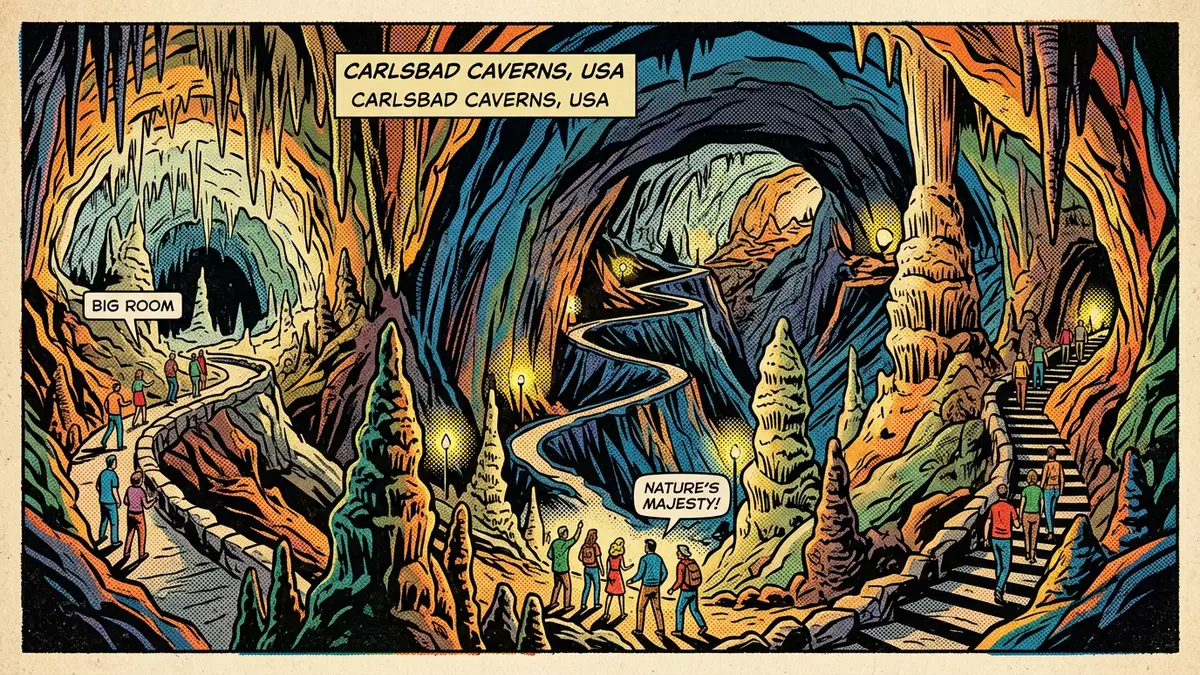
Carlsbad Caverns National Park in New Mexico takes travellers beneath the desert into vast limestone chambers carved inside an ancient fossil reef. The park lies in the Guadalupe Mountains near the city of Carlsbad and protects caves formed within the Permian-age Capitan Reef, where a shallow inland sea once covered this corner of the United States.
An ancient Permian reef turned cavern landscape
The story of Carlsbad Caverns begins in the Permian Period, when an inland sea spread across what is now south-eastern New Mexico and western Texas. Along its margin grew the Capitan Reef, a horseshoe-shaped complex of limestone and dolomite that later became the bedrock of the park. As the sea evaporated and sediments accumulated, the fossil reef was buried beneath deposits of salt and other materials, locking its marine history into stone.About 250 million years ago this reef framed the coastline of the Permian sea, and is now exposed both at the surface and underground where caves have opened inside it.The Capitan Reef complex
Geologists describe Carlsbad Caverns as a rare example of caves formed by sulphuric acid rather than the more usual carbonic-acid action of surface water. Deep beneath the reef, petroleum reserves released hydrogen sulphide into groundwater moving through fractures in the limestone. When this hydrogen sulphide met oxygen-bearing water, it produced sulphuric acid that aggressively dissolved the limestone from below, enlarging fractures into passages and chambers and leaving gypsum deposits as a by-product.Hydrogen-sulphide-rich waters reshaped the fossil reef into an underground landscape where blocks fell from ceilings and later speleothems began to grow as the caves drained and rainwater seeped down from the surface.Sulphuric acid dissolution of limestone
Monumental chambers and delicate cave formations
Within Carlsbad Caverns National Park more than 100 limestone caves have been documented, ranging from massive chambers to intricate networks of smaller passages. The best-known of these is Carlsbad Cavern itself, a cave containing a large underground room known as the Big Room, alongside a series of galleries filled with calcite formations such as stalactites, stalagmites, columns and flowstone.Carlsbad Cavern includes a large limestone chamber The variety and density of these speleothems reflect long periods during which water dripping from the cave roof deposited minerals into ever-growing shapes.
The park’s caves are notable for the diversity of their decorative rock formations, from slender “soda straws” to thick draperies and pools lined with cave pearls. In nearby Lechuguilla Cave, which also lies within the Capitan Reef complex but is accessed separately, rare speleothems include large gypsum features described as chandeliers, some reaching several metres in length.Lechuguilla Cave speleothems While Lechuguilla is not open for general tourism, its formations contribute to the scientific significance of Carlsbad Caverns National Park as an underground laboratory of mineral growth and microbial activity.Carlsbad Caverns formed within the Capitan Reef complex
From national monument to UNESCO World Heritage Site
The caves around Carlsbad were known locally before gaining federal protection in the early twentieth century. The area was proclaimed a national monument in 1923 and later redesignated as Carlsbad Caverns National Park in 1930, reflecting its growing importance within the United States’ system of protected landscapes.Established as a national monument on 25 October 1923 The park covers thousands of hectares of the Guadalupe Mountains, overlying a segment of the fossil reef that continues into neighbouring parts of Texas.The park covers an area of 18,926 ha
In 1995 Carlsbad Caverns National Park was inscribed on the UNESCO World Heritage List as a natural site under criteria that emphasise the outstanding geology and speleothems of its caves.Year of inscription on the World Heritage List 1995 The nomination highlighted the more than 80 recognised caves within the park and the ongoing geologic processes that continue to shape formations in places such as Lechuguilla. Together, Carlsbad Cavern and its neighbouring caves present an accessible cross-section through the Capitan Reef, allowing scientists and visitors alike to trace a journey from ancient marine life to dissolved chambers and modern mineral decoration.
Visiting Carlsbad Caverns National Park: what travellers from Western Europe should know
- Carlsbad Caverns National Park lies in south-eastern New Mexico, south of the town of Carlsbad; the main entrance is reached by road from Carlsbad and connects with regional highways across the desert.
- The developed routes inside Carlsbad Cavern follow maintained paths and, in places, steep gradients; the descent from the natural entrance leads down a lengthy path through underground switchbacks before reaching the main chambers.
- The wider park sits within the Guadalupe Mountains, a semi-arid landscape of limestone hills and desert vegetation, so surface trails involve exposure to sun and modest elevation changes on rocky ground.
- The official language is English and the currency is the United States dollar.
- Entry requirements depend on your nationality; UK travellers can check the FCDO travel advice at gov.uk/foreign-travel-advice, Irish travellers the Department of Foreign Affairs at ireland.ie.
Searching for Carlsbad Caverns National Park on social platforms
These links open searches for Carlsbad Caverns National Park on each platform.
Frequently asked questions about Carlsbad Caverns National Park
Where is Carlsbad Caverns National Park located?
Carlsbad Caverns National Park is in south-eastern New Mexico in the United States, near the town of Carlsbad and within the Guadalupe Mountains.
What can visitors expect on a visit to Carlsbad Caverns National Park?
Visitors encounter developed underground routes through Carlsbad Cavern, passing extensive limestone chambers filled with stalactites, stalagmites and other calcite formations, alongside desert landscapes on the surface.
What makes Carlsbad Caverns National Park distinctive among cave destinations?
The park’s caves formed through sulphuric acid dissolution inside an ancient Permian reef, creating large chambers and rare speleothems recognised by UNESCO as a World Heritage Site for their geological value.


