
Capilano Suspension Bridge and the canyon forest of North Vancouver
Published on 08/18/2026 at 13:27 | Editorial responsibility: Rafael Müller, Editor-in-Chief AD HOC NEWS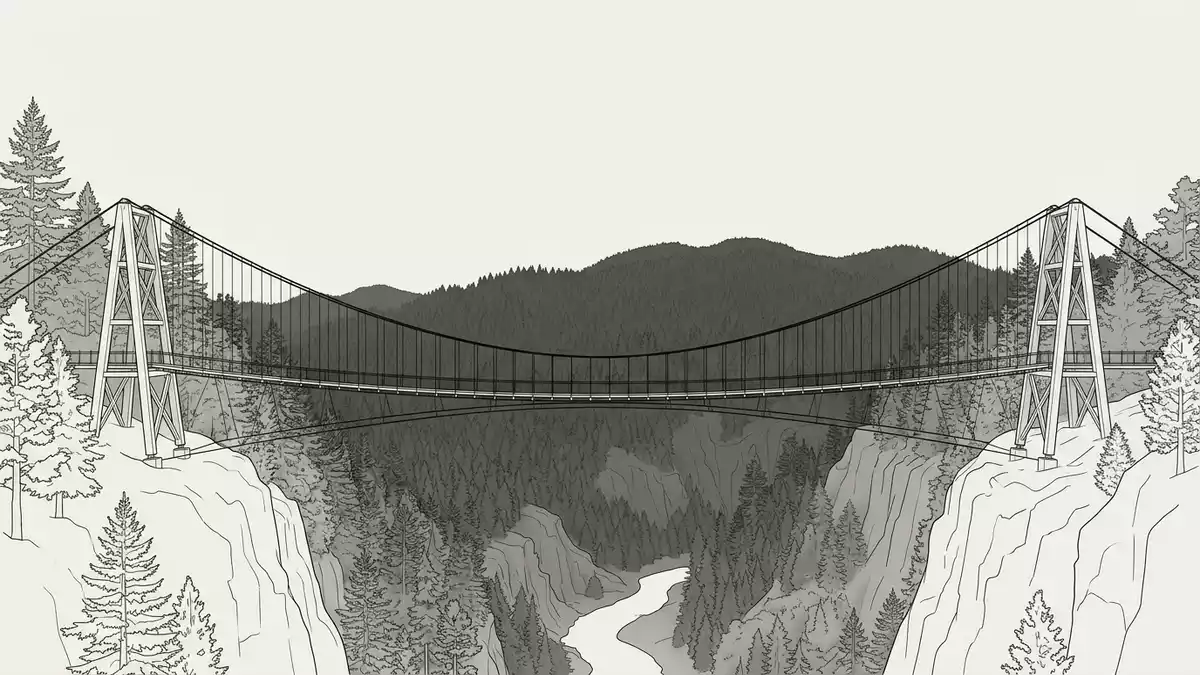
Capilano Suspension Bridge in North Vancouver is a long, swaying footbridge that carries visitors high over the Capilano River canyon, linking two steep forested cliffs in coastal British Columbia. Built in the late nineteenth century and rebuilt several times since, it anchors a privately run park where a tall span, rainforest trails and elevated walkways share the same dramatic ravine.
A late nineteenth-century crossing above the Capilano River
The story of Capilano Suspension Bridge begins in the 1880s, when Scottish civil engineer George Grant Mackay established a cabin on the cliff edge above the Capilano River and needed a way to reach land on the opposite side of the canyon.George Grant Mackay In 1889 he built a simple crossing made of hemp ropes and cedar planks that hung over the river, an early structure that set the line for every bridge that followed.first built in 1889
In the early twentieth century the fragile rope bridge was replaced with a wire?cable span, opening the canyon crossing to paying visitors and marking the beginning of its life as a tourist attraction.wire cable bridge in 1903 The bridge was completely rebuilt in 1956, giving it the steel?cable structure that still carries visitors between the cliffs today.rebuilt in 1956 Over successive ownerships the surrounding land was developed into a park, with trails, gardens and a forest backdrop that frame the span.
The bridge and the canyon: height, length and setting
The present Capilano Suspension Bridge is a pedestrian-only structure of steel cables and timber decking that stretches about 137 m (450 ft) across the canyon and rises roughly 70 m (230 ft) above the Capilano River.450 ft long and 230 ft high The walkway runs broadly parallel to the river below, suspended between anchorage points set into the rock near the top of each canyon wall, with handrails and vertical supports forming its recognisable narrow profile.137 m long and 70 m above
From the deck, the view reaches along the river corridor and down to water flowing between boulders in a steep-sided gorge surrounded by dense temperate rainforest. Old-growth Douglas fir, cedar and other conifers rise from the canyon slopes, their trunks separating the bridge from the wider urban landscape of North Vancouver. The combination of tall trees, a high, narrow crossing and the drop to the river makes the span a distinctive way to experience the local forest and canyon terrain.
A forest park of elevated walkways and totem poles
Capilano Suspension Bridge Park extends beyond the main bridge to a network of trails and elevated walks laid out on both sides of the canyon. On the west side a series of small suspension bridges, collectively known as Treetops Adventures, links platforms attached to mature Douglas fir trees, forming a canopy-level route that sits up to about 30 m (98 ft) above the forest floor.Treetops Adventures opened in 2004 These shorter spans are secured with additional supports so that they can be fitted to the living trees without invasive fastenings.walkway above the canyon floor
Closer to the canyon rim, a route known as Cliffwalk follows the rock face along the edge of the gorge, using walkways and platforms fixed into the cliff to trace the curvature of the wall.Cliffwalk added in 2011 Around the park, carved totem poles recall the early involvement of local Indigenous communities in the site and stand among the trees and clearings. Together, the main bridge, forest canopy walkways, cliffside paths and cultural carvings form a layered landscape where visitors move at different heights through the same ravine.
Visiting Capilano Suspension Bridge: what travellers from Western Europe should know
- Capilano Suspension Bridge Park lies in North Vancouver, across Burrard Inlet from central Vancouver, and is reached by road along Capilano Road and by public transport services from the city.
- The main bridge is a narrow pedestrian span with timber decking and handrails, and the approaches involve walking on sloping paths and stairways along the canyon rim.
- The park sits in a coastal temperate rainforest, and the forested setting means that paths, bridges and viewing platforms are surrounded by tall trees and uneven natural ground.
- The official language is English and the currency is the Canadian dollar.
- Entry requirements depend on your nationality; UK travellers can check the FCDO travel advice at gov.uk/foreign-travel-advice, Irish travellers the Department of Foreign Affairs at ireland.ie.
Searching for Capilano Suspension Bridge on social platforms
These links open searches for Capilano Suspension Bridge on each platform.
Frequently asked questions about Capilano Suspension Bridge
Where is Capilano Suspension Bridge?
Capilano Suspension Bridge stands over the Capilano River canyon in North Vancouver, in the province of British Columbia on Canada’s Pacific coast.
What should visitors expect on a visit?
Visitors cross a long, high suspension bridge above a forested gorge and can explore trails, elevated walkways and viewing platforms within a privately operated park.
What makes Capilano Suspension Bridge distinctive?
The combination of a tall pedestrian suspension bridge, deep canyon, temperate rainforest trees and additional canopy and cliffside walks makes the site a distinctive engineered landscape in coastal British Columbia.


