
Cape Coast Castle and the architecture of captivity
Published on 09/03/2026 at 09:35 | Editorial responsibility: Rafael Müller, Editor-in-Chief AD HOC NEWS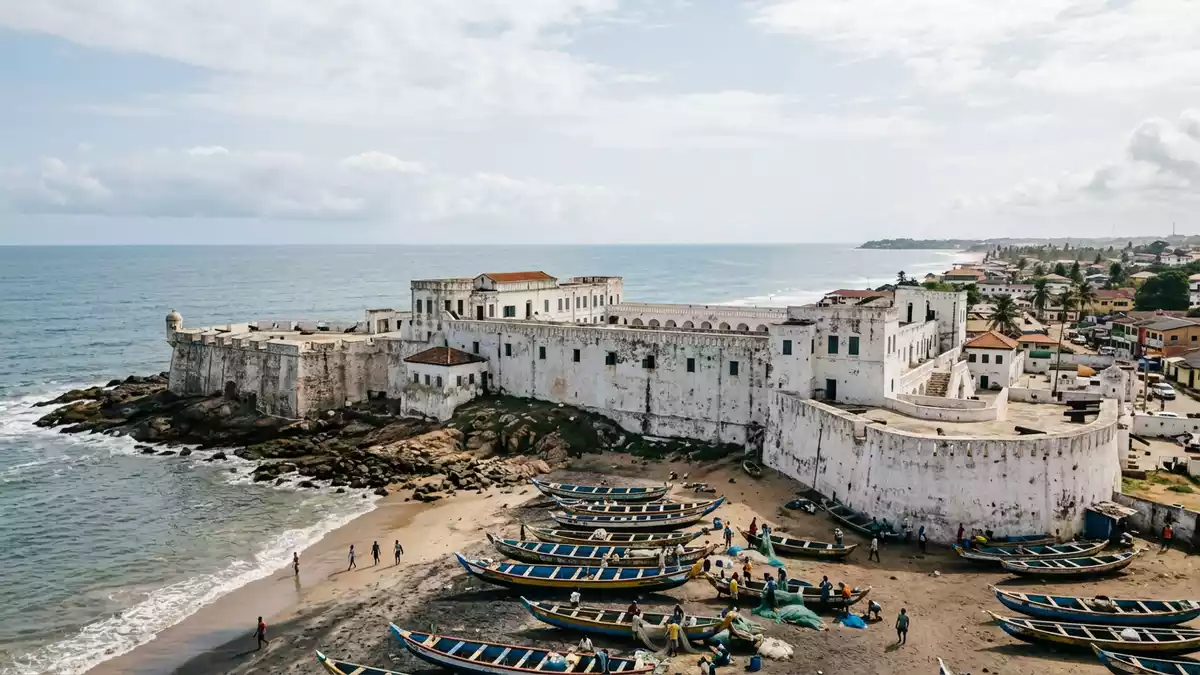
Cape Coast Castle on Ghana’s central Atlantic coast is a whitewashed fortress whose massive walls once organised the traffic of enslaved Africans, gold and power along the shoreline at Cape Coast. Built as a European trading post in the seventeenth century and expanded into a major stronghold of the transatlantic slave trade under British rule in the eighteenth century, it now stands as a museum and memorial within the historic fabric of Cape Coast.
From Cabo Corso trading post to British stronghold
Long before the castle took its present form, European traders established a foothold on this stretch of coast with a Portuguese “feitoria” or trading post founded in 1555 and named Cabo Corso, meaning “Short Cape”.Portuguese trading post In 1653 a timber fort rose on the rocky shore under the Swedish Africa Company, dedicated to King Charles X Gustav and known as Carolusborg.timber fort constructed by the Swedes Over the following decades Danish, Dutch and British forces contested this strategic site, and by 1664 British control set the stage for a much larger fortified complex in stone.
Under British administration in the eighteenth century the fortifications grew into a castle bristling with cannons, enclosing courtyards, offices and lodging above a series of underground spaces. During this period Cape Coast emerged as a principal shipping point on the Gold Coast for enslaved Africans bound across the Atlantic, with dungeons under the castle housing large numbers of captives awaiting transport.principal shipping point for enslaved people In 1807 the British Parliament abolished participation in the slave trade, and over the nineteenth century the castle’s role shifted towards administration and education, reflecting changes in imperial policy.abolition of the British slave trade in 1807
The architecture of the slave trade
Seen from the ocean, Cape Coast Castle reads as a long, low mass of pale walls and battlements, set directly on the shore with the town climbing inland behind it. Within these walls, the eighteenth-century expansion added stone dungeons where enslaved Africans were confined in crowded conditions, while European merchants and officials worked and lived in rooms above the underground spaces.castle dungeons beneath offices and housing The physical separation between the underground chambers and the upper floors, divided by thick masonry and small openings, expresses in built form the hierarchy that structured life and commerce here.
One element that visitors encounter on guided tours is the Door of No Return, a low passage leading from the interior towards the ocean, through which enslaved men and women were forced to leave African soil for ships anchored offshore.Door of No Return The castle also includes spaces linked with the spread of Christianity and the establishment of early European-style schooling in the region, reflecting the way religious and educational programmes were introduced alongside trading and military functions.centre of early European education These layers of use sit within a single complex, making a visit as much about the architecture of power as about its coastal setting.
From colonial headquarters to Ghanaian museum and World Heritage
In the nineteenth century Cape Coast Castle served as the seat of government for the British colony known as the Gold Coast, with administrative offices arranged behind the fortifications until the capital moved to Accra in 1877.seat of government for the Gold Coast Restoration work in the 1920s under British supervision stabilised the ageing structure, and after Ghana gained independence in 1957 the castle’s role changed again.
Since 1974 Cape Coast Castle has functioned as a historical museum, presenting exhibitions on West African history and the Atlantic trades within its former administrative rooms.opened as a museum in 1974 In 1979 it was inscribed as part of a UNESCO World Heritage site that brings together forts and castles along Ghana’s coast, recognised for their testimony to the intertwined histories of gold trading and the transatlantic slave trade.UNESCO World Heritage listing since 1979 Within the complex, a Ghanaian arts and crafts shop and the regional headquarters of the Ghana Museums and Monuments Board occupy former service spaces, underlining how the castle has moved from a centre of foreign rule to a site curated by a Ghanaian institution.regional headquarters of Ghana Museums and Monuments Board
Visiting Cape Coast Castle: what travellers from Western Europe should know
- Cape Coast Castle stands on the shoreline of Cape Coast in southern Ghana, reached along the coastal highway from Accra and other towns in the Central Region.
- The site occupies uneven rocky ground beside the Atlantic, with staircases, stone steps and changes of level between the dungeons, courtyards and upper rooms.
- The castle is part of a wider ensemble of historic forts on Ghana’s coast, with Elmina Castle to the west visible along the same stretch of shoreline on clear days.
- The official language is English and the currency is the Ghanaian cedi.
- Entry requirements depend on your nationality; UK travellers can check the FCDO travel advice at gov.uk/foreign-travel-advice, Irish travellers the Department of Foreign Affairs at ireland.ie.
Searching for Cape Coast Castle on social platforms
These links open searches for Cape Coast Castle on each platform.
Frequently asked questions about Cape Coast Castle
Where is Cape Coast Castle located?
Cape Coast Castle stands on the Atlantic shoreline of Cape Coast in the Central Region of Ghana, on the stretch of coast historically known as the Gold Coast.
What should visitors expect inside Cape Coast Castle?
Visitors encounter coastal fortifications, former administrative rooms, underground dungeons connected with the slave trade and museum displays on West African and Atlantic history.
What makes Cape Coast Castle distinctive among coastal forts?
The castle combines its role as a British colonial headquarters, its extensive dungeons linked to the transatlantic slave trade and its inclusion in a UNESCO World Heritage ensemble of Ghanaian forts and castles.


