
Canyon de Chelly’s living sandstone walls in Chinle
Published on 09/15/2026 at 15:28 | Editorial responsibility: Rafael Müller, Editor-in-Chief AD HOC NEWS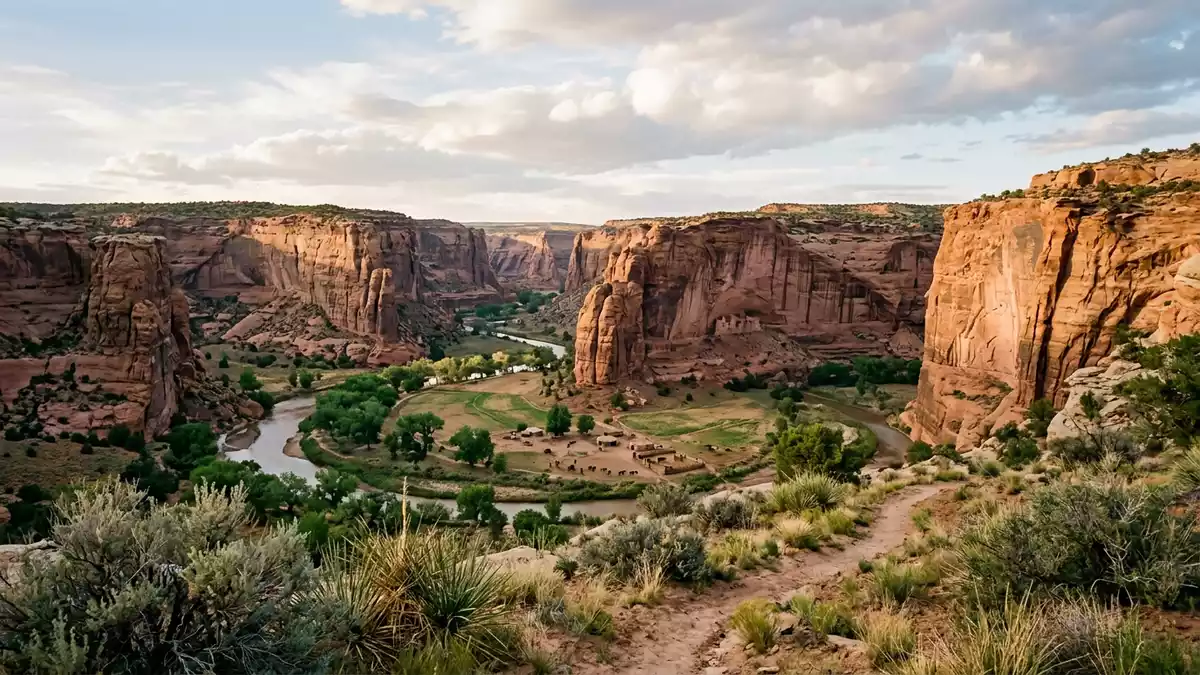
Canyon de Chelly in northeastern Arizona is a sandstone canyon landscape where ancient cliff dwellings, Navajo farms and towering rock formations share the same winding gorge. Set on Navajo Tribal Trust Land near Chinle in Apache County, it forms a national monument that links thousands of years of human presence with a rugged desert setting.
Sandstone walls and a double canyon
Canyon de Chelly lies in the high desert of northeastern Arizona, within Apache County and close to the town of Chinle. The protected area forms Canyon de Chelly National Monument, which was established in 1931 to safeguard both the canyon landscape and the traces of past communities in its walls and floor.Canyon de Chelly National Monument was created in 1931 The monument lies within the Navajo Nation and is managed in partnership with the National Park Service.
The protected area covers tens of thousands of acres and centres on a branching canyon system carved into sandstone.The monument contains roughly 83,840 acres of land The name refers both to the main canyon and to side canyons that cut through the plateau, their walls dropping in steep faces to a floor of sand, fields and meandering streams. From the rim drives the canyon appears as a sequence of overlooks, each with its own view of bends, side gorges and the contrasting green of cultivated land against the rock.
Ancient dwellings in the cliffs
The cliffs of Canyon de Chelly carry evidence of long human occupation in the form of masonry dwellings built into sheltered ledges. Archaeological work places human presence in this landscape several millennia ago, with settled life and farming developing in the first millennium AD.Occupation in the canyons dates back at least 5,000 years Many of the structures now visible were raised by ancestral Puebloan communities who used the protection of the canyon walls.
One prominent group of ruins is known as White House Ruin, named for the pale plaster on one of its walls, which sits partway up the canyon wall and is visible from an overlook. Other sites are set in alcoves at varying heights, their stone walls blending with the surrounding rock. These dwellings tell a layered story of people adapting to the canyon environment over centuries through building style, layout and choice of location within the cliffs.Cliff dwellings such as White House Ruin occupy alcoves in the canyon walls
Spider Rock and a lived-in landscape
Among the most striking rock features in Canyon de Chelly is Spider Rock, a sandstone spire that rises prominently from the canyon floor near the junction of the main branches. The pinnacle stands several hundred feet above the surrounding terrain, its sides marked by vertical lines where layers of sedimentary rock meet.Spider Rock rises about 800 ft above the canyon floor Seen from the South Rim, it forms a focal point against the broader expanse of canyon walls stretching into the distance.
Canyon de Chelly is not only a preserved archaeological site and scenic landscape but also a place where Navajo families live and farm. The monument lies entirely on Navajo trust land, and the canyon floor includes homesteads, cultivated fields and grazing areas that continue long-standing patterns of land use.The monument consists of Navajo Tribal Trust Land that remains home to a canyon community This combination of ongoing daily life with the preserved ruins and rock formations gives the place a character distinct from many other protected landscapes in the American Southwest.
Visiting Canyon de Chelly: what travellers from Western Europe should know
- Canyon de Chelly lies near the town of Chinle in northeastern Arizona, on Navajo Tribal Trust Land. It is reached by road, with routes converging on Chinle from the surrounding high desert.
- The canyon floor includes sand, cultivated fields and tracks, while the rim overlooks sit on rocky ground. Reaching some viewpoints involves walking over uneven surfaces close to cliff edges.
- The protected area lies in a high-desert environment with marked seasonal temperature variations between day and night. Weather conditions can change, and sun exposure on the rim is often strong.
- English is an official language in this part of the United States and the currency is the US dollar.
- Entry requirements depend on your nationality; UK travellers can check the FCDO travel advice at gov.uk/foreign-travel-advice, Irish travellers the Department of Foreign Affairs at ireland.ie.
Searching for Canyon de Chelly on social platforms
These links open searches for Canyon de Chelly on each platform.
Frequently asked questions about Canyon de Chelly
Where is Canyon de Chelly?
Canyon de Chelly is in Apache County in northeastern Arizona, near the town of Chinle, within the Navajo Nation.
What can visitors expect on a visit?
Visitors encounter high sandstone canyon walls, rim overlooks, views of cliff dwellings and a canyon floor that includes Navajo homesteads and fields.
What makes Canyon de Chelly distinctive?
The canyon combines long-term archaeological remains, formations such as Spider Rock and an ongoing Navajo community living within a national monument landscape.


