
Candi Prambanan and its stone towers near Yogyakarta
Published on 08/09/2026 at 15:08 | Editorial responsibility: Rafael Müller, Editor-in-Chief AD HOC NEWS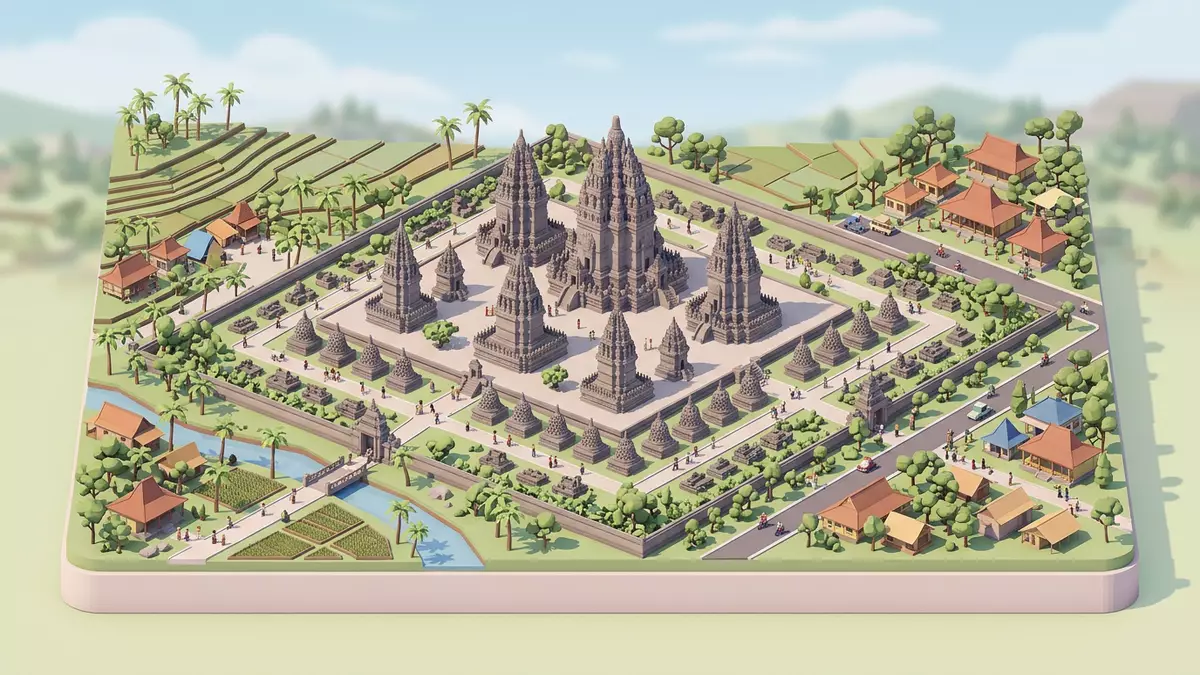
Candi Prambanan rises as a tall stone complex near Yogyakarta, with slender towers, carved panels and a strong vertical silhouette. Built in the 9th century under the Mataram Kingdom, it is one of Indonesia’s best-known Hindu temple ensembles.
Stone towers and carved reliefs at Candi Prambanan
The central group is dominated by high, tapering towers built in dark volcanic stone. Around them, smaller shrines and gate structures create a dense composition that reads clearly from a distance.
Carved reliefs run along the temple walls, with scenes from Hindu epics among the most prominent features. The surfaces are detailed rather than plain, and the whole complex combines mass with fine ornament.
Hindu royal architecture in 9th-century Java
Candi Prambanan belongs to the late 9th-century religious landscape of Central Java. The site is linked with the Mataram Kingdom, a powerful Javanese court culture that left major temples across the region.
The complex is associated with Hindu worship and with the building traditions of the period. Its stone forms, stepped towers and sculpted surfaces place it firmly within that classical Javanese tradition.
The temple complex around the main sanctuary
The main sanctuary stands within a wider temple field that includes smaller shrines and aligned structures. Seen together, they give the site a formal layout and a clear ceremonial character.
Visitors encounter broad paths, open ground and high stonework rather than an enclosed interior experience. The site works as both an archaeological monument and a place for architectural study.
Visiting Candi Prambanan: what travellers from Western Europe should know
- The site is near Yogyakarta in Java and is reached by road from the city.
- Admission arrangements and opening hours are set by the site's operator and change with the season; the official website is the only binding source.
- Dry weather suits the stone surfaces and open paths best, while strong sun can make the exposed ground feel demanding.
- The complex includes steps, uneven paving and extensive stone areas under open sky.
- Cash and card use may vary on site, and local language support is more practical than assuming English everywhere.
- Entry requirements depend on your nationality. UK travellers should check the FCDO travel advice at gov.uk/foreign-travel-advice; Irish travellers the Department of Foreign Affairs at ireland.ie; EU and EEA citizens their own national foreign ministry.
Searching for Candi Prambanan on social platforms
These links open searches for Candi Prambanan on each platform.
Frequently asked questions about Candi Prambanan
Where is Candi Prambanan?
It stands near Yogyakarta in Central Java, Indonesia. The complex is a short road journey from the city.
What should a visitor expect?
Expect open ground, stone steps, carved walls and a large temple layout. It is a place for walking, looking and reading the architecture at close range.
What makes it distinctive?
Its tall central towers and rich stone carving give it a strong visual identity. The site is a major Hindu temple complex from 9th-century Java.


