
Candi Borobudur as a stone mandala in Magelang
Published on 08/29/2026 at 18:42 | Editorial responsibility: Rafael Müller, Editor-in-Chief AD HOC NEWS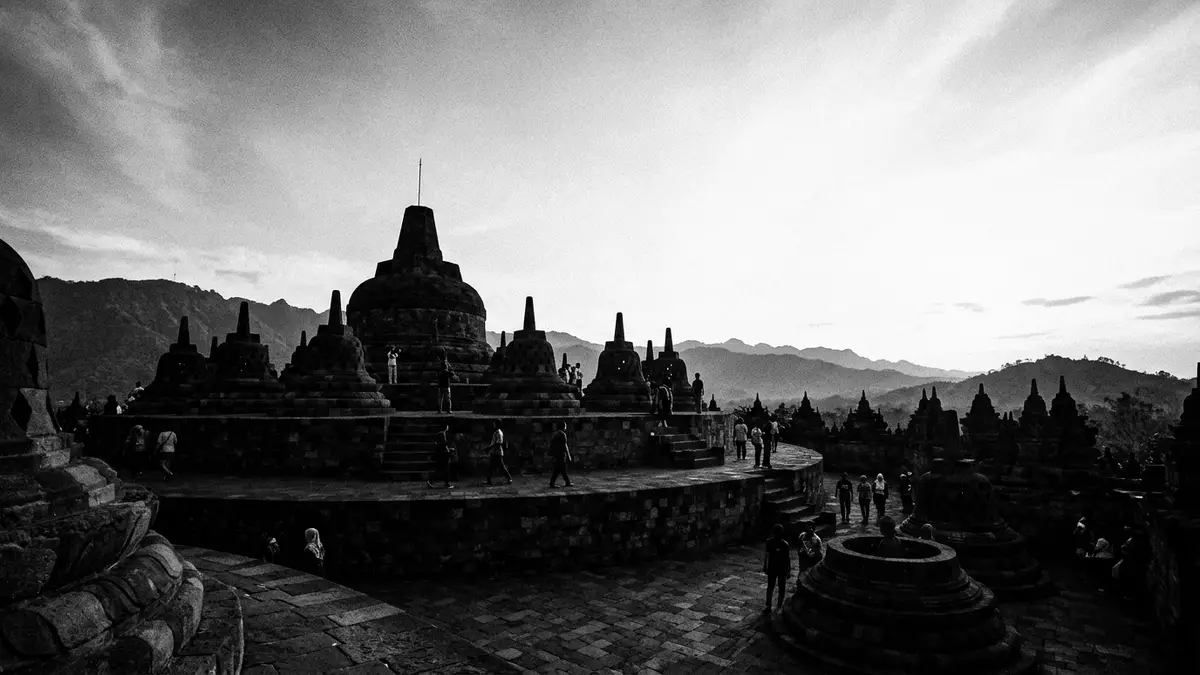
Candi Borobudur in Magelang in Central Java is a vast Mahayana Buddhist temple laid out as a stepped stone mandala that rises above the Kedu Valley. Built in the eighth and ninth centuries during the Sailendra dynasty, it is inscribed as the Borobudur Temple Compounds on the UNESCO World Heritage List.
A terraced mountain of stone and stories
Candi Borobudur stands in the Kedu Valley of Central Java, surrounded by the volcanic silhouettes of Merapi, Merbabu, Sindoro and Sumbing and framed by the Menoreh hills to the south.Its setting between the Progo and Elo rivers underlines how completely the monument commands its landscape.
The temple itself rises on a modified hill as a stepped pyramid built from grey volcanic stone, enclosing the natural mound beneath.Its mass is organised into a square base, a middle zone of five square terraces and an upper zone of three circular terraces, giving nine distinct levels crowned by a central stupa. Each change of level shifts the visitor’s perspective, from close views of carved walls to open vistas across the valley.
A ninth-century Buddhist mandala in stone
Candi Borobudur was constructed between the late eighth century and around 825 under the Sailendra dynasty, which ruled parts of Central Java and patronised Mahayana Buddhism.The temple forms the core of the Borobudur Temple Compounds, recognised for their outstanding testimony to this religious tradition. The monument’s plan follows a vast mandala, with the concentric terraces and central stupa aligning with Buddhist cosmological ideas.
The lower terraces carry continuous galleries of relief panels carved into the stone balustrades and walls.There are thousands of bas-relief scenes illustrating stories from the life of the Buddha and other Buddhist texts, so detailed that many visitors trace specific narratives as they walk the galleries. Higher up, rows of Buddha statues sit in niches and under perforated stupas, creating a gradual transition from the narrative richness of the lower levels to the more abstract geometry of the top platforms.
Experiencing the climb at Candi Borobudur
Climbing Candi Borobudur means moving along stone corridors that wrap around the hill in successive terraces, with stairs linking each level at the corners and along the sides.The base measures over 120 m on each side, so a full circuit around one gallery already makes a substantial walk. From the upper circular terraces the view opens over the Kedu Valley, with the surrounding volcanoes standing above the fields and villages.
Despite its scale, many details reward close attention, from the individual relief scenes to the differing expressions of the Buddha statues and the varied designs of the smaller stupas.The structure combines architectural geometry, sculpture and landscape into a single composition that has drawn scholars of religion, art history and architecture for decades. The temple also remains an active site for Buddhist worship, with pilgrims following the galleries and terraces in ritual circuits.
Visiting Candi Borobudur: what travellers from Western Europe should know
- Candi Borobudur stands in Borobudur district in Magelang Regency in Central Java in Indonesia, north-west of Yogyakarta and within reach of that city’s international airport by road.
- The monument rises on a hill with multiple flights of stone steps linking the terraces, so a visit involves repeated climbs over uneven surfaces and extended walks along the galleries.
- The wider setting is rural, with the Progo and Elo rivers, small villages and views towards volcanoes such as Merapi and Merbabu, so many visitors combine the temple with short excursions in the surrounding valley.
- The official language is Indonesian and the currency is the Indonesian rupiah.
- Entry requirements depend on your nationality; UK travellers can check the FCDO travel advice at gov.uk/foreign-travel-advice, Irish travellers the Department of Foreign Affairs at ireland.ie.
Searching for Candi Borobudur on social platforms
These links open searches for Candi Borobudur on each platform.
Frequently asked questions about Candi Borobudur
Where is Candi Borobudur?
Candi Borobudur stands in Borobudur district in Magelang Regency in Central Java in Indonesia, in the Kedu Valley north-west of Yogyakarta.
What can visitors expect during a visit?
A visit involves walking the stone galleries, climbing several flights of steps between terraces and spending time among reliefs, Buddha statues and the upper stupas with valley views.
What makes Candi Borobudur distinctive among Buddhist sites?
Candi Borobudur combines a stepped pyramid of grey volcanic stone, extensive narrative reliefs, hundreds of Buddha figures and a mandala-like plan in a single hilltop monument from the Sailendra period.


