
Candi Borobudur and the stepped stupa in Magelang
Published on 09/16/2026 at 18:37 | Editorial responsibility: Rafael Müller, Editor-in-Chief AD HOC NEWS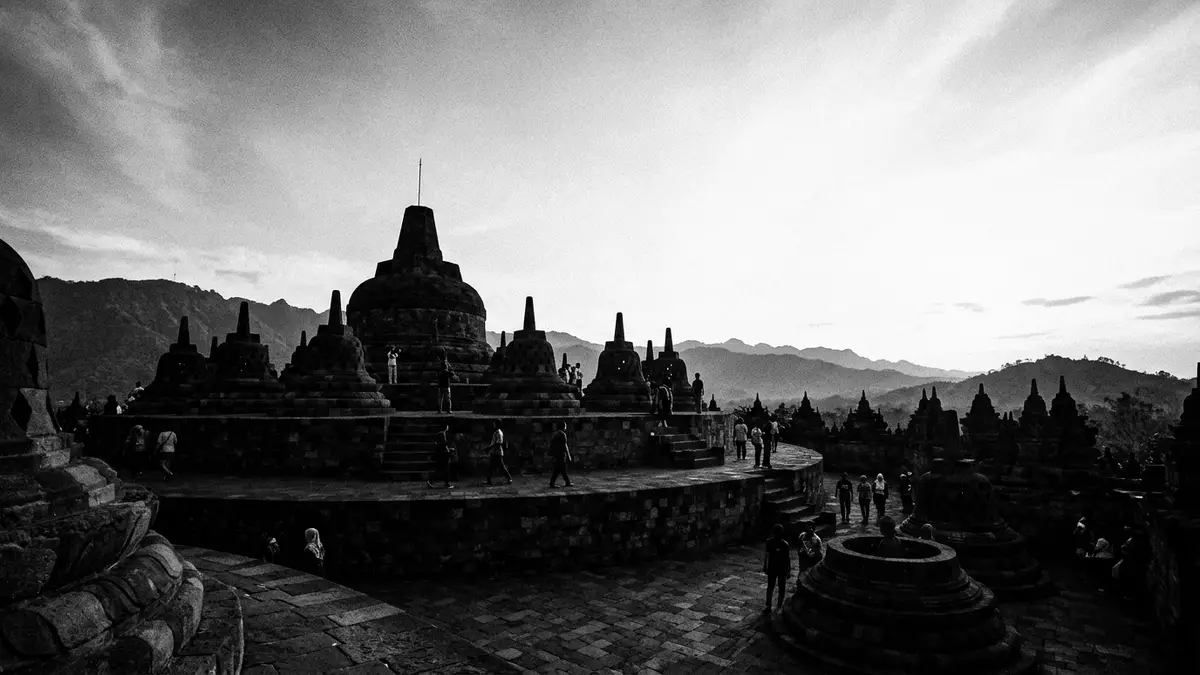
Candi Borobudur rises in central Java as a stepped Buddhist monument of stone, terraces and stupas. Built under the Syailendra Dynasty in the eighth and ninth centuries, it is one of Indonesia’s defining historical works. eighth and ninth centuries
Stone terraces above the Kedu Valley
The monument takes the form of a layered pyramid with a square base, circular upper platforms and a large central stupa. Its walls and balustrades carry finely cut reliefs, and the whole structure stands in the Kedu Valley in Central Java. square base
The material is volcanic andesite, fitted without mortar. From a distance, the mass reads as a compact hill of stone, but closer up the terraces reveal galleries, stairs and framed passages that break the form into clear levels. volcanic andesite
Reliefs, Buddhas and the upper platforms
The reliefs cover scenes from Buddhist teaching and narrative tradition, giving the monument a dense surface of figures and episodes. Around the higher platforms stand perforated stupas, each enclosing a Buddha image, while the summit carries a single dominant stupa. perforated stupas
This arrangement turns the upper levels into a rhythm of solid wall, open tracery and enclosed image. The contrast between the square terraces below and the circular platforms above is one of the most striking features of the monument. circular platforms above
A monument of the Sailendra period
UNESCO describes Candi Borobudur as part of the Borobudur Temple Compounds and records its inscription as a World Heritage Site in 1991. The temple compounds were built in the reign of the Syailendra Dynasty, and that named period remains central to its identity. World Heritage Site
Its historical importance rests on both scale and survival. The monument combines a formal Buddhist plan with a sculptural programme that covers walls, terraces and upper enclosures, making the whole ascent part of the experience of the site. formal Buddhist plan
Visiting Candi Borobudur: what travellers from Western Europe should know
- The monument stands in Magelang Regency, in central Java, northwest of Yogyakarta. Road access is the normal approach, and the site lies within the wider Borobudur Temple Compounds.
- The ascent uses stone stairs and narrow galleries. The upper levels are open to the sky, and the reliefs continue along long runs of wall and balustrade.
- The setting is a volcanic landscape. The structure uses andesite blocks, and the hill beneath the monument is part of its visible mass.
- Candi Borobudur is linked with the Syailendra Dynasty and the eighth and ninth centuries. Those anchors frame the place as a Buddhist monument of early medieval Java.
Searching for Candi Borobudur on social platforms
These links open searches for Candi Borobudur on each platform.
Frequently asked questions about Candi Borobudur
Where is Candi Borobudur?
It stands in Magelang Regency, central Java, in Indonesia. The monument belongs to the Borobudur Temple Compounds and sits in the Kedu Valley.
What does a visit involve?
A visit means moving through stone stairs, terraces and galleries around a large Buddhist monument. The structure is best read as an ascent through visible levels rather than as a single hall.
What makes it distinctive?
The combination of stepped form, circular upper platforms, dense reliefs and rows of stupas gives the monument its character. Its association with the Syailendra Dynasty and the eighth and ninth centuries adds historical depth.


