
Candi Borobudur and its stone mandala above the Kedu Valley
Published on 09/14/2026 at 22:12 | Editorial responsibility: Rafael Müller, Editor-in-Chief AD HOC NEWS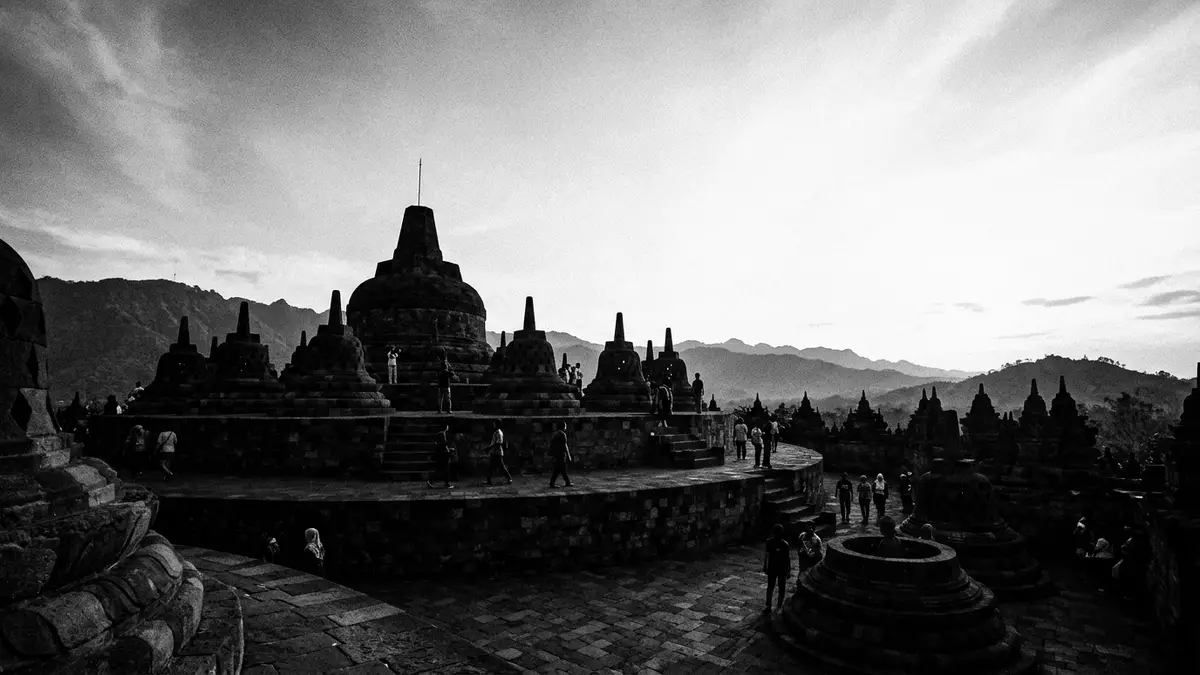
Candi Borobudur in Magelang, Central Java, is a monumental Buddhist temple that rises over the fertile Kedu Valley like a stepped stone mandala built in the 8th and 9th centuries.8th and 9th centuries Constructed under the Sailendra Dynasty, it became a major Mahayana Buddhist shrine shaped as a vast pyramid of dark volcanic stone.Sailendra Dynasty Today it stands as a UNESCO World Heritage site and one of the most complete surviving expressions of Buddhist cosmology in architecture.UNESCO World Heritage site
Stone mountain of terraces and stupas
The immediate impression of Candi Borobudur is its mass: a stone mountain enclosing a low hill, built from grey volcanic andesite in a layered pyramid form.grey volcanic stone The base forms a large square platform, above which rise five concentric square terraces that step inward, creating receding levels of walls and balustrades.pyramidal base with five concentric square terraces Above these stand three circular platforms crowned by a single central stupa, giving the whole monument a clear vertical progression from broad base to focused summit.three circular terraces
Walking the stone corridors, a visitor moves through galleries lined with reliefs and framed by balustrades, then emerges onto the upper circular platforms dominated by openwork stupas. Around these upper platforms stand 72 perforated stupas, each sheltering a seated Buddha statue inside its latticework.72 openwork stupas The highest point is a plain monumental stupa at the centre, visible from across the valley and closing the ascent with a simple geometric form contrasting with the detail below.world's largest Buddhist temple
A carved mandala of Buddhist cosmology
Candi Borobudur is laid out as a three-level representation of Buddhist cosmology, with Kamadhatu, Rupadhatu and Arupadhatu expressed as stacked platforms.Kamadhatu, Rupadhatu and Arupadhatu The lower galleries represent the world of desire, the square terraces the world of forms, and the upper circular terraces the formless realm, so that moving upward becomes both a physical and symbolic journey.three-realm structure Seen from above, the monument forms a mandala pattern, with its concentric terraces and central stupa mapping an ordered spiritual universe in stone.
The narrative carved into the walls is vast. The monument carries thousands of relief panels illustrating Buddhist scriptures such as the Jataka and Lalitavistara, alongside scenes of daily life in ancient Java.2,672 relief panels Niches in the balustrades contain hundreds of Buddha statues, arranged according to mudra and orientation, so that each level combines teaching images, decorative borders and rhythmic stonework.432 niches containing 432 statues As the galleries turn around the hill, the continuous frieze of narratives and ornamental motifs creates a sense of movement through stories carved into the walls.
Dynasty, rediscovery and restoration
Candi Borobudur was constructed under the Sailendra Dynasty in Central Java, with work beginning in the late 8th century and continuing into the early 9th century.constructed between 760–830 CE The style reflects influences from Indian Gupta and post-Gupta art combined with local Javanese traditions, giving the monument a distinctive blend of imported forms and regional stone craftsmanship.Indian Gupta and post-Gupta art After the spread of Islam in Java in the fourteenth and fifteenth centuries, the temple ceased to function as a major pilgrimage centre and gradually became covered by volcanic deposits and vegetation.
In 1814 the English lieutenant governor Thomas Stamford Raffles received reports of an ancient monument in the jungle and organised an effort to clear and document the structure, bringing Candi Borobudur to wider attention.discovered by Thomas Stamford Raffles in 1814 Dutch archaeologists undertook an early restoration between 1907 and 1911, followed in the twentieth century by a major international conservation campaign that stabilised the base and cleaned the reliefs.restored 1907–11 The monument was inscribed as a World Heritage site in 1991, formally recognising its significance for Buddhist art and the history of Southeast Asia.inscribed 1991
Visiting Candi Borobudur: what travellers from Western Europe should know
- Candi Borobudur stands in the Kedu Valley near Magelang in Central Java, Indonesia, reached overland from regional centres such as Yogyakarta and Semarang.
- The monument is arranged as a stepped pyramid, and a visit involves climbing stone stairways through several terraces to reach the upper circular platforms.
- The stone surfaces are exposed and can feel warm in strong sunlight, with limited shade once on the upper terraces, so head coverings and simple sun protection are practical.
- The official language is Indonesian and the currency is the Indonesian rupiah.
- Entry requirements depend on your nationality; UK travellers can check the FCDO travel advice at gov.uk/foreign-travel-advice, Irish travellers the Department of Foreign Affairs at ireland.ie.
Searching for Candi Borobudur on social platforms
These links open searches for Candi Borobudur on each platform.
Frequently asked questions about Candi Borobudur
Where is Candi Borobudur located?
Candi Borobudur stands in the Kedu Valley near Magelang in Central Java, Indonesia, north-west of Yogyakarta and within sight of several volcanic peaks.
What should visitors expect during a visit?
A visit involves ascending stone stairways through successive terraces lined with reliefs and Buddha statues before reaching the upper circular platforms and central stupa.
What makes Candi Borobudur distinctive among Buddhist sites?
Its stepped pyramid of nine levels, vast programme of carved panels and concentric terraces of stupas together form an unusually complete stone mandala of Mahayana Buddhist cosmology.


