
Candi Borobudur: a stone mandala in the Kedu Valley
Published on 09/08/2026 at 11:03 | Editorial responsibility: Rafael Müller, Editor-in-Chief AD HOC NEWS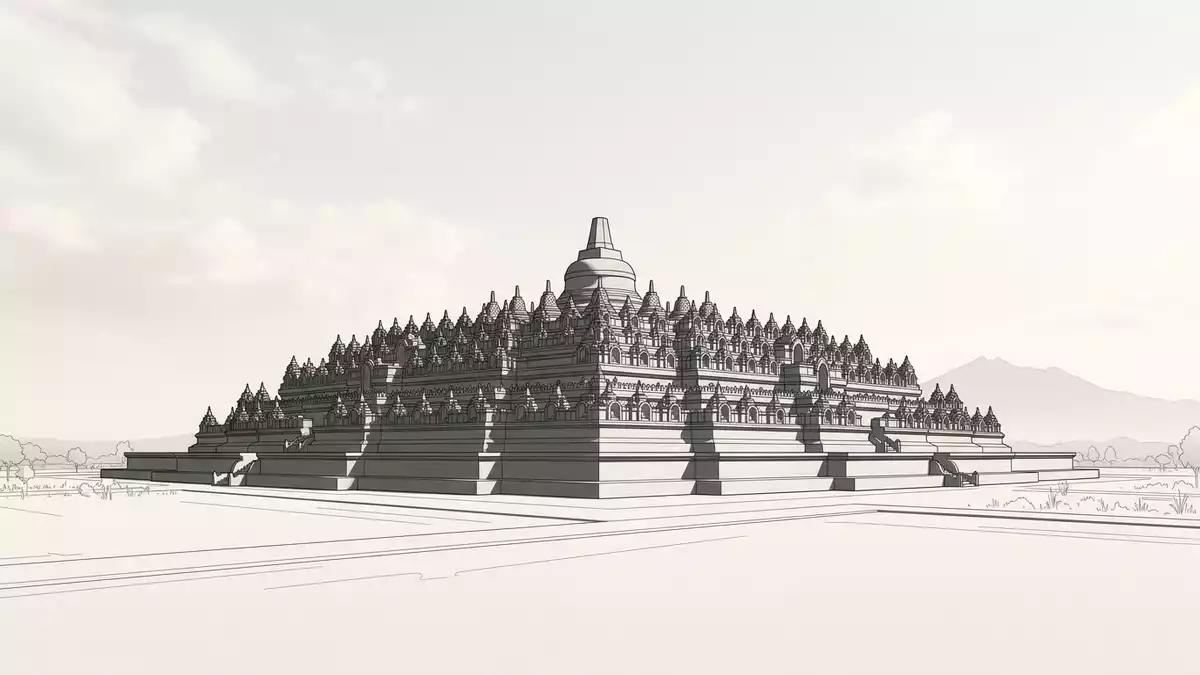
Candi Borobudur in Magelang, Central Java, is a vast Mahayana Buddhist temple whose stepped form rises above the Kedu Valley like a stone mandala in three dimensions. Built in the eighth and ninth centuries under the Sailendra dynasty, it has become one of Indonesia’s defining sacred monuments and a major reference point for Buddhist art in South?East Asia.
A hill transformed into a Buddhist mountain
Candi Borobudur stands on a natural hill in the Kedu Plain, surrounded by agricultural land and distant volcanic ridges that frame its silhouette against the sky.Candi Borobudur terletak di Desa Borobudur The monument lies in Magelang Regency in the southern part of Central Java, at the centre of the island of Java in Indonesia.located in the Kedu Valley
The Sailendra rulers of Central Java commissioned Borobudur as a major Buddhist shrine during the eighth and ninth centuries AD, shaping the hill into a tiered stone mountain dedicated to the Dharma.built in the 8th and 9th centuries AD In its present form the monument rises about 30 m (98 ft) above the surrounding plain and is built from grey volcanic stone that was quarried locally in Central Java.gray volcanic stone shaped into a stepped pyramid
Nine stacked levels and a walk through Buddhist cosmology
On the lower terraces, walls and balustrades are lined with relief panels narrating scenes from Buddhist texts and everyday life in ancient Java, while niches hold seated Buddha images facing outwards across the valley.a Mahayana Buddhist temple located close to Muntilan Higher up, the circular terraces carry rows of perforated stupas, each containing a Buddha statue within, leading the eye towards the solid central stupa at the summit that marks the axis of the whole composition.nine stacked terraces, relief panels and a crowning central stupa
From royal monument to World Heritage site
Historical sources and inscriptions link Candi Borobudur to the Sailendra dynasty, which dominated Central Java between about 650 and 1,000 CE and patronised Mahayana Buddhist institutions across the region.built during the rule of the Sailendra Dynasty The temple complex is one of several Buddhist monuments in the area, together with sites such as Mendut and Pawon, that form a wider sacred landscape in the Kedu Valley.The Borobudur Temple Compounds include Mendut and Pawon
In 1991 Candi Borobudur and its associated temple compounds were inscribed on the UNESCO World Heritage List as a cultural property recognised for their outstanding Buddhist art and historical significance.Borobudur Temple Compounds is one of the greatest Buddhist monuments in the world The inscription formalised decades of conservation work and placed the monument within a global context as one of the largest and most elaborate Buddhist temple complexes anywhere.
Visiting Candi Borobudur: what travellers from Western Europe should know
- Candi Borobudur lies in Magelang Regency in Central Java, north?west of Yogyakarta, and is reached by road from regional centres such as Yogyakarta and Semarang.
- The temple stands on a hill above the Kedu Plain, and a visit involves walking up stone terraces and stairways that climb from the base to the upper levels.
- The monument is in Indonesia; the official language is Indonesian and the currency is the Indonesian rupiah.
- Entry requirements depend on your nationality; UK travellers can check the FCDO travel advice at gov.uk/foreign-travel-advice, Irish travellers the Department of Foreign Affairs at ireland.ie.
Searching for Candi Borobudur on social platforms
These links open searches for Candi Borobudur on each platform.
Frequently asked questions about Candi Borobudur
Where is Candi Borobudur located?
Candi Borobudur is in Borobudur village in Magelang Regency, Central Java, in the Kedu Valley at the centre of the island of Java in Indonesia.
What should visitors expect during a visit?
A visit involves walking around successive stone terraces lined with reliefs and Buddha statues, and climbing stairways that lead up towards the circular terraces and central stupa.
What makes Candi Borobudur distinctive among Buddhist monuments?
Its combination of a tiered hill?top structure, extensive narrative reliefs and multiple terraces culminating in a large central stupa gives Candi Borobudur an architectural scale and sculptural richness that is rare among Buddhist temples.


