

Candi Borobudur, a stone mandala above the Kedu Plain
Published on 08/24/2026 at 22:16 | Editorial responsibility: Rafael Müller, Editor-in-Chief AD HOC NEWS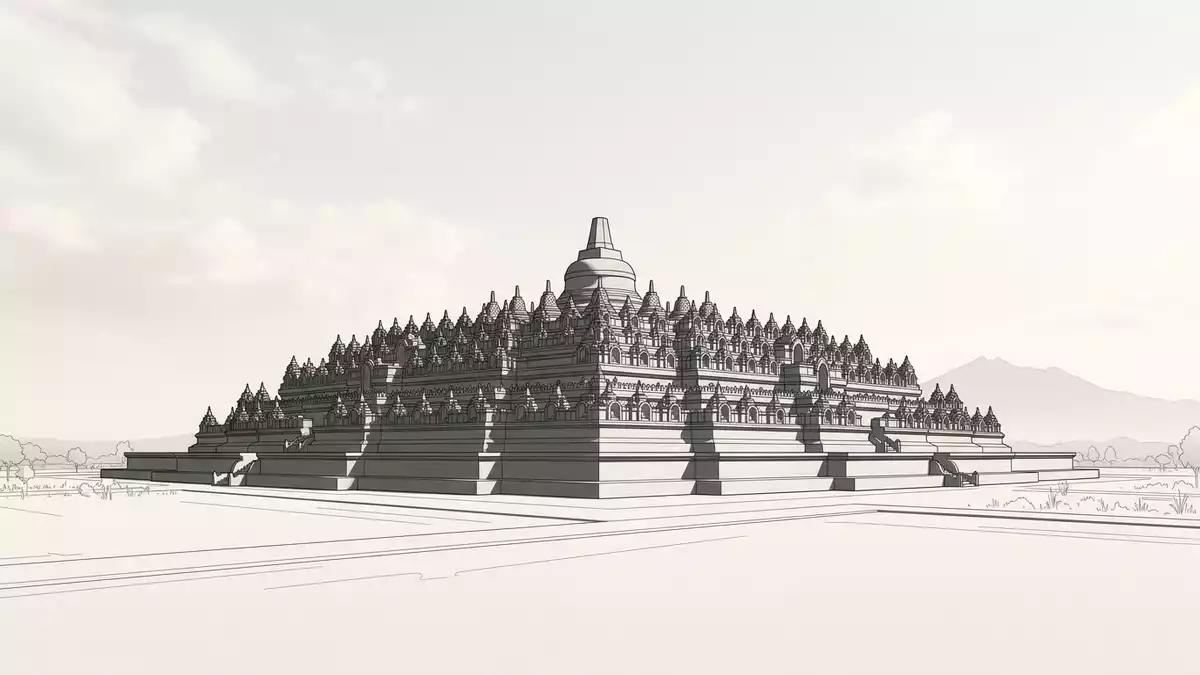
Candi Borobudur in Magelang, Central Java, is a vast Buddhist temple that rises above the Kedu Plain like a stepped stone mandala of terraces and stupas. Built in the eighth and ninth centuries under the Sailendra dynasty, this monument turns a low hill into a layered pilgrimage route in stone, with geometry, sculpture and symbolism tightly interwoven.
A mountain of Buddhas in volcanic stone
Candi Borobudur stands in Central Java, Indonesia, north-west of Yogyakarta, enclosing a natural hill within a man-made pyramid of grey volcanic stone.central Java setting The temple takes the form of a stepped mass with a broad square base, a middle zone of several square terraces and an upper zone of circular terraces, forming nine stacked levels that read as a three-dimensional mandala.stepped pyramid plan
Construction of Candi Borobudur is dated to between about 778 and 850 CE, during the rule of the Sailendra dynasty in Central Java.construction between 778 and 850 Built with tens of thousands of cubic metres of andesite, the structure encloses the hill completely, turning it into the core of the monument.andesite stone volume The overall composition combines the commemorative form of the stupa, the tiered temple mountain associated with Mount Meru in Hindu cosmology and the square-and-circle geometry of the Buddhist mandala in a single mass of stone.
Terraces, stupas and bas-reliefs
The monument’s lower terraces form galleries lined with bas-reliefs. In total the temple carries 2,672 carved relief panels arranged along the balustrades and walls, illustrating Buddhist stories and teachings in long stone friezes.2,672 relief panels Above these sculpted corridors rise levels dotted with Buddha images; the site contains 504 Buddha statues placed in niches and within perforated stupas.504 Buddha statues
The uppermost terraces are circular and carry a pattern of small stupas encircling a larger central stupa at the summit. On the top platform, seventy-two perforated stupas stand around the main stupa, each enclosing a seated Buddha.seventy-two stupas on the top From above, the entire complex reads as a single giant stupa shaped like a mandala, with a square foundation and circular upper levels that symbolise different realms in Buddhist cosmology.mandala-like form
History, rediscovery and World Heritage status
Candi Borobudur was constructed during the height of Sailendra rule in Central Java, a period spanning roughly 760 to 830 CE, when Mahayana Buddhism flourished in the region.Sailendra dynasty period Over time the temple fell out of ritual use as Buddhist and Hindu courts declined and Islam became established on Java; by about the fifteenth century the monument lay buried in volcanic ash and vegetation.abandonment and burial
The site was brought back to wider attention in 1814, when Thomas Stamford Raffles, then British governor of Java, was informed of a large ruined structure on the Kedu Plain and initiated clearance work.Raffles and 1814 Systematic restoration followed in the early twentieth century under Dutch archaeologists, and a major conservation campaign in the late twentieth century stabilised the fabric and stonework. In 1991 Candi Borobudur was inscribed on the UNESCO World Heritage List as the Borobudur Temple Compounds, recognising its significance as one of the greatest Buddhist monuments in the world.1991 World Heritage inscription
Visiting Candi Borobudur: what travellers from Western Europe should know
- Candi Borobudur stands on the Kedu Plain in Magelang Regency, Central Java, north-west of Yogyakarta and reached overland from that city and other towns in the region.
- The monument is built on a hill with multiple stone terraces; visiting involves walking along sloping paths and stairways and climbing several flights of steps between levels.
- The surrounding landscape is lowland countryside with views towards nearby hills and volcanic peaks, so weather exposure on the upper terraces can be more pronounced than at ground level.
- The official language is Indonesian and the currency is the Indonesian rupiah.
- Entry requirements depend on your nationality; UK travellers can check the FCDO travel advice at gov.uk/foreign-travel-advice, Irish travellers the Department of Foreign Affairs at ireland.ie.
Searching for Candi Borobudur on social platforms
These links open searches for Candi Borobudur on each platform.
Frequently asked questions about Candi Borobudur
Where is Candi Borobudur located?
Candi Borobudur is in Magelang Regency on the Kedu Plain in Central Java, Indonesia, north-west of the city of Yogyakarta.
What should visitors expect on a visit?
Visitors encounter a large stone temple built as stacked terraces around a hill, with long relief-lined corridors, stairways between levels and open views from the upper platforms.
What makes Candi Borobudur distinctive among Asian monuments?
Candi Borobudur combines a nine-level stepped pyramid, thousands of carved relief panels and hundreds of Buddha statues into a single stone mandala that fuses stupa, temple mountain and cosmological diagram.


