
Canal de Panama: an interocean gateway beside Panama-Stadt
Published on 08/28/2026 at 14:51 | Editorial responsibility: Rafael Müller, Editor-in-Chief AD HOC NEWS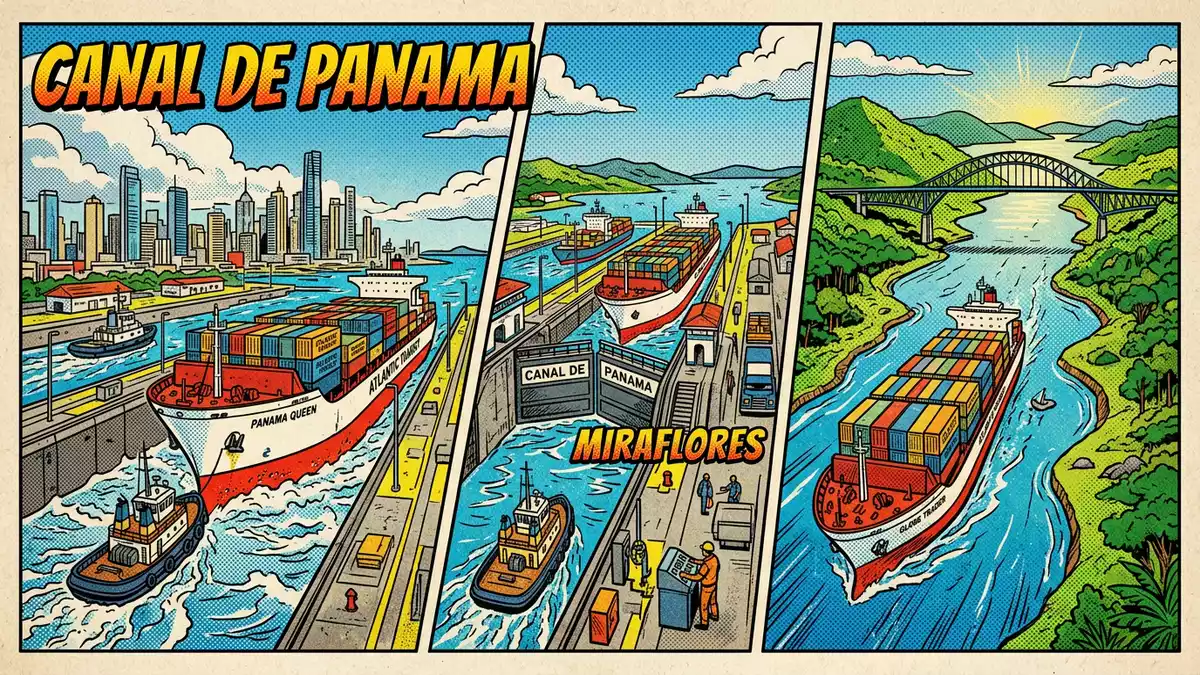
Canal de Panama, better known in English as the Panama Canal, is a ship canal that cuts across the Isthmus of Panama near Panama-Stadt and links the Atlantic and Pacific oceans through a chain of artificial lakes, channels and locks. Completed in 1914 after an earlier French attempt in the 1880s, it turned Panama into a crossroads of maritime trade where vessels traverse a man-made route instead of rounding South America.
An engineered passage across a narrow isthmus
The canal runs for around 77 km (about 48 mi) between the Caribbean entrance near Colón and the Pacific entrance near Panama-Stadt, following a corridor of excavated channels and dammed valleys across central Panama.A 77 kilometre ship canal links the oceans by raising ships up from sea level to the height of Gatún Lake and then lowering them again, rather than cutting a sea-level trench across the isthmus.The canal locks operate by gravity flow of water from lakes fed by the Chagres and other rivers.
The route passes through the Culebra Cut, a narrow section carved through the continental divide, then across Gatún Lake, an expansive reservoir held back by Gatún Dam. Along the way three main sets of locks—Gatún, Pedro Miguel and Miraflores—step ships up and down between sea level and the lake surface, each complex paired so that vessels can pass in both directions along parallel chambers.
Locks and chambers: the canal’s moving architecture
The original locks of Canal de Panama follow a standard pattern, with chambers about 300 m (1,000 ft) long and 33 m (110 ft) wide that determine the classic “Panamax” ship size.Lock chambers 1,000 feet long and 110 feet wide were built in pairs so that two ships can move through each flight side by side.Gatún, Pedro Miguel and Miraflores locks lift or lower vessels by tens of metres in a sequence of steps.
At Gatún on the Atlantic side, three consecutive chambers raise ships roughly 26 m (around 85 ft) from the approach channel up to the level of Gatún Lake, forming a continuous flight of locks bordered by massive concrete walls and steel gates.A ship is raised or lowered 26 metres at Gatun Locks through three steps in one direction. On the Pacific side near Panama-Stadt, the single-step Pedro Miguel Locks and the two-step Miraflores Locks together lower vessels from the lake level down to sea level at the ocean entrance.
From French ambition to a 1914 opening
Interest in a canal across Panama stretches back to the nineteenth century, when the narrow isthmus was recognised as a potential shortcut between Atlantic and Pacific shipping routes. Construction began under the French engineer Ferdinand de Lesseps in 1881, inspired by his experience with the Suez Canal, but that effort faltered after extensive technical and health difficulties.French construction started in 1881 and stopped before completion.
In 1903 Panama declared independence and granted the United States a canal zone under the Hay–Bunau-Varilla Treaty, allowing a new project to proceed.The Hay–Bunau-Varilla Treaty of 1903 provided a strip of land for the canal and financial terms. The United States programme shifted the design towards a lock-and-lake system rather than a sea-level passage, damming the Chagres River to form Gatún Lake and building large concrete locks at each end. Canal de Panama opened to traffic on 15 August 1914, when the cargo ship SS Ancon passed through as part of the formal inauguration.
Watching Canal de Panama at work near Panama-Stadt
For travellers based in Panama-Stadt, the easiest point to see Canal de Panama in operation is the Miraflores area on the Pacific side, where a visitor centre stands beside the Miraflores Locks.Miraflores Visitor Center overlooks the canal, with terraces facing the lock chambers where ships rise or descend between Miraflores Lake and the Pacific entrance channel.Miraflores locks near Panama City give views of vessels moving through each step of the flight.
Inside the visitor centre an exhibition explains the canal’s history, its lock mechanisms and its expansion, while a cinema presents a film about Canal de Panama and its role in maritime trade. Outdoor platforms provide elevated views of the lock complex, the concrete approach channels and the machinery that controls water flow and gate movement, so visitors can watch as ships line up, enter the chambers and are raised or lowered by controlled changes in water level.
Visiting Canal de Panama: what travellers from Western Europe should know
- Canal de Panama runs inland from the Caribbean coast to the Pacific near Panama-Stadt, and the Miraflores area west of the city provides direct views of the Pacific-side locks.
- The lock complexes and visitor terraces include flights of stairs and elevated platforms, and approaching Miraflores from the main road involves a walk along paved surfaces beside busy infrastructure.
- Other vantage points, such as the locks at Gatún and Agua Clara near Colón, also stand beside the canal, so overland journeys can combine sea-level entrances, lake sections and different lock sites.
- The official language is Spanish and the currency is the Panamanian balboa, which is pegged to the US dollar and circulates alongside US dollar notes.
- Entry requirements depend on your nationality; UK travellers can check the FCDO travel advice at gov.uk/foreign-travel-advice, Irish travellers the Department of Foreign Affairs at ireland.ie.
Searching for Canal de Panama on social platforms
These links open searches for Canal de Panama on each platform.
Frequently asked questions about Canal de Panama
Where is Canal de Panama in relation to Panama-Stadt?
Canal de Panama crosses the Isthmus of Panama between Colón on the Caribbean and the Pacific coast beside Panama-Stadt, with the Miraflores Locks lying just outside the city.
What can visitors expect when they go to see Canal de Panama?
Visitors usually watch ships moving through lock chambers from elevated terraces at sites such as Miraflores, and explore exhibitions that explain the canal’s construction, operations and surrounding landscape.
What makes Canal de Panama distinctive among major waterways?
Canal de Panama combines large artificial lakes, deep excavations through the continental divide and multi-step lock flights, creating an interocean route where ships are lifted over central Panama rather than sailing around South America.


