

Caminito in Buenos Aires: a painted street turned open-air museum
Published on 08/24/2026 at 10:34 | Editorial responsibility: Rafael Müller, Editor-in-Chief AD HOC NEWS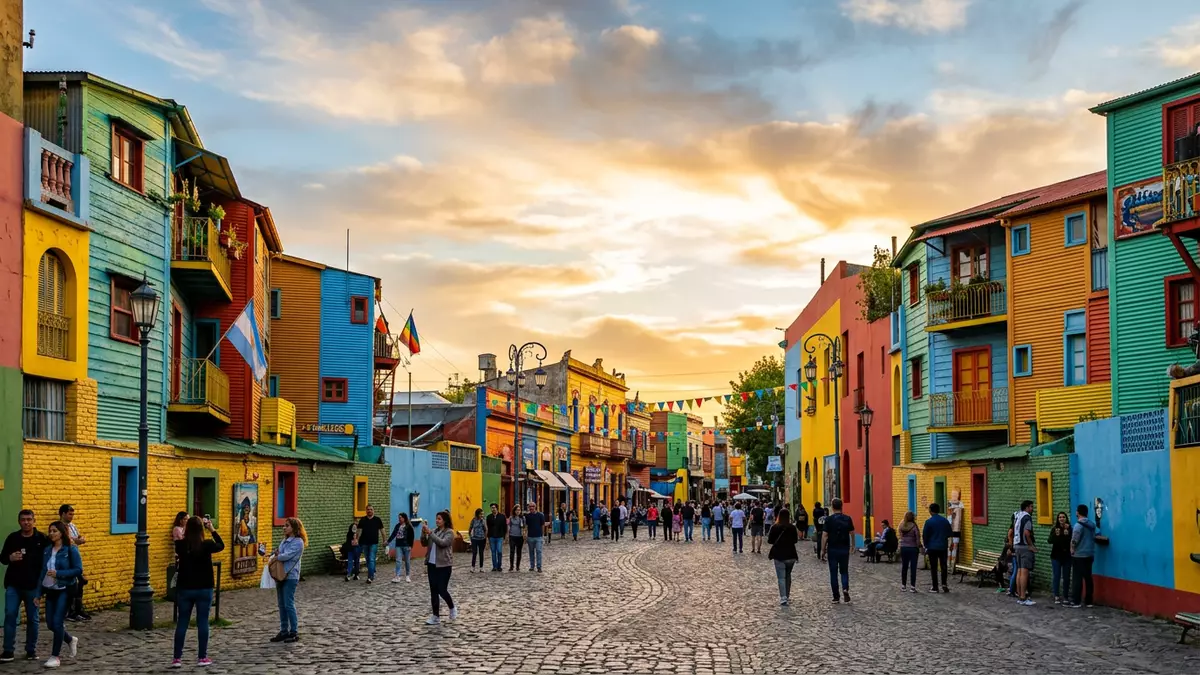
Caminito in Buenos Aires is a short pedestrian street in La Boca where brightly painted tenement houses line a former railway cutting, turned in the mid?twentieth century into an open?air museum of everyday urban life. Set near the old port on the Riachuelo, it took shape in the 1950s under the influence of painter Benito Quinquela Martín, whose work and neighbourhood ties helped fix Caminito as a symbol of immigration, tango and street art in Argentina.
From stream and railway to street museum
The route now known as Caminito follows a sinuous line through La Boca because it occupies the course of a small stream that once flowed into the Riachuelo River in the nineteenth century.small stream flowed When the waterway dried up, tracks for the Ferrocarril Buenos Aires y Puerto de la Ensenada were laid along the same corridor, linking the portside barrio with wider rail networks.Ferrocarril Buenos Aires y Puerto de la Ensenada For decades this strip formed part of that railway route, with trains running between Buenos Aires and Ensenada.
The railway branch through La Boca was closed in 1954, and the abandoned cutting deteriorated into an ill?regarded alley and landfill between the tenement walls.railway branch closed in 1954 In the later 1950s neighbours and artists began reclaiming the space, and in 1959 the street was formally recognised as a museum?street, or “calle museo”, dedicated to the history and daily culture of La Boca.museum street recognised in 1959 The transformation preserved parts of the former track alignment while turning the corridor into a pedestrian walkway where architecture and art share the same narrow stage.
Immigrant tenements and painted façades
Caminito’s houses are built in the style of conventillos, the communal tenements associated with Genoese immigrants who settled La Boca in the late nineteenth and early twentieth centuries.communal tenements associated with Genoese immigrants Many dwellings use timber and sheet metal, including corrugated zinc panels salvaged from shipyards, reflecting the working?class origins of the district beside the docks.corrugated zinc panels salvaged from shipyards Raised foundations appear under several buildings, a response to past flooding from the nearby river and reminder of the practical constraints shaping the neighbourhood.
The colours that give Caminito its character follow from this patchwork construction, with façades painted in deliberate combinations of strong tones that echo the marine paints once used on ships and improvised on tenement walls.marine paints once used on ships Balconies, external stairways and projecting galleries overlook the narrow lane, and sculptural figures referencing political leaders, musicians and footballers appear on some upper levels, signalling how La Boca’s local stories have been folded into this compact urban theatre.sculptural figures appear The built fabric is dense, so the experience of Caminito comes from proximity: painted walls, ironwork and signage are all within arm’s length as visitors move along the street.
Tango, Quinquela Martín and La Boca’s memory
The name Caminito, meaning “little path”, is shared with a tango composed in 1926 by Juan de Dios Filiberto, whose music was inspired by a path in La Boca and who maintained close ties with the neighbourhood.tango composed in 1926 That tune, which tells of a love lost along a remembered path, gave the street its evocative title and connected the physical place with Argentina’s broader tango tradition.evocative title connected The association between song and street is part of why Caminito is framed as a cultural site rather than simply a picturesque corner.
Central to the regeneration of Caminito was Benito Quinquela Martín, an artist born in 1890 who became known for paintings of La Boca’s docks, ships and workers and who lived close to the future museum?street.artist born in 1890 In the years following the railway closure he organised painting campaigns on the tenement façades and encouraged neighbours and fellow artists to treat the alley as a canvas, embedding colour and art into the everyday structures.encouraged neighbours and artists A small stage erected at the southern end in 1960, later replaced by a nearby theatre house in 1972, reinforced Caminito’s role as a space where performance, painting and architecture meet at street level.stage erected and later replaced
Visiting Caminito: what travellers from Western Europe should know
- Caminito runs through the La Boca district of Buenos Aires, near the bend of the Riachuelo River and close to the historic port area linked with immigrant arrivals.
- The street is pedestrian, with uneven surfaces and short flights of steps between levels; many façades and balconies sit close to the walkway, so movement takes place in tight urban space.
- La Boca forms part of the wider city of Buenos Aires, where the official language is Spanish and the currency is the Argentine peso.
- Nearby, the Riachuelo waterfront and the stadium of Club Atlético Boca Juniors mark further points of interest, adding river and football landmarks to a visit centred on Caminito.
- Entry requirements depend on your nationality; UK travellers can check the FCDO travel advice at gov.uk/foreign-travel-advice, Irish travellers the Department of Foreign Affairs at ireland.ie.
Searching for Caminito on social platforms
These links open searches for Caminito on each platform.
Frequently asked questions about Caminito
Where is Caminito in Buenos Aires?
Caminito is a pedestrian street in the La Boca district of Buenos Aires, close to the historic port on the Riachuelo River in Argentina.
What can visitors expect when walking along Caminito?
Visitors encounter brightly painted tenement façades, narrow pedestrian passages, balconies and street?level artworks that together form an open?air museum of La Boca’s built and cultural history.
What makes Caminito distinctive among Buenos Aires streets?
Caminito stands out through its combination of immigrant tenement architecture, strong colours, tango associations and a layout that traces the line of a former stream and railway.


