
Caislean na Blarnan and its tower rising over the gardens
Published on 09/15/2026 at 09:09 | Editorial responsibility: Rafael Müller, Editor-in-Chief AD HOC NEWS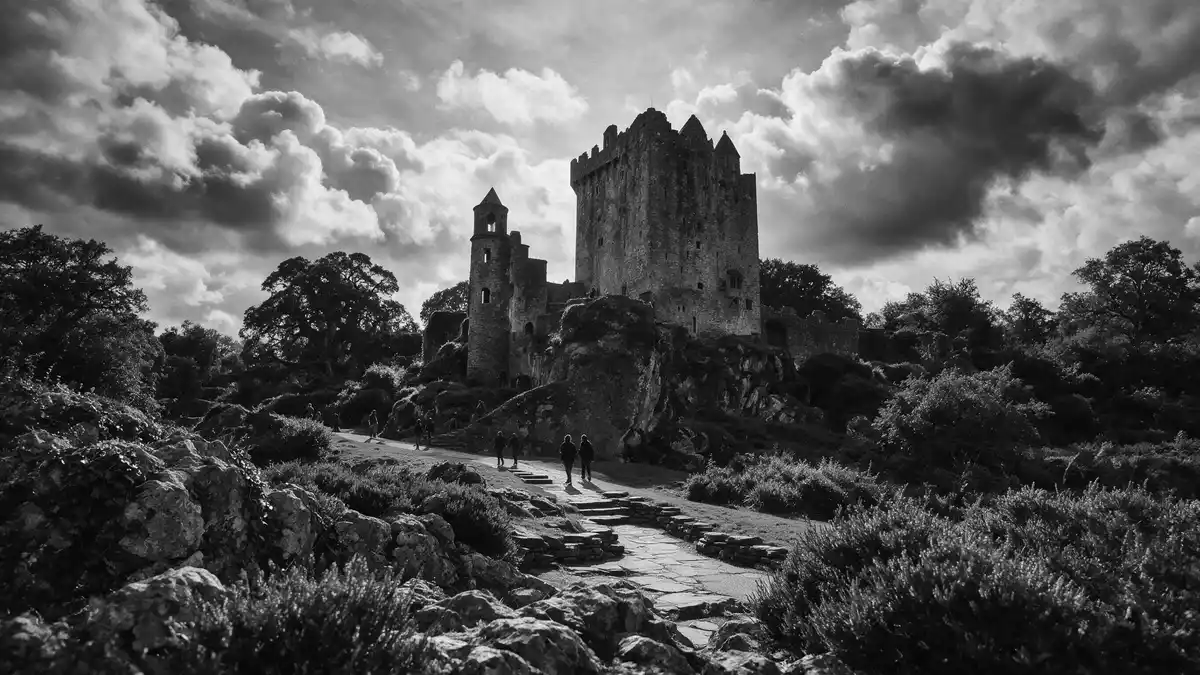
Caislean na Blarnan, the Irish name for the medieval stronghold known in English as Blarney Castle, rises above the village of Blarney in southern Ireland as a tall stone tower framed by landscaped gardens and water. The present castle structure dates to 1446 and was built by Cormac Láidir MacCarthy of the MacCarthy of Muskerry branch, giving the site a clear link to the late medieval world of Munster chieftains.dates to 1446 and was built
A tower house on rock and river
Caislean na Blarnan is a substantial stone tower house standing on rocky ground above lawns and the River Martin, with the tower itself forming a high, rectangular keep typical of fifteenth-century Gaelic and Anglo-Irish fortifications.stone keep standing on rocky ground The keep has thick masonry walls and rises several storeys, with internal floors linked by narrow stairways and chambers arranged vertically rather than in broad wings.
The wider demesne includes fragments of outer defensive walls and the remains of later estate buildings, with Blarney House, a nineteenth-century mansion in Scottish baronial style, standing within the grounds as a separate residence from 1874.Blarney House in Scottish baronial style Around the stone structures, paths run through lawns, planted areas and around streams, so the tower stands in deliberate contrast to the surrounding soft landscape.
MacCarthy power and the fifteenth century castle
The core identity of Caislean na Blarnan lies in its association with the MacCarthy of Muskerry dynasty, a cadet branch of the Kings of Desmond, who rebuilt the castle in the mid fifteenth century after earlier fortifications on the same rock had fallen.MacCarthy of Muskerry dynasty Cormac Láidir MacCarthy, Lord of Muskerry, is credited with commissioning the present tower in 1446, placing Caislean na Blarnan firmly in the late medieval phase of Irish castle building.commissioning the present tower in 1446
The site has earlier stone fortification history, with sources tracing a castle at Blarney to around 1210, though the surviving structure belongs to the later rebuild and carries architectural features of that period, such as tall crenellated walls and a dominant tower footprint.a castle at Blarney to around 1210 Over the centuries, the stronghold was involved in conflicts including the Irish Confederate Wars, when it was besieged and seized by Parliamentarian forces in 1646, and the Williamite War, after which MacCarthy lands were confiscated and the estate passed through new hands.besieged and seized by Parliamentarian forces
The Blarney Stone and the surrounding gardens
Caislean na Blarnan is closely associated with the Blarney Stone, a block of limestone built into the battlements of the tower that became linked to tales of eloquence through legends involving Cormac MacCarthy and the Stone of Scone.the Blarney Stone Over generations, visitors have climbed to the upper levels of the keep to reach the stone, which sits at the edge of the castle wall and requires a short lean back over an opening held by supports.
Beyond the tower, the grounds of Caislean na Blarnan have been shaped into a series of gardens and walking areas, with planted sections, streams and paths that create a parkland setting around the medieval remains.gardens and walking areas These surroundings give the castle a second life as an estate landscape, where stone walls, water and greenery share space and the ruined outer structures and later mansion can be seen from different points on the grounds.ruined outer structures and later mansion
Visiting Caislean na Blarnan: what travellers from Western Europe should know
- Caislean na Blarnan stands near the village of Blarney in County Cork, with the castle grounds lying north-west of Cork city and reached by road transport from the urban area.northwest from Cork city
- The castle tower rises above uneven rocky ground and lawns, and the internal routes to the battlements use confined stairways and passages that require steady footing.
- Walkways through the gardens pass streams and planted areas, so outdoor paths include natural surfaces, gentle gradients and steps on some approaches around the estate.
- The official language is Irish and English and the currency is the euro.
Searching for Caislean na Blarnan on social platforms
These links open searches for Caislean na Blarnan on each platform.
Frequently asked questions about Caislean na Blarnan
Where is Caislean na Blarnan located?
Caislean na Blarnan stands near the village of Blarney in County Cork in the south of Ireland, north-west of Cork city and close to the River Martin.near Cork and the River Martin
What should visitors expect on a visit?
Visitors encounter a tall medieval tower house with thick stone walls, internal stairways leading to high battlements, and extensive gardens and parkland surrounding the historic structures.
What makes Caislean na Blarnan distinctive?
Caislean na Blarnan combines a fifteenth-century MacCarthy-built tower, legends attached to the Blarney Stone in its battlements, and a later estate landscape with Blarney House and formal gardens on the same grounds.


