
Caislean na Blarnan and its tower rising over Blarney
Published on 08/30/2026 at 13:10 | Editorial responsibility: Rafael Müller, Editor-in-Chief AD HOC NEWS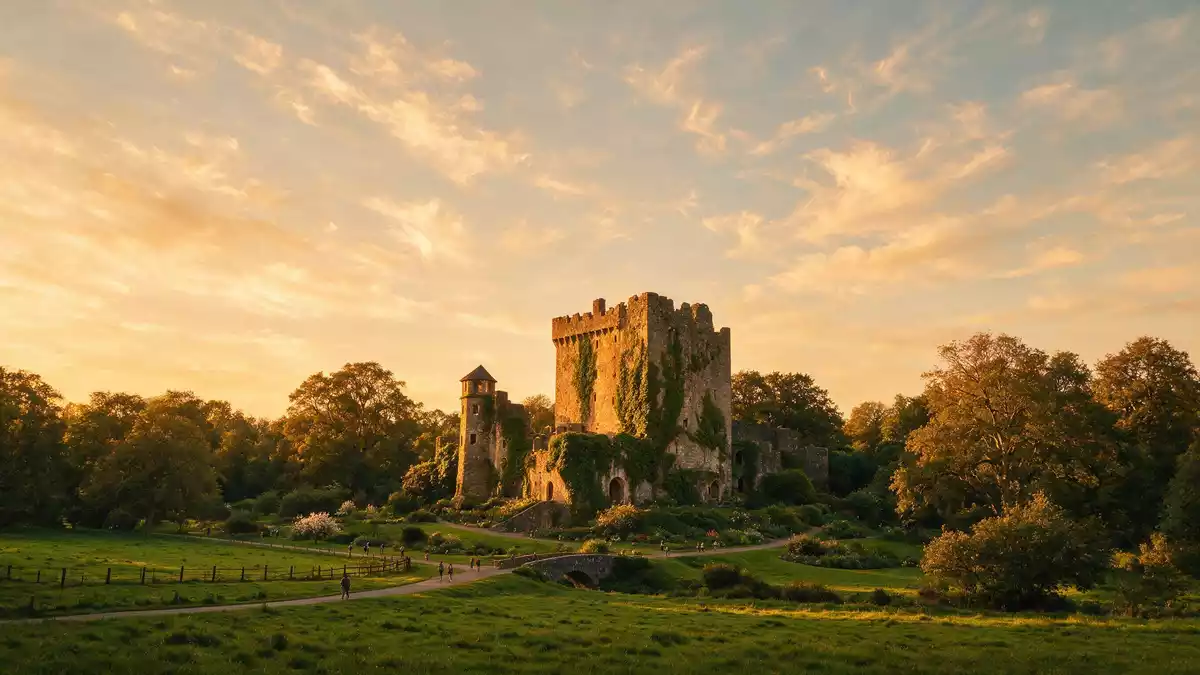
Caislean na Blarnan stands above the village of Blarney in southern Ireland, a fifteenth?century stone tower house rising over river, woodland and landscaped gardens. Its present castle structure, dating from 1446 and attributed to Cormac Láidir MacCarthy of the MacCarthy of Muskerry dynasty, forms the centre of an estate where fortified architecture and planted grounds sit side by side.
A medieval stronghold over river and rock
Caislean na Blarnan is a medieval stronghold in Blarney, in County Cork, set near the River Martin and surrounded by undulating parkland. The present tower belongs to a type known as a tower house, a tall, compact fortified residence built in stone by Gaelic lords and Anglo?Irish families between the fifteenth and seventeenth centuries.a tower house The keep rises above thick walls and defensive features, creating the vertical silhouette now associated with Blarney.
The site carries traces of a longer story, with earlier fortifications preceding the structure visible today. A wooden stronghold is traditionally dated to the tenth century, followed by a stone fortification built around 1210 and later destroyed.third castle on this site In 1446 Cormac Láidir MacCarthy, Lord of Muskerry, rebuilt the castle in stone on these foundations, giving Caislean na Blarnan its enduring form and establishing it as a power centre in Munster.Cormac Láidir MacCarthy in 1446
MacCarthy lords, sieges and changing ownership
The MacCarthy of Muskerry dynasty, a cadet branch of the Kings of Desmond, shaped the medieval phase of Caislean na Blarnan, using the castle as a stronghold in the politics of southern Ireland.MacCarthy of Muskerry dynasty The tower and its surrounding defences were part of a network of MacCarthy castles in the region, including Kilcrea and Carrignamuck, which marked their territorial control in Cork.
Conflict in the seventeenth century brought sieges and confiscations to Caislean na Blarnan. In 1646, during the Irish Confederate Wars, Parliamentarian forces under Lord Broghill besieged and took the castle, using artillery from higher ground to damage its walls.seventeenth?century siege After the Restoration, the estate returned to Donough MacCarty, later Earl of Clancarty, before being finally forfeited by Donogh MacCarthy, 4th Earl of Clancarthy, for supporting James II in the Williamite War in Ireland in the 1690s.forfeited by the 4th Earl of Clancarthy The property then passed through several hands, including Sir Richard Pyne, and was purchased in the early eighteenth century by Sir James St John Jefferyes, governor of Cork, whose descendants remained associated with the estate.Sir James Jeffreys purchase
Stone battlements and expansive gardens
The upper parts of Caislean na Blarnan carry battlements where visitors encounter the stone associated with the castle’s long?standing legend. The Blarney Stone, set into the fabric of the battlements, is linked to a tradition that kissing it grants eloquence, tying the experience of climbing the tower to a piece of Irish folklore about speech.legendary Blarney Stone From the top, views extend across the surrounding estate, revealing the relationship between the fortified core and the later landscaped grounds.
The gardens and parkland around Caislean na Blarnan form an integral part of a visit, with paths leading through planted areas, rock features and water. Nineteenth?century interventions added Victorian influences to the grounds, combining formal design elements with the existing natural terrain.Victorian?era designs to the gardens Together, the tower, battlements, stone fabric and gardens present Caislean na Blarnan as both a medieval fortress and an estate shaped by later centuries.
Visiting Caislean na Blarnan: what travellers from Western Europe should know
- Caislean na Blarnan stands in the village of Blarney in County Cork, in the south of Ireland, north?west of Cork city and close to the River Martin.
- The castle tower is reached by interior stairways with multiple flights, and the estate grounds include paths across uneven parkland and sections of natural rock.
- The wider estate around Caislean na Blarnan includes planted gardens and wooded areas, so visiting involves both ascending the stone structure and walking across outdoor terrain.
- The official language is Irish and English and the currency is the euro.
Searching for Caislean na Blarnan on social platforms
These links open searches for Caislean na Blarnan on each platform.
Frequently asked questions about Caislean na Blarnan
Where is Caislean na Blarnan located?
Caislean na Blarnan stands in the village of Blarney in County Cork, in the south of Ireland, near the River Martin and north?west of Cork city.
What should travellers expect when visiting?
A visit combines climbing a fifteenth?century stone tower house with walking through extensive gardens and parkland, including uneven paths and natural rock features.
What makes Caislean na Blarnan distinctive among Irish castles?
It combines a medieval tower house built in 1446 by the MacCarthy of Muskerry dynasty with the legendary Blarney Stone in its battlements and landscaped nineteenth?century gardens around the stronghold.


