
Burj Khalifa, a vertical city above Downtown Dubai
Published on 09/07/2026 at 12:27 | Editorial responsibility: Rafael Müller, Editor-in-Chief AD HOC NEWS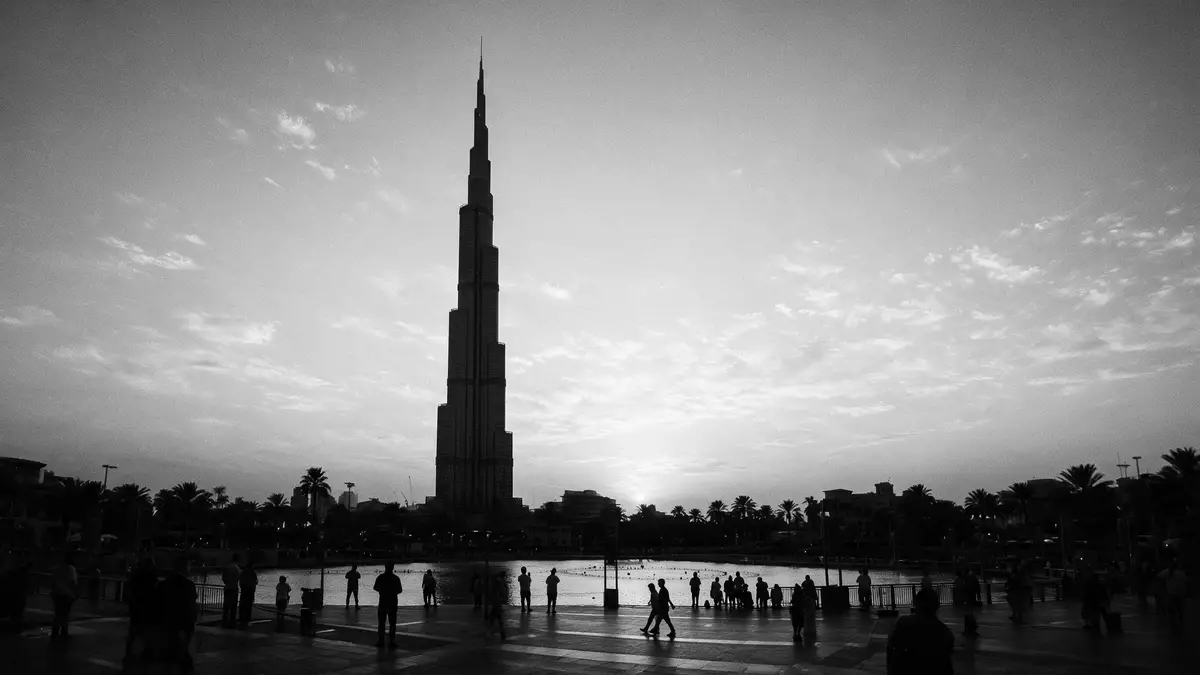
Burj Khalifa in Dubai is a mixed-use skyscraper that turns extreme height into a stacked city of hotel, residences and offices in the desert air. Completed between 2004 and 2010 and officially opened on 4 January 2010, it reaches an architectural height of 828 m (2,717 ft), making it the tallest building on earth.828 m architectural height Designed by Adrian Smith of Chicago-based Skidmore, Owings & Merrill, it anchors the Downtown Dubai development along Sheikh Zayed Road and has become a defining figure of the United Arab Emirates skyline.Adrian Smith and SOM
A megatall tower shaped as a vertical city
From a distance, Burj Khalifa reads as a single slender needle of concrete, glass and aluminium, yet its plan arranges that height into a sequence of neighbourhoods. The tower rises to 163 occupied floors, tapering through setbacks that reduce the floor plates as the building climbs.163 floors Below the spire, the main shaft is formed by three wings that radiate from a central core, a layout that stabilises the structure and creates clusters of apartments with broad outward views.three-winged plan
Concrete forms the lower body of the tower, with the upper sections transitioning to steel as the structure narrows towards the pinnacle.concrete and steel structure The exterior cladding combines reflective glazing with aluminium and textured steel spandrels, giving the facade a silvery surface that catches the strong desert light. Setbacks create terraces and ledges, so the tower does not read as a smooth extrusion but as an articulated stack of vertical elements rising out of the Downtown Dubai podium.
Downtown Dubai and the stacking of uses
Burj Khalifa stands within the Downtown Dubai district, a large-scale development laid out south of Dubai Creek along Sheikh Zayed Road.Downtown Dubai setting The tower was conceived as the focal point of this area, with boulevards, residential blocks and landscaped water features set around its base. Rather than a single-function office stack, the building is organised as a vertical mixed-use complex: hotel floors clustered at the lower levels, large residential apartments above, and corporate suites close to the top.
The lower portion houses a boutique hotel, while the middle bands contain condominium residences occupying the wings around the central core.hotel and residences Higher up, the smallest floor plates are reserved for office suites, interspersed with observation levels that open the view over Dubai and the surrounding desert.mixed-use tower The effect is that of a stacked programme where each band of height corresponds to a different everyday use, turning a single spire into a layered extension of the city below.
Engineering height in the Gulf climate
Achieving 828 m demanded a combination of high-strength concrete, tuned structural systems and careful detailing for the Gulf climate.high-strength concrete The tower’s Y-shaped plan spreads the load across three wings, while the central reinforced concrete core acts as a spine resisting lateral forces. As the structure ascends, the setbacks and taper reduce the exposed surface and help manage wind effects at altitude.tapering and setbacks
Construction began in 2004, with the structure topping out in 2009 before the official opening in early 2010.2004–2010 construction The building’s height was kept under close control by the Council on Tall Buildings and Urban Habitat, which later certified Burj Khalifa as the world’s tallest building after reviewing detailed architectural drawings.tallest building certification Standing more than twice the height of the Empire State Building in New York, the tower’s scale redefined expectations of what a commercial, residential and hospitality building could be in the early twenty-first century.comparison to Empire State Building
Visiting Burj Khalifa: what travellers from Western Europe should know
- Burj Khalifa rises from the Downtown Dubai district, south of Dubai Creek along Sheikh Zayed Road, and is integrated with the city’s metro and road network.
- The tower is accessed through a multi-level podium with indoor approaches; once inside, visitors encounter lifts and staircases connecting different public levels.
- The surrounding area includes landscaped promenades and water features, so reaching viewpoints around the base involves walking on paved surfaces rather than rough ground.
- Dubai is in the United Arab Emirates; the official language is Arabic and the currency is the UAE dirham.
- Entry requirements depend on your nationality; UK travellers can check the FCDO travel advice at gov.uk/foreign-travel-advice, Irish travellers the Department of Foreign Affairs at ireland.ie.
Searching for Burj Khalifa on social platforms
These links open searches for Burj Khalifa on each platform.
Frequently asked questions about Burj Khalifa
Where is Burj Khalifa located?
Burj Khalifa stands in the Downtown Dubai district of Dubai, in the United Arab Emirates, close to Sheikh Zayed Road and the city’s main business area.
What can visitors expect inside Burj Khalifa?
Visitors encounter a mixed-use interior with hotel areas, residential zones, office suites and designated public levels, including observation areas reached by high-speed lifts.
What makes Burj Khalifa distinctive among skyscrapers?
Its 828 m height, 163 occupied floors and tapered three-wing plan make Burj Khalifa the tallest building in the world and a rare example of a true vertical city.


