

Burj Khalifa: a vertical city above Downtown Dubai
Published on 08/23/2026 at 10:58 | Editorial responsibility: Rafael Müller, Editor-in-Chief AD HOC NEWS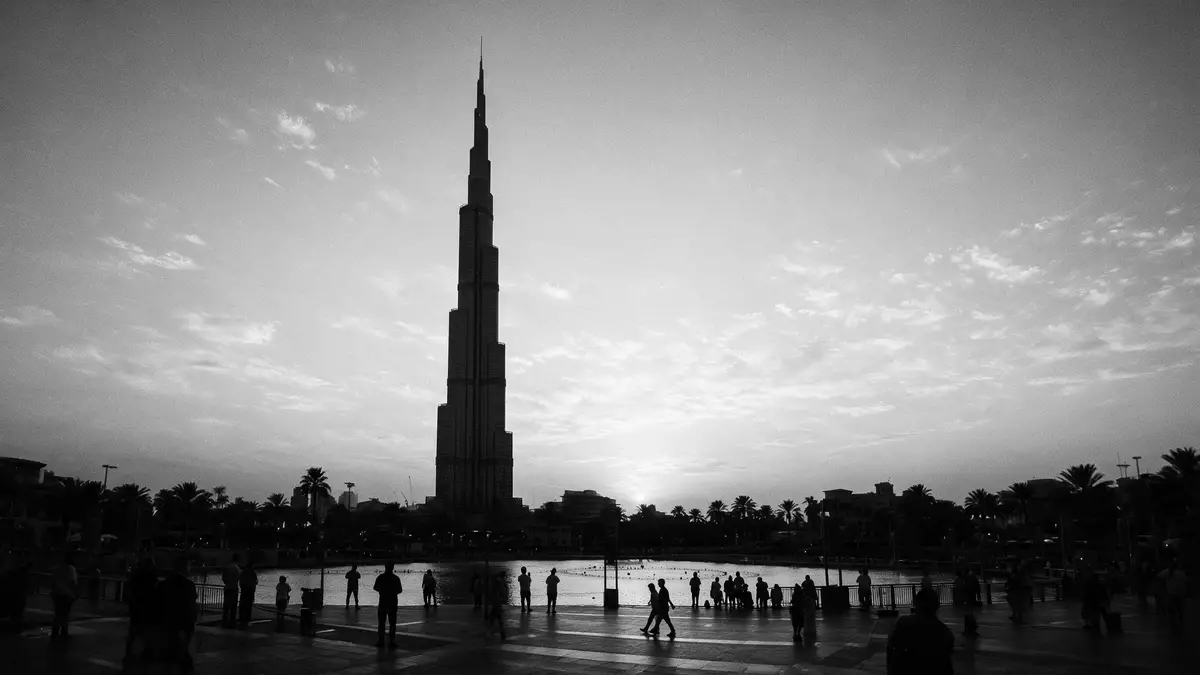
Burj Khalifa in Dubai stands as a vertical city in the sky, stacking homes, offices, hotels and viewing terraces into a single tapering tower that reshaped the city’s skyline. Rising to an architectural height of 828 m (2,717 ft), it was designed by Skidmore, Owings & Merrill with architect Adrian Smith and completed in 2010 as the world’s tallest building by standard criteria, a landmark that combines daily life with extreme height.architectural height of 828 m
From desert crossroads to vertical landmark
Burj Khalifa rises in Downtown Dubai, a master-planned district along Sheikh Mohammed bin Rashid Boulevard where the city’s dense cluster of towers meets broad highways and the Dubai Mall. The tower’s address on that boulevard places it within a compact ensemble of commercial and leisure buildings, yet it dominates their outlines by reaching more than 800 m above the ground.1 Sheikh Mohammed bin Rashid Boulevard
Construction began on 21 September 2004 and the exterior was completed in October 2009 before the tower opened in early 2010, marking six years of work on the reinforced concrete and steel frame that carries its stacked floors.construction began on 21 September 2004 The building reaches 163 floors above ground, a count that underlines how far its vertical city concept extends.163 floors
Designing a city stacked into a single tower
The design of Burj Khalifa uses a bundled form, with wings arranged around a central core that step back as the tower rises, giving the building its tapering silhouette on the Dubai skyline.reached completion at 163 floors At lower levels, the footprint is spread out to accommodate larger floorplates, while higher levels narrow to slender floors that sit within the upper shaft and spire. This arrangement supports a mix of uses, with office space, serviced residences and hospitality functions arranged in stacked zones.
Adrian Smith, working with SOM’s structural engineer William F. Baker, adapted a Y-shaped plan using high-strength concrete and a central spine to carry the loads of this height.Adrian Smith served as architect The tower’s cladding uses reflective glazing and aluminium to create a smooth exterior, broken by vertical fins and horizontal bands that mark mechanical floors and setbacks, so that the building reads as a series of stepped tiers rather than a simple shaft.
Observation decks and life on the upper levels
For many visitors, Burj Khalifa is experienced through its observation decks, which occupy dedicated floors high above Downtown Dubai. Public viewing platforms on Levels 124 and 125 sit at around 452 m and 456 m above ground according to published figures, combining indoor spaces with outdoor areas that look over the Arabian Gulf, the Dubai Fountain and the city’s road grid.Levels 124 and 125
A further deck, branded as an upper-tier experience, occupies Level 148 and is described as the world’s highest observation deck at about 555 m above ground, marking a second layer of viewing space within the upper tower.observation deck at a height of 555 metres Above these levels, the Lounge on Floors 152 to 154 sits close to the highest occupied floors of the building, turning the top of Burj Khalifa into a sequence of public and semi-public spaces rather than a closed technical crown.The Lounge occupies Levels 152, 153 and 154
Visiting Burj Khalifa: what travellers from Western Europe should know
- Burj Khalifa stands in Downtown Dubai beside the Dubai Mall, with the main entrance to the observation levels located within the mall complex on its lower ground floor.
- The tower is linked to the city’s metro system via Burj Khalifa/Dubai Mall station on the Red Line, with enclosed walkways leading from the station towards the mall and the base of the building.
- Reaching the mid-level and upper-level decks involves high-speed lifts travelling directly to the viewing floors, so time inside the tower includes vertical travel followed by circulation across large glazed halls.
- The approach from surrounding streets is over paved plazas and broad promenades, and interior routes include escalators and staircases between ticketing areas and lift lobbies.
- The official language in the United Arab Emirates is Arabic and the currency is the UAE dirham.
Searching for Burj Khalifa on social platforms
These links open searches for Burj Khalifa on each platform.Frequently asked questions about Burj Khalifa
Where is Burj Khalifa located?
Burj Khalifa stands in Downtown Dubai, in the United Arab Emirates, with its address on Sheikh Mohammed bin Rashid Boulevard close to the Dubai Mall.
What can visitors expect during a visit?
A visit usually centres on the observation decks on Levels 124, 125 and 148, reached by high-speed lifts and offering extensive views over Dubai and the surrounding landscape.
What makes Burj Khalifa distinctive among tall buildings?
Burj Khalifa combines an architectural height of 828 m, 163 floors and a mixed-use programme in a single tapering tower, making it the tallest building in the world by standard measures.


