
Burj Al Arab, the sail-shaped hotel rising from the Gulf
Published on 09/14/2026 at 08:52 | Editorial responsibility: Rafael Müller, Editor-in-Chief AD HOC NEWS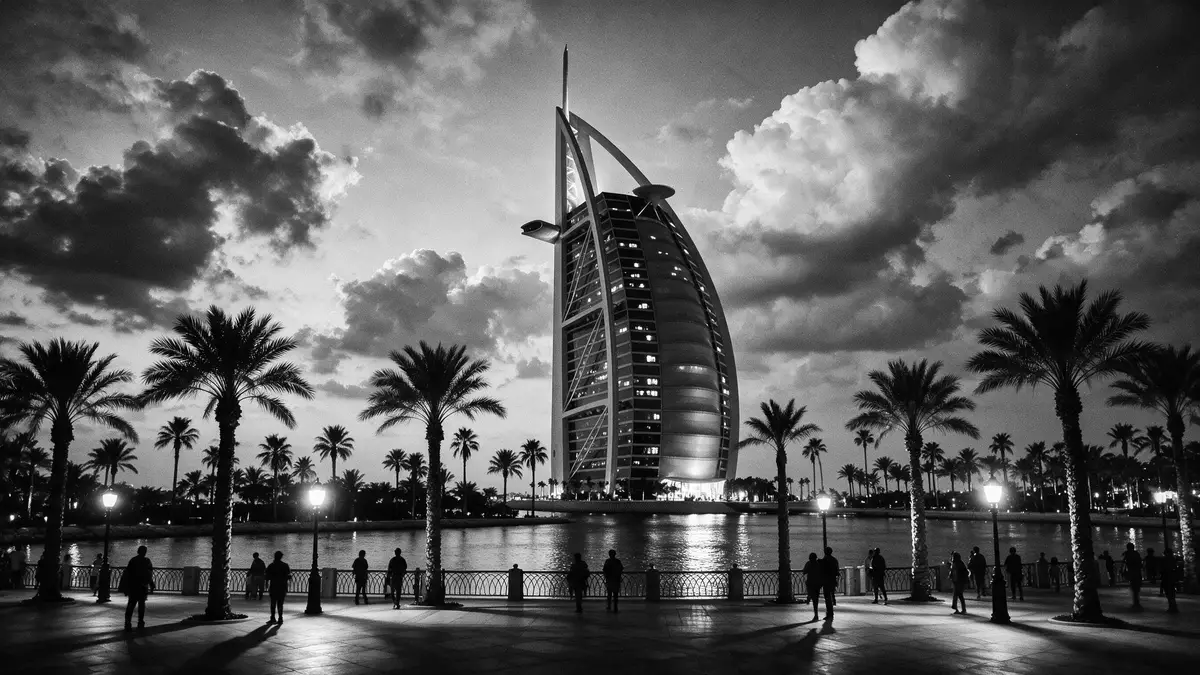
Burj Al Arab is the sail-shaped luxury hotel that rises from an artificial island off Jumeirah Beach in Dubai, a late twentieth-century statement on the edge of the Arabian Gulf. Built in the 1990s as a landmark for the United Arab Emirates, it stands as a tall, slender tower whose form recalls the billowing sail of a traditional Arabian dhow.
A sail on an artificial island
Burj Al Arab stands on a man-made island set a few hundred metres offshore from the Jumeirah coastline, linked to the mainland by a dedicated curving causeway that separates the hotel from the urban fabric of Dubai.man-made island approximately 280 metres off the Jumeirah Beach coastline The hotel reaches a height of about 321 m (1,053 ft), putting it among the tallest hotels built as stand-alone hospitality towers in the world.321 metres tall
The project was commissioned in the early 1990s and designed by British architect Tom Wright of WS Atkins, working with the consultancy Atkins on a form that would give Dubai a distinctive profile on the global skyline.architect Tom Wright of WS Atkins Construction began in 1994 and the hotel opened on 1 December 1999, making Burj Al Arab a late twentieth-century addition to the city’s waterfront rather than part of its older trading quarter.construction started in 1994 and opening in 1999
Architecture shaped like a dhow sail
The tower’s silhouette is defined by two wings that spread in a broad V-shape from a central spine, enclosing a vast atrium and giving the building its sail-like profile when seen from the sea or the shore.sail-inspired V-shaped tower The architectural style is often classified as structural expressionism, with external steel trusses and bracing members expressed on the façade to outline the curve of the sail and the supporting mast.structural expressionism
Burj Al Arab’s atrium rises through many storeys, creating a tall volume behind the sail form that is visible in cross-section from the interior galleries and lift lobbies.highest atrium reaching around 180 metres The outer envelope combines glass, steel and fabric-like cladding panels that reflect the strong Gulf light during the day and become a surface for coloured illumination after dark. At the top of the tower, a projecting platform forms the well-known helipad, while a later-added deck structure extends from the island’s seaward side, carrying pools and terraces close to the water.
Interior worlds and suites above the Gulf
Behind its sail profile, Burj Al Arab is an all-suite hotel, with guest accommodation arranged over multiple levels that look into the atrium or out across the Arabian Gulf and the Dubai shoreline.all-suite hotel at 321 metres The hotel offers 202 suites, each occupying generous floor area compared with typical city hotel rooms, and is operated by the Jumeirah Group, which manages several high-end properties in the emirate.202 rooms managed by Jumeirah Group
The interior design is known for its use of rich materials, with extensive marble surfaces, bold colours and large areas of gold-coloured detailing, including gold leaf applied to selected walls and columns.around 8,000 m² of 24-carat gold leaf adorns the interior One of the ground-level restaurants incorporates a large saltwater aquarium behind thick transparent walls, while upper levels contain further dining spaces, lounges and spa facilities arranged to make use of views over the sea and towards the city.
Visiting Burj Al Arab: what travellers from Western Europe should know
- Burj Al Arab stands off Jumeirah Beach in Dubai on an artificial island linked to the mainland by a private bridge, reached by road from the city.
- The approach to the hotel crosses the causeway and passes security on the island; inside, public areas span several levels connected by lifts and escalators.
- The hotel is located in the United Arab Emirates, where the official language is Arabic and the currency is the UAE dirham.
- Entry requirements depend on your nationality; UK travellers can check the FCDO travel advice at gov.uk/foreign-travel-advice, Irish travellers the Department of Foreign Affairs at ireland.ie.
Searching for Burj Al Arab on social platforms
These links open searches for Burj Al Arab on each platform.Frequently asked questions about Burj Al Arab
Where is Burj Al Arab located?
Burj Al Arab stands on an artificial island off Jumeirah Beach Road in Dubai, United Arab Emirates, a short distance offshore from the sandy coastline.
What should visitors expect inside Burj Al Arab?
Visitors encounter multi-level public spaces, restaurants, lounges and an interior marked by bold colours, marble surfaces and extensive use of gold-coloured detailing.
What makes Burj Al Arab distinctive among hotels?
Its sail-shaped form rising 321 m (1,053 ft) above an artificial island, combined with an all-suite layout and lavish interiors, makes Burj Al Arab a singular landmark in Dubai.


