
Burj Al Arab and its sail-shaped silhouette over Dubai
Published on 09/10/2026 at 22:02 | Editorial responsibility: Rafael Müller, Editor-in-Chief AD HOC NEWS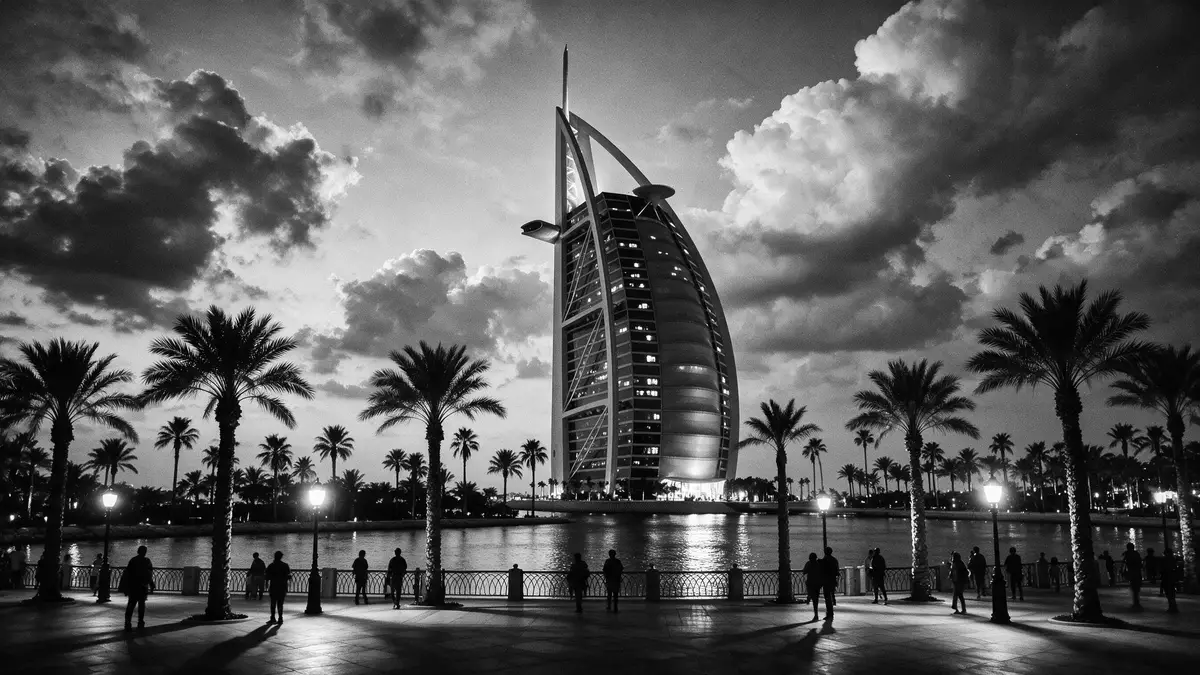
Burj Al Arab is a vast luxury hotel in Dubai, rising from an artificial island off Jumeirah Beach and shaped to evoke the sail of an Arabian dhow. Its distinctive silhouette and offshore setting have made it one of the most recognisable structures on the Emirate’s coastline since its completion in 1999.
A sail of concrete and steel offshore Jumeirah
The defining experience of Burj Al Arab is its shape: a sweeping sail profile rising high above the Gulf, held between two broad structural wings and anchored to a man-made platform in the sea. The hotel stands on an artificial island set offshore from the Jumeirah shoreline, linked back to the mainland by a dedicated bridge that curves towards the tower. This separation gives the building a clear frame against open water, with the broad “mast” of its twin wings visible from long stretches of the coast.luxury hotel located in Dubai Rising to an architectural height of 321 m (1,053 ft), Burj Al Arab is among the tallest hotels constructed so far, its upper levels and mast extending well beyond neighbouring mid-rise buildings.architectural height of 321 m
The tower was designed by British architect Tom Wright while working with the multidisciplinary consultancy Atkins, which led the project’s engineering and design.project developed by Atkins Construction began in the mid-1990s and the hotel opened on 1 December 1999, marking a distinct moment in Dubai’s expansion along the Gulf shore.opened on 1 December 1999 From the mainland, the sail form reads as a single gesture, yet closer inspection reveals a triangulated plan with two side wings flanking a tall central void that houses the atrium and circulation spaces.
Inside the all-suite tower and its vast atrium
Behind the glass and structural frame, Burj Al Arab operates as an all-suite hotel, with duplex suites arranged over multiple levels rather than conventional single-storey rooms. The tower’s interior is organised around a huge atrium that rises through much of the height of the building, enclosed between the V-shaped wings that form the visual mast.massive atrium 590 feet tall Corridors line the inner faces of these wings, with suite entrances looking into the atrium and floor-to-ceiling glazing on the outer sides facing the sea.
The published material of the hotel’s operator describes Burj Al Arab as an all-suite property with under 250 suites, many arranged over two floors, and floor-to-ceiling windows facing the Arabian Gulf.all-suite hotel features 198 expansive luxury duplexes Suites vary in size, but the emphasis is on expansive layouts and a vertical sequence of spaces rather than compact rooms. Above and around them, the atrium forms a column of air and light within the structure, with decorative finishes and lifts drawing the eye upwards along the inner curve of the sail.
Engineering a sail-shaped hotel on a man-made island
Beneath Burj Al Arab, the man-made island supports the weight of the tower through deep foundations sunk into the seabed, a prerequisite for building at this height just offshore. The island lies roughly 280 m (about 920 ft) from the beach, giving room for water on all sides and creating a distinct podium for the hotel.man-made island 280 metres from the shores From this base, the building’s structural system combines a central concrete core with a steel exoskeleton, including two main legs on each side that trace the curved outline of the sail.
Engineering presentations about the project describe how these side legs function as deep plate girders, connected by braced members that follow the building’s edge and define the sail profile.composite structure uses a steel exoskeleton At the rear of the structure, a platform for helicopters projects from high above the main roofline, forming a circular landing area cantilevered from the tower’s frame. This helipad has been engineered to support several tonnes of load at an elevation of over 200 m, adding another distinctive element to the building’s outline when viewed from the sea or shore.helipad perched 212 meters above the ground
Visiting Burj Al Arab: what travellers from Western Europe should know
- Burj Al Arab stands on a dedicated artificial island off Dubai’s Jumeirah coastline, reached by a bridge road that connects directly to the mainland.
- The approach from the mainland runs along a paved causeway, and within the complex visitors encounter escalators, lifts and internal staircases rather than extended outdoor gradients.
- Dubai is in the United Arab Emirates, where the official language is Arabic and the currency is the United Arab Emirates dirham.
- Entry requirements depend on your nationality; UK travellers can check the FCDO travel advice at gov.uk/foreign-travel-advice, Irish travellers the Department of Foreign Affairs at ireland.ie.
Searching for Burj Al Arab on social platforms
These links open searches for Burj Al Arab on each platform.
Frequently asked questions about Burj Al Arab
Where is Burj Al Arab located in Dubai?
Burj Al Arab stands on a purpose-built island off the Jumeirah coast of Dubai in the United Arab Emirates, connected to the mainland by a private bridge.
What can visitors expect when approaching Burj Al Arab?
Visitors cross the causeway from Jumeirah and see the sail-shaped tower rising from its island, with the bridge and podium framing the hotel against the waters of the Gulf.
What makes Burj Al Arab distinctive among hotels?
Its combination of a 321 m (1,053 ft) sail-shaped profile, offshore island setting and all-suite interior centred around a towering atrium gives the building a singular presence on Dubai’s shoreline.


