
Burj Al Arab and Dubai’s sail-shaped waterfront silhouette
Published on 09/23/2026 at 07:32 | Editorial responsibility: Rafael Müller, Editor-in-Chief AD HOC NEWS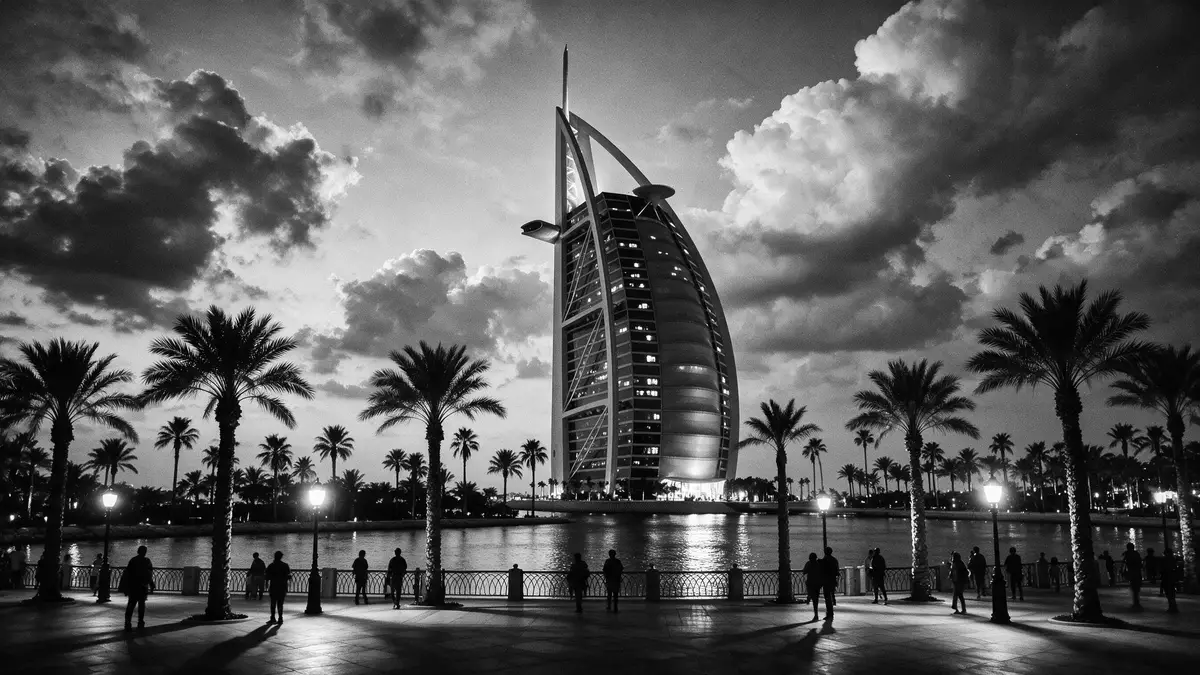
Burj Al Arab rises from an artificial island off Dubai’s Jumeirah coast, with two sweeping white wings framing a central open space. Completed in 1999 under British architect Tom Wright, the 321 m (1,053 ft) hotel reads from the shore as a sail suspended above the Arabian Gulf.
Burj Al Arab: a sail above the Arabian Gulf
The building’s most recognisable feature is its curved outer profile. Its twin wings flare from a central spine, while a large open atrium occupies the space between them. From Jumeirah, the white structure presents a clear silhouette against the water and sky.
Tom Wright led the design for the British consultancy Atkins. The form recalls the billowing sail of an Arabian dhow, a traditional vessel associated with the Gulf. The reference links a late twentieth-century hotel to Dubai’s maritime setting without reproducing the shape of a working boat. Burj Al Arab’s architect was Tom Wright, and the hotel was completed in 1999.
From construction landmark to all-suite hotel
Burj Al Arab opened on 1 December 1999 as a luxury hotel. Its accommodation consists of suites arranged through the tower, rather than conventional single-level hotel rooms. The building’s height and internal volume are part of its architectural identity.
The interior is organised around a towering atrium rising through the central space. Balconies, lifts, stairways and public rooms occupy the wings and the open volume between them. The external sail profile therefore corresponds with a complex interior arrangement, not a flat decorative façade. the hotel’s 1999 opening fixed Burj Al Arab within Dubai’s late twentieth-century waterfront development.
The building stands apart from the mainland on a man-made island connected to Jumeirah by a private causeway. Its offshore position leaves the full profile visible from the coast, while the island platform places the base directly above the Gulf.
321 metres of structure, colour and open space
At 321 m (1,053 ft), Burj Al Arab is among the tallest hotels in the world. The measurement includes the building’s high structural mast, which extends above the accommodation levels and completes the sail-like outline. the 321-metre structure combines a tall mast with broad curved wings and a central atrium.
White exterior surfaces contrast with the vivid colours used inside the hotel. The atrium contains patterned finishes, reflective surfaces and large areas of colour, while the outer envelope remains visually restrained from a distance. This contrast gives the building two distinct appearances: a precise coastal silhouette outside and a richly layered interior within.
The helipad projects from the seaward side high above the island. It is a separate horizontal element within the vertical composition, adding a visible platform to the sweeping profile. The open atrium, the mast and the helipad make the building legible as a collection of large structural gestures.
Visiting Burj Al Arab: what travellers from Western Europe should know
- Burj Al Arab stands off Jumeirah Beach in Dubai, United Arab Emirates. It is reached from the mainland by a private causeway connected with Jumeirah Beach Road.
- The hotel is on a man-made island, so the approach crosses water before reaching the island platform. Interior movement includes lifts, stairs and different hotel levels.
- The official language is Arabic and the currency is the United Arab Emirates dirham.
- Burj Al Arab is a hotel rather than a standalone museum. The architectural experience is concentrated in its exterior silhouette, atrium and hospitality spaces.
Searching for Burj Al Arab on social platforms
These links open searches for Burj Al Arab on each platform.
Frequently asked questions about Burj Al Arab
Where is Burj Al Arab?
Burj Al Arab stands on a man-made island off Jumeirah Beach in Dubai, United Arab Emirates. A private causeway connects the island with the mainland.
What can visitors expect from the building?
Burj Al Arab is a luxury hotel with suite accommodation, a tall central atrium and richly coloured interior spaces. Its exterior is best understood from the Jumeirah coastline or the surrounding Gulf.
What makes Burj Al Arab distinctive?
Its 321 m (1,053 ft) height, offshore island setting and sail-shaped profile combine into a clear architectural composition. Tom Wright’s design links the hotel’s form with the maritime character of the Arabian Gulf.


