

Burano’s painted canals and lace traditions near Venice
Published on 08/23/2026 at 12:20 | Editorial responsibility: Rafael Müller, Editor-in-Chief AD HOC NEWS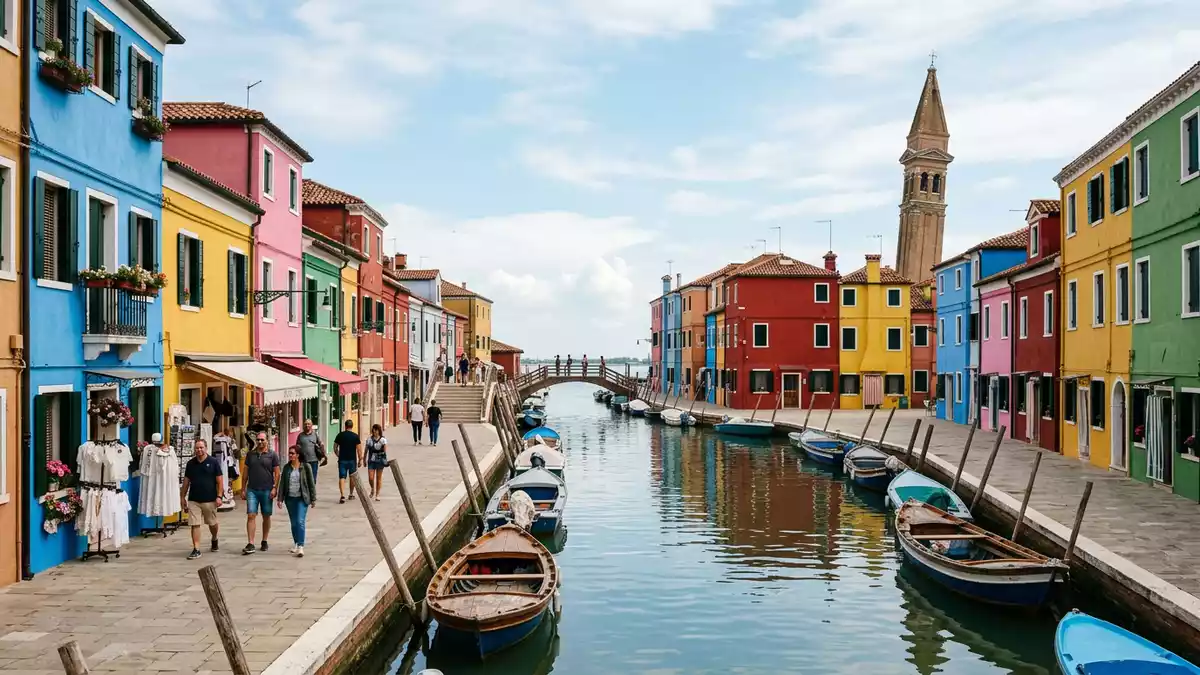
Burano, an island in the northern Venetian lagoon, is immediately recognisable for its brightly painted houses reflected in narrow canals. A former fishing community turned lacemaking centre, it sits north-east of Venedig and remains one of the lagoon’s most distinctive small towns.
Colours along the canals of Burano
The first impression of Burano is a compact townscape of low houses painted in strong, contrasting colours along the canals. The island belongs to the northern part of the Venetian lagoon and lies a short boat ride north-east of the historic centre of Venice.Burano is a small fishing island in Venice’s northern lagoon The canals cut the settlement into blocks linked by small bridges, and the water brings working boats into streets that would otherwise feel like ordinary lanes.
The houses themselves are modest in scale, usually no more than a few storeys, but their painted façades create long ribbons of colour beside the canals. Many front doors open almost directly onto the narrow pavements, with washing lines and small boats making the townscape feel lived-in. Local tradition connects the strong colours with the fishing families who once needed to recognise their homes through lagoon fog, and the effect remains central to the character of the island.Burano is described as a picturesque island in the northern lagoon with characteristic coloured houses
Lace, fishing and everyday life
Behind the painted walls, Burano carries a long association with both fishing and needle lace. The island’s origins lie in a modest fishing community, and small working boats still serve the lagoon around it.Its early inhabitants lived mainly from fishing Burano’s main historical craft, however, is lace made entirely with needle and thread, a technique known as punto in aria, or “stitch in the air”.Burano lace is defined as punto in aria needle lace worked over a paper pattern
The tradition of punto in aria lace became prominent in the sixteenth century, when lace from Burano circulated among European elites.Burano lace is linked with Venetian lace that spread across Europe Commercial production declined after the fall of the Venetian Republic in 1797 but was revived in 1872 with the founding of the Scuola dei Merletti di Burano, backed by Countess Andriana Marcello.The lace school in Burano was founded in 1872 with the support of Countess Andriana Marcello The lace school functioned for decades and its building now houses the Museo del Merletto, which presents historic lace patterns and explains the techniques behind them.Burano lace was revived in 1872 and the former lace school survives as the Museo del Merletto
Squares, churches and the structure of the island
Although small in area, Burano is structured as a compact town with canals, a central square and a parish church. The settlement is formed by several islands separated by internal canals and linked by short bridges, creating a pattern of small neighbourhoods that remain close to the water on all sides.Burano is described as an island made up of four islands separated by canals The main square, Piazza Baldassare Galuppi, takes its name from the eighteenth-century Venetian composer who was born on the island.
Facing this square stands the Museo del Merletto and the parish church of San Martino, whose bell tower tilts noticeably away from the vertical.Burano is known for the leaning bell tower of the Chiesa San Martino The church interior combines simple architectural forms with artworks linked to local devotion, while the square around it holds cafés and small shops that continue the pattern of coloured façades. Beyond the centre, narrow lanes and canals lead towards the edges of the lagoon, where the water opens out towards the marshes and distant outlines of other islands.
Visiting Burano: what travellers from Western Europe should know
- Burano lies in the northern Venetian lagoon, north-east of Venedig, and is reached by public boat services that connect it with central Venice and nearby lagoon islands.
- The island is flat and compact, with canals crossed by small bridges and narrow pavements, so walking means frequent stepping up and down over bridge ramps.
- Piazza Baldassare Galuppi forms the main open space, with the Museo del Merletto and the church of San Martino set among coloured houses around the square.
- The official language is Italian and the currency is the euro.
Searching for Burano on social platforms
These links open searches for Burano on each platform.
Frequently asked questions about Burano
Where is Burano in relation to Venice?
Burano is an island settlement in the northern part of the Venetian lagoon, lying north-east of the historic centre of Venedig and connected by public boats.
What can visitors expect when walking around Burano?
Visitors encounter low canalside houses painted in strong colours, narrow lanes, small bridges over canals and a central square with the parish church and lace museum.
What makes Burano distinctive among lagoon islands?
Burano combines a long-standing tradition of needle lace, represented by the Museo del Merletto, with vividly coloured fishermen’s houses that line its canals in every direction.


