
Burano’s painted canals and lace traditions in the Venetian Lagoon
Published on 09/19/2026 at 20:47 | Editorial responsibility: Rafael Müller, Editor-in-Chief AD HOC NEWS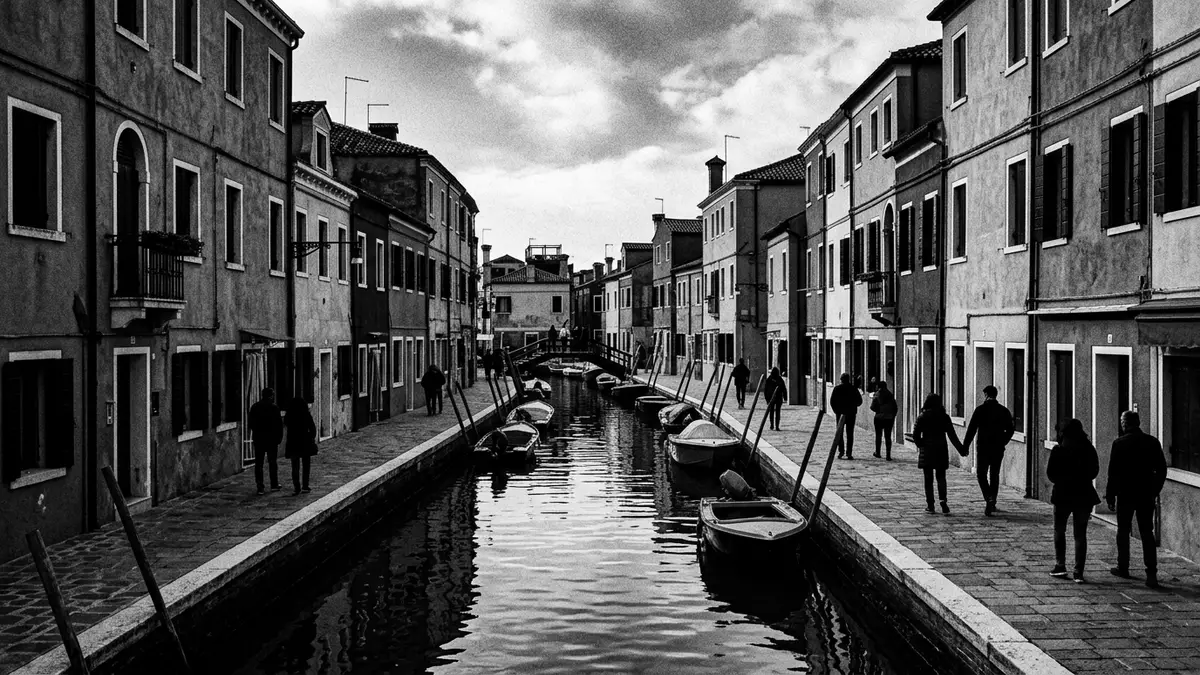
In the northern stretch of the Venetian Lagoon, Burano turns a working island into a study in colour and craft, with painted canalside houses and a lace tradition that reaches back to the sixteenth century.
Burano’s canals framed by colour
Burano lies in the lagoon north of Venice, close to Torcello and the other islands that mark the outer limit of the city’s historic waterscape.An island in the Venetian Lagoon It has the compact scale of a village, cut through by narrow canals where low houses stand almost to the water’s edge.Village layout and waterways
Those houses are finished in strong colours that run along each canal in uninterrupted bands, turning ordinary façades into long painted surfaces that reflect in the water. The individual buildings are modest in height, but the sequence of colour makes the canals feel like corridors lined with vividly painted walls, with bridges stepping over the water at short intervals.
Painted façades and a regulated palette
Burano’s houses are deliberately painted in bright tones, from blues and greens to reds, yellows and mauves, and the contrast between neighbouring façades is part of the island’s character.Contrasting colours on Burano houses In many streets the walls facing each other differ sharply in colour, so that bridges cross between one hue and another while the canal below carries their reflections.
The colour scheme follows an organised system that links each building to a defined palette for its plot, administered by the authorities of Venice.Regulated colours for façades Residents who wish to repaint do so within this framework, which keeps strong colours in place along the canals and preserves the alternation of tones from house to house. The result is a streetscape where small fishermen’s houses form continuous runs of painted surfaces, turning ordinary domestic architecture into a landmark landscape.
Lace-making on Burano from punto in aria to the museum
Alongside its painted streets, Burano is closely tied to lace-making, a craft that took on a distinctive form here in the sixteenth century. Lacemakers on the island developed a needle technique known as “punto in aria”, literally “stitch in the air”, where the lace is worked with a needle and thread over a temporary pattern rather than on a woven backing fabric.Punto in aria needle lace This method shaped European fashion in the sixteenth and seventeenth centuries, when Venetian needle lace was worn at courts across the continent.Burano lace in European fashion
The craft nearly disappeared after the fall of the Venetian Republic in 1797, as the economic structures that had supported high-quality lace collapsed, but it returned to Burano in 1872 with the founding of the Scuola dei Merletti di Burano, the lace school on the island.Lace school founded in 1872 The school operated into the twentieth century and its former premises on Piazza Galuppi now house the Museo del Merletto, the Lace Museum, where examples of Venetian and lagoon lace from the sixteenth to the twentieth century are displayed in the old palace that once served as the seat of the lace school.Lace Museum in the former school
Burano’s lagoon setting and village life
Burano belongs administratively to the Metropolitan City of Venice in the Veneto region of Italy and sits among the northern lagoon islands, with a recorded population in the low thousands.Population and administrative status Canals take the place of streets for much of the island, and stone-paved lanes link small squares where churches and community buildings stand among the houses.
The main square, Piazza Galuppi, forms a central open space away from the water, edged by cafés, shops and the Lace Museum in the former palace of the Podestà of Torcello.Piazza Galuppi and the palace Near by rises the campanile of San Martino, a bell tower with a visible lean that marks the island in views from the surrounding lagoon. From the quays at the edge of Burano the straight horizon of the lagoon opens out, with other islands and the distant outline of Venice visible across the water.
Visiting Burano: what travellers from Western Europe should know
- Burano stands in the Venetian Lagoon north of the historic centre of Venice and is reached by waterbus services that run between the city and the outer islands.
- The island’s streets alternate between paved lanes and canal-side passages, with bridges crossing the waterways at short intervals; walking involves frequent short flights of steps.
- Burano lies in Italy, where the official language is Italian and the currency is the euro.
Searching for Burano on social platforms
These links open searches for Burano on each platform.
Frequently asked questions about Burano
Where is Burano in relation to Venedig?
Burano is an island village in the Venetian Lagoon north of Venice, within the Metropolitan City of Venice in the Veneto region of Italy.
What should visitors expect on a first walk through Burano?
A walk passes along canals lined with low houses painted in strong contrasting colours, crossed by bridges and opening into small squares such as Piazza Galuppi.
What makes Burano distinctive among the lagoon islands?
Burano combines regulated brightly painted façades along its canals with a historically important needle lace tradition centred on punto in aria and the Lace Museum.


