

Bulkang Mayon’s near-perfect cone above Legazpi
Published on 08/26/2026 at 21:34 | Editorial responsibility: Rafael Müller, Editor-in-Chief AD HOC NEWS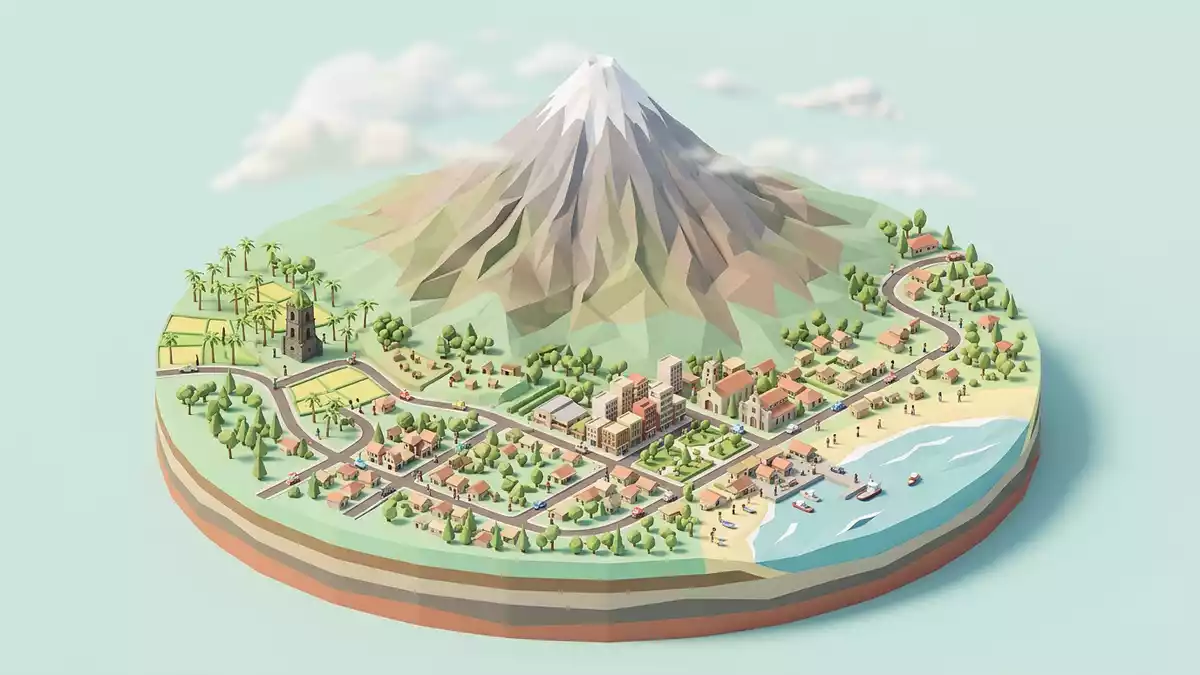
Bulkang Mayon, also known in English as Mayon Volcano, rises above the city of Legazpi in southern Luzon as an almost perfectly conical volcanic peak in the Philippines. Its near-symmetrical cone, climbing to about 2,462 m (8,077 ft) above sea level, dominates the landscape of Albay province and the wider Bicol Region.
An almost perfect volcanic cone in Albay
Bulkang Mayon stands in the province of Albay on the Bicol Peninsula of Luzon, with its slopes spreading towards the Albay Gulf and the lowland plains around Legazpi. The volcano forms the highest point in the province and is widely recognised as an active stratovolcano, part of the long chain of peaks that mark the Pacific Ring of Fire across the Philippines.Bulkang Mayon is an active volcano with a base that extends across the territories of several municipalities and cities around Albay Gulf.
The cone rises steeply from fields and coconut groves into a central peak that reaches roughly 2,462 m (8,077 ft), a height that makes it one of the most prominent landmarks on Luzon.The summit elevation is consistently given at just over 2,460 m in geological profiles and travel accounts. From Legazpi and neighbouring towns such as Daraga and Camalig, the volcano’s profile fills the skyline, with the upper slopes forming a sharply defined cone that is visible from many points along the coast.
A landscape shaped around an active stratovolcano
Geologically, Bulkang Mayon is classified as a stratovolcano, built from successive layers of lava, ash and other volcanic material that have accumulated over repeated eruptions.Volcanological catalogues describe it as the most active volcano in the Philippines, with a recorded history of eruptions stretching back several centuries. Over time, eruptions have sculpted deep gullies on its flanks and spread volcanic deposits across the surrounding plains.
The volcano stands within a protected area known as Mayon Volcano Natural Park, which covers several thousand hectares of slopes, ravines and forested zones around the cone.The natural park is listed on the UNESCO World Heritage tentative list as a natural site under Albay Province in the Bicol Region. Within this landscape, agricultural land, small settlements and patches of secondary forest extend towards the lower slopes, while higher elevations are marked by more barren surfaces shaped by recent flows and deposits.
Bulkang Mayon in culture and daily life
Beyond its geological profile, Bulkang Mayon carries a strong cultural presence for communities around Legazpi and across the Bicol Region. Local traditions and legends refer to the volcano in stories that link its almost regular cone to tales of love, conflict and transformation, and the mountain appears in paintings, crafts and regional symbols across Albay. Its silhouette is used in civic emblems and tourism promotion, underscoring how closely the volcano is tied to regional identity.A separate proposal describes the Mayon Volcano Cultural Landscape as a cultural property centred on the volcano and the communities around it, emphasising the long relationship between volcanic activity, agriculture and settlement patterns on its flanks.
Bulkang Mayon is also a focus for scientific monitoring and education. The Philippine Institute of Volcanology and Seismology, known as PHIVOLCS, maintains instruments and observatories that track seismic activity, gas emissions and ground deformation around the mountain.The volcano’s status as an active stratovolcano under continuous monitoring is a central feature of its profile. Information campaigns, signage and school materials in Albay explain volcanic hazards and preparedness, reflecting the way Bulkang Mayon influences both daily routines and long-term planning in the region.
Visiting Bulkang Mayon: what travellers from Western Europe should know
- Bulkang Mayon rises inland from the Albay Gulf in the province of Albay, with Legazpi on its southeastern flank and other towns such as Daraga and Camalig arranged around its lower slopes.
- The volcano forms a steep-sided cone, and approaches into the Mayon Volcano Natural Park involve uneven ground, loose volcanic rock and paths that can climb sharply over relatively short horizontal distances.
- The wider landscape around Bulkang Mayon combines farmland, small settlements and patches of forest, so walks near the lower slopes may alternate between village streets, cultivated fields and rougher volcanic terrain.
- The official language is Filipino and English is widely used; the currency is the Philippine peso.
- Entry requirements depend on your nationality; UK travellers can check the FCDO travel advice at gov.uk/foreign-travel-advice, Irish travellers the Department of Foreign Affairs at ireland.ie.
Searching for Bulkang Mayon on social platforms
These links open searches for Bulkang Mayon on each platform.
Frequently asked questions about Bulkang Mayon
Where is Bulkang Mayon located?
Bulkang Mayon is located in Albay province on the Bicol Peninsula of southern Luzon in the Philippines, with the city of Legazpi lying near its southeastern flank.
What should visitors expect when viewing Bulkang Mayon?
Visitors encounter a steep, near-symmetrical volcanic cone rising above farmland, towns and the Albay Gulf, with views that shift between coastal scenes and the mountain’s upper slopes.
What makes Bulkang Mayon distinctive among volcanoes?
Bulkang Mayon is distinctive for its almost regular conical profile, its status as an active stratovolcano and its close integration into the cultural and agricultural landscape around Legazpi.


