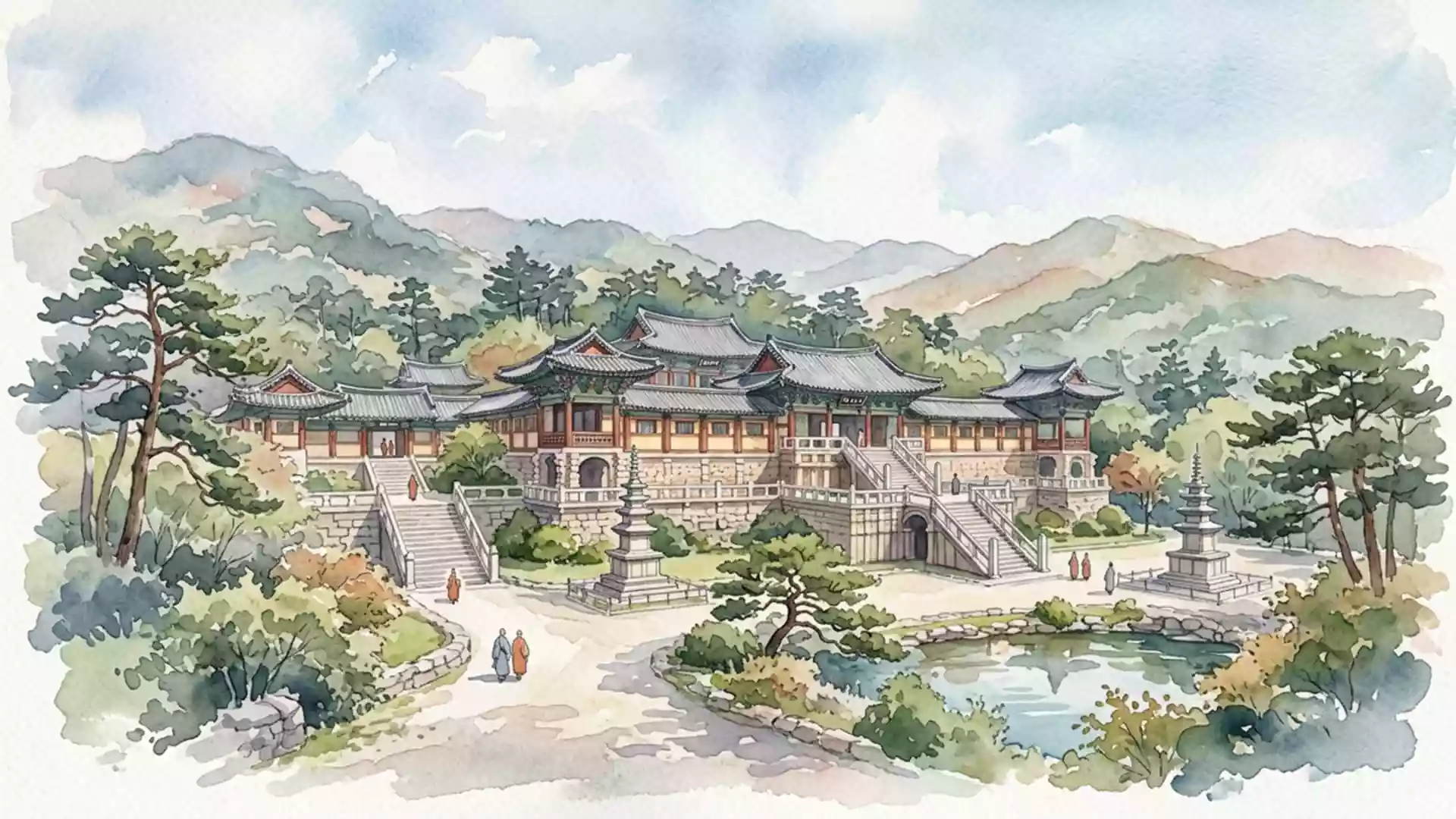
Bulguksa temple and terraces above Gyeongju
Published on 09/11/2026 at 14:52 | Editorial responsibility: Rafael Müller, Editor-in-Chief AD HOC NEWS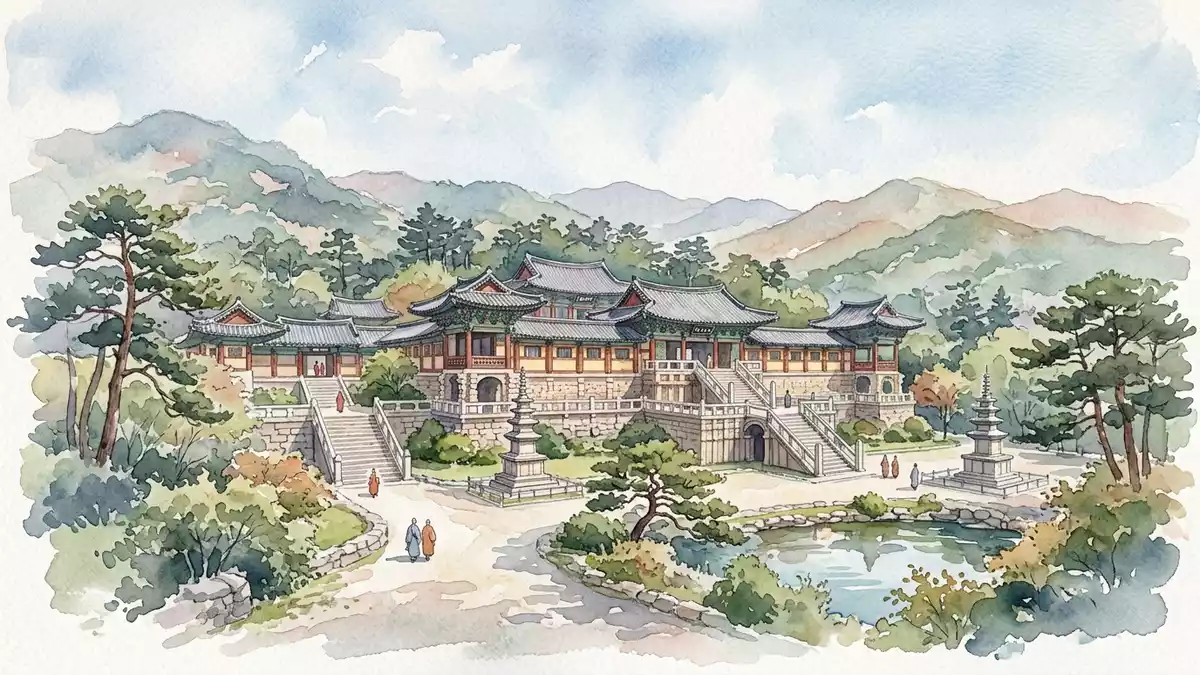
Bulguksa on the wooded slopes of Tohamsan near Gyeongju is a Buddhist temple complex where Silla-period stone terraces support wooden halls and stone pagodas.Bulguksa Temple is a representative relic of Buddhist culture from the Silla kingdom and forms part of a UNESCO World Heritage listing together with the nearby Seokguram Grotto.
Stone terraces and wooden halls on Tohamsan
Bulguksa stands on the slopes of Mount Tohamsan in Jinhyeon-dong, east of central Gyeongju in North Gyeongsang Province, where stone platforms step up the hillside and support a sequence of wooden buildings.Bulguksa is a Buddhist temple complex that comprises a series of wooden buildings on raised stone terraces and the complex is laid out as distinct precincts linked by stairways and bridges.
The temple is a head temple of the Jogye Order of Korean Buddhism and is associated with the Silla kingdom, whose capital was at Gyeongju.Bulguksa is a Buddhist temple on Tohamsan in Gyeongju and a head temple of the Jogye Order and sources attribute major rebuilding works in the eighth century to the Silla minister Kim Dae-seong.The chief architect of Bulguksa is traditionally credited as Kim Dae-seong in the Unified Silla kingdom
Pagodas, bridges and national treasures
Within Bulguksa’s courtyards, pairs of stone pagodas rise from broad plinths, with squared bases carrying the tiered upper sections associated with Korean Buddhist architecture of the Silla period.Bulguksa contains six National Treasures, including the Dabotap and Seokgatap stone pagodas and these pagodas stand in front of tiled-roof halls that house gilt-bronze Buddha statues.
The complex’s stone stairways and bridges form formal approaches to the main courtyards, including Cheongun-gyo, whose name is rendered in English as “Blue Cloud Bridge”, leading up from the lower gateway to the higher terrace.Bulguksa was added to the UNESCO World Heritage List in 1995 and the temple is also listed by the South Korean government as a historic and scenic site.
Silla-period origins and modern restoration
Accounts of Bulguksa’s history trace its origins to the Silla kingdom in the sixth century, with one tradition placing its founding in the reign of King Beopheung and further major works later in the eighth century under Kim Dae-seong.Bulguksa has about 1,400 years of history and sources describe founding in the Silla period and the temple’s present form reflects both these origins and extensive restoration campaigns carried out in the twentieth century.
The World Heritage listing Seokguram Grotto and Bulguksa Temple dates from 1995, recognising the temple and its nearby stone grotto as a religious architectural complex of particular significance for Korean Buddhism and for the history of the Silla capital region.The Temple of Bulguksa and the Seokguram Grotto form a religious architectural complex of exceptional significance
Visiting Bulguksa: what travellers from Western Europe should know
- Bulguksa lies on the slopes of Mount Tohamsan to the east of Gyeongju, reached by road from the city and standing within a wider landscape of wooded hills.
- Within the temple complex, stone stairways and stepped terraces link the levels, and reaching the higher courtyards involves climbing flights of steps.
- The temple is in South Korea, where the official language is Korean and the currency is the South Korean won.
- Seokguram Grotto, included in the same UNESCO World Heritage listing as Bulguksa, lies nearby on the same mountain and can be combined with a visit to the temple.
- Entry requirements depend on your nationality; UK travellers can check the FCDO travel advice at gov.uk/foreign-travel-advice, Irish travellers the Department of Foreign Affairs at ireland.ie.
Searching for Bulguksa on social platforms
These links open searches for Bulguksa on each platform.
Frequently asked questions about Bulguksa
Where is Bulguksa located?
Bulguksa is on the slopes of Mount Tohamsan in Jinhyeon-dong near Gyeongju in North Gyeongsang Province, in the south-east of South Korea.
What should visitors expect on a visit to Bulguksa?
Visitors walk through gateways, climb stone stairways between terraces and explore courtyards with wooden halls, stone pagodas and formal bridges set against a wooded mountain backdrop.
What makes Bulguksa distinctive among Korean temples?
Bulguksa combines Silla-period stone terraces, pagodas and wooden halls in a single complex and is recognised together with Seokguram Grotto as a UNESCO World Heritage site.