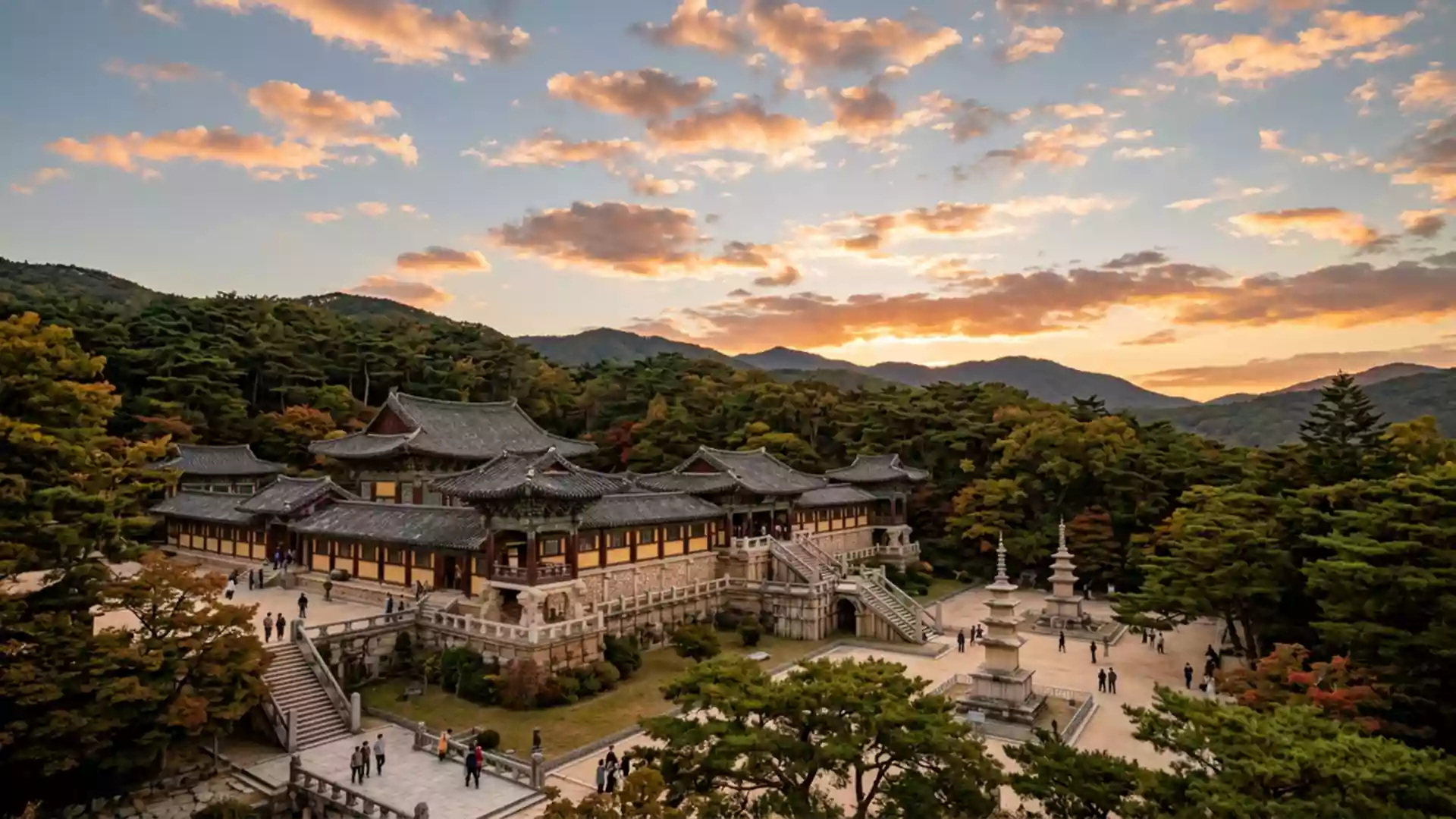
Bulguksa and its stone terraces above Gyeongju
Published on 09/09/2026 at 22:47 | Editorial responsibility: Rafael Müller, Editor-in-Chief AD HOC NEWS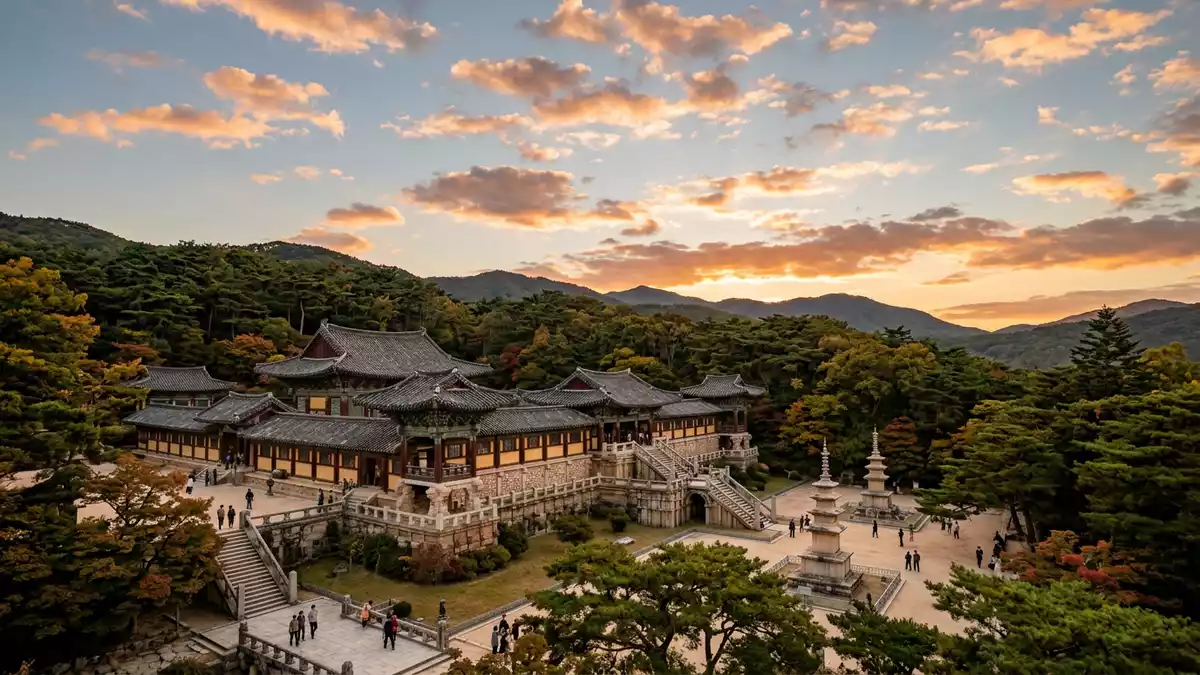
Bulguksa in Gyeongju is a Buddhist temple complex on the slopes of Tohamsan, where stone terraces carry wooden halls, pagodas and bridges that express Silla?period Buddhism in built form. Built under the Silla royal court and completed in 774, Bulguksa anchors the religious landscape of the former capital and forms a UNESCO World Heritage Site together with the nearby Seokguram Grotto.
Stone terraces and a hillside plan
Bulguksa stands on the western side of Mount Tohamsan, using a series of stone platforms to step the temple complex up the hillside above Gyeongju. The temple occupies Jinhyeon?dong in Gyeongju, in North Gyeongsang Province, placing it within the former heartland of the Silla kingdom.Buddhist temple on Tohamsan At Bulguksa the main wooden halls are raised on masonry, so that visitors move from courtyard to courtyard by climbing stone stairways between the terraces.
The overall layout divides the temple into distinct precincts, each set on its own level. The central group includes Daeungjeon, the Hall of Great Enlightenment, which holds an image of Shakyamuni Buddha and stands behind an elevated stone terrace entered by paired stairways. To one side lies Birojeon, the Vairocana Buddha Hall, while another group centres on Geungnakjeon, the Hall of Supreme Bliss, reflecting different realms of Buddhist teaching in physical zones of the complex.grounds divided into three areas
Silla heritage and later restoration
The origins of Bulguksa reach back to the reign of King Beopheung in the sixth century, when a temple was founded on the site as the Silla kingdom embraced Buddhism as a state religion.representative relic of Buddhist culture In 751 the Silla official Kim Dae?seong initiated a major rebuilding, and the temple complex in its developed form is linked to this project and to its later completion in 774 under royal patronage.completed in 774 by the Silla royal court These dates tie Bulguksa closely to the height of Silla power, when Gyeongju acted as the political and spiritual centre of the kingdom.
The wooden buildings seen at Bulguksa today have lived through damage and restoration. The temple suffered fires during the Imjin War of the 1590s, and for centuries after the conflict the complex stood in a damaged state, with structures decaying and its treasures exposed to theft.caught fire during the Imjin War Systematic restoration began in 1920 and continued through the twentieth century, including major works in the 1960s and 1970s that rebuilt halls and reinforced the stone terraces, consolidating Bulguksa as both an active temple and a historic site.
Pagodas, bridges and national treasures
Bulguksa is renowned for its stone pagodas and stairways, several of which are designated National Treasures of South Korea. In the main courtyard in front of Daeungjeon stand the paired pagodas Dabotap and Seokgatap, set on the same terrace but differing strikingly in form and detail.Dabotap Pagoda and Seokgatap Pagoda Dabotap shows an elaborate, multi?tiered composition with decorative stone railings and balustrades, while Seokgatap follows a simpler three?storey profile characteristic of Korean stone pagodas. Both are around ten metres tall and face each other between the main hall and the gateway, creating a stone axis at the centre of the temple.
Approaching the core of Bulguksa, visitors cross celebrated stone bridges that climb from the lower courtyard up to the central terrace. Cheongun?gyo, the Blue Cloud Bridge, and Baegun?gyo, the White Cloud Bridge, rise in sequence beneath an arched stairway leading to Jahamun Gate, connecting the earthly level with the higher precinct of Daeungjeon. These structures, together with the pagodas and gilt?bronze Buddha statues, account for several of the temple’s recognised National Treasures and demonstrate the stone craftsmanship of the Silla period.houses six National Treasures including Dabotap Bulguksa has been classified as Historic and Scenic Site No. 1 within South Korea and carries seven national treasures in total, underscoring its importance in Korean Buddhist architecture.temple now holds seven national treasures
Visiting Bulguksa: what travellers from Western Europe should know
- Bulguksa lies south?east of central Gyeongju on the slopes of Tohamsan in Jinhyeon?dong, reached by road and local buses from Gyeongju bus terminals.
- The temple complex rises on stone terraces with stairways and bridges between levels, so a visit involves walking up sets of steps and moving across uneven stone surfaces.
- Seokguram Grotto, sharing the same UNESCO World Heritage inscription as Bulguksa, sits higher on Tohamsan and is accessible from the temple area by road and walking paths.
- The official language is Korean and the currency is the South Korean won.
- Entry requirements depend on your nationality; UK travellers can check the FCDO travel advice at gov.uk/foreign-travel-advice, Irish travellers the Department of Foreign Affairs at ireland.ie.
Searching for Bulguksa on social platforms
These links open searches for Bulguksa on each platform.Frequently asked questions about Bulguksa
Where is Bulguksa located?
Bulguksa stands in Jinhyeon?dong on the slopes of Mount Tohamsan, south?east of central Gyeongju in North Gyeongsang Province, South Korea.
What should visitors expect at Bulguksa?
Visitors encounter a hillside temple complex with stone terraces, stairways, wooden halls, pagodas, bridges and courtyards that together form an active Buddhist site and historic monument.
What makes Bulguksa distinctive among Korean temples?
Bulguksa is distinctive for its Silla?period stone pagodas, cloud bridges, multiple Buddha halls and its joint UNESCO World Heritage status with Seokguram Grotto.