
Buckingham Palace, London’s working royal residence
Published on 09/16/2026 at 16:00 | Editorial responsibility: Rafael Müller, Editor-in-Chief AD HOC NEWS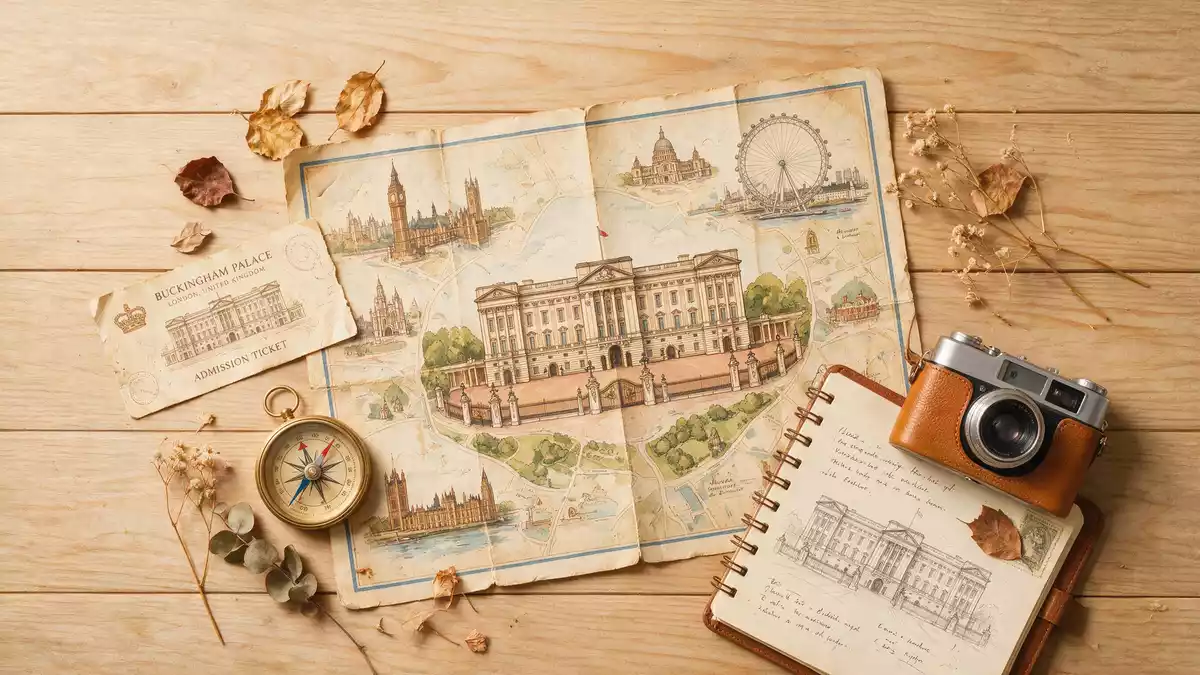
Buckingham Palace in Westminster is both a royal residence and the administrative headquarters of the monarch of the United Kingdom, a rare combination of home, office and ceremonial stage in one complex. The building developed from an eighteenth-century townhouse into a palace under George IV and later architects, and has served as the principal London residence of Britain’s sovereigns since the reign of Queen Victoria in 1837.
From Buckingham House to royal palace
The story of Buckingham Palace begins with Buckingham House, a large private residence built in the early eighteenth century for John Sheffield, 1st Duke of Buckingham and Normanby, on a site that had previously held Arlington House.Buckingham House in 1703 The original house was a substantial townhouse rather than a palace, laid out with a central block and flanking wings and set within formal grounds on the western edge of St James’s Park. In 1761 George III purchased the property for Queen Charlotte as a private family residence, and for decades it was known as “The Queen’s House”, distinct from the official court at St James’s Palace.
The decisive shift from house to palace came under George III’s son George IV in the 1820s, when he commissioned John Nash, then Official Architect to the Office of Woods and Forests, to enlarge and remodel the building.John Nash’s expansion work Nash retained the core of Buckingham House but extended it into a grand U-shaped layout around a forecourt, creating new state rooms and a more imposing presence facing towards St James’s Park. After Nash’s dismissal in 1830, Edward Blore took over the project and continued the transformation, preparing the complex that would later serve as the monarch’s London seat.
A Victorian court and a twentieth-century façade
Buckingham Palace became the official seat of the court when the eighteen-year-old Queen Victoria moved in shortly after her accession in 1837, making her the first British sovereign to rule from the palace as a primary London residence.Queen Victoria’s move in 1837 This change fixed Buckingham Palace’s role at the centre of royal ceremonial life, shifting the focus away from St James’s Palace and embedding the building into the rhythms of coronations, investitures and diplomatic receptions. During Victoria’s reign the palace also acquired additional wings and interiors, including grand ballrooms and galleries suited to large gatherings.
The familiar façade facing The Mall and the Victoria Memorial owes much to later work in the nineteenth and early twentieth centuries. Blore extended the east side and enclosed the forecourt, while Sir Aston Webb reworked the outward face in the early 1900s, giving the palace the pale Portland stone east front recognised in countless images.Aston Webb’s Portland stone front Behind this frontage lies a quadrangular plan, with ranges of state rooms and private apartments arranged around a central courtyard, and ceremonial focus on the central balcony above the principal entrance.
A working residence in Westminster
Buckingham Palace stands within the City of Westminster, with St James’s Park and Green Park bordering its grounds, and has long been described as the monarch’s official London residence and working headquarters.Official London residence and headquarters The complex contains state rooms used for formal occasions, royal and guest bedrooms, staff accommodation and offices, all arranged within a building that is over 100 m (328 ft) across the main frontage and more than 20 m (65 ft) high. The layout reflects its dual role: processional spaces for ceremonial functions, alongside working areas where the administrative side of the monarchy is conducted.
The palace forms one point in a wider ceremonial landscape in central London. To its east runs The Mall towards Admiralty Arch and Trafalgar Square; to its west lie residential streets and royal mews; and to its north and south the green spaces of the royal parks frame views of the building. The Victoria Memorial and the open space before the east front act as a forecourt and gathering area, with the palace’s façade as a backdrop to formal events and public appearances.
Visiting Buckingham Palace: what travellers from Western Europe should know
- Buckingham Palace stands in Westminster, west of Trafalgar Square, and is reached by London Underground services to nearby stations such as Green Park and St James’s Park, as well as by city bus routes.
- The area around the palace includes broad ceremonial avenues and paved spaces, with level approaches from The Mall and adjacent parks, and barriers and railings defining the forecourt and perimeter.
- St James’s Park lies directly to the east and Green Park to the north, so a visit to the palace combines easily with walks through these royal parks and views towards other nearby landmarks.
- The official language in the United Kingdom is English and the currency is the pound sterling.
Searching for Buckingham Palace on social platforms
These links open searches for Buckingham Palace on each platform.
Frequently asked questions about Buckingham Palace
Where is Buckingham Palace located in London?
Buckingham Palace is situated in the City of Westminster, with St James’s Park and Green Park bordering its grounds and The Mall running from its main east front towards central London.
What can visitors expect when they go to Buckingham Palace?
Visitors encounter a large Portland stone-fronted palace with a formal forecourt, views towards the Victoria Memorial and The Mall, and immediate access to surrounding royal parks and ceremonial streets.
What makes Buckingham Palace distinctive among royal residences?
Buckingham Palace is distinctive because it serves simultaneously as the monarch’s official London residence and administrative headquarters, combining state rooms, private apartments and offices within a single historic complex.


