
Buckingham Palace and the long shape of royal London
Published on 09/01/2026 at 14:28 | Editorial responsibility: Rafael Müller, Editor-in-Chief AD HOC NEWS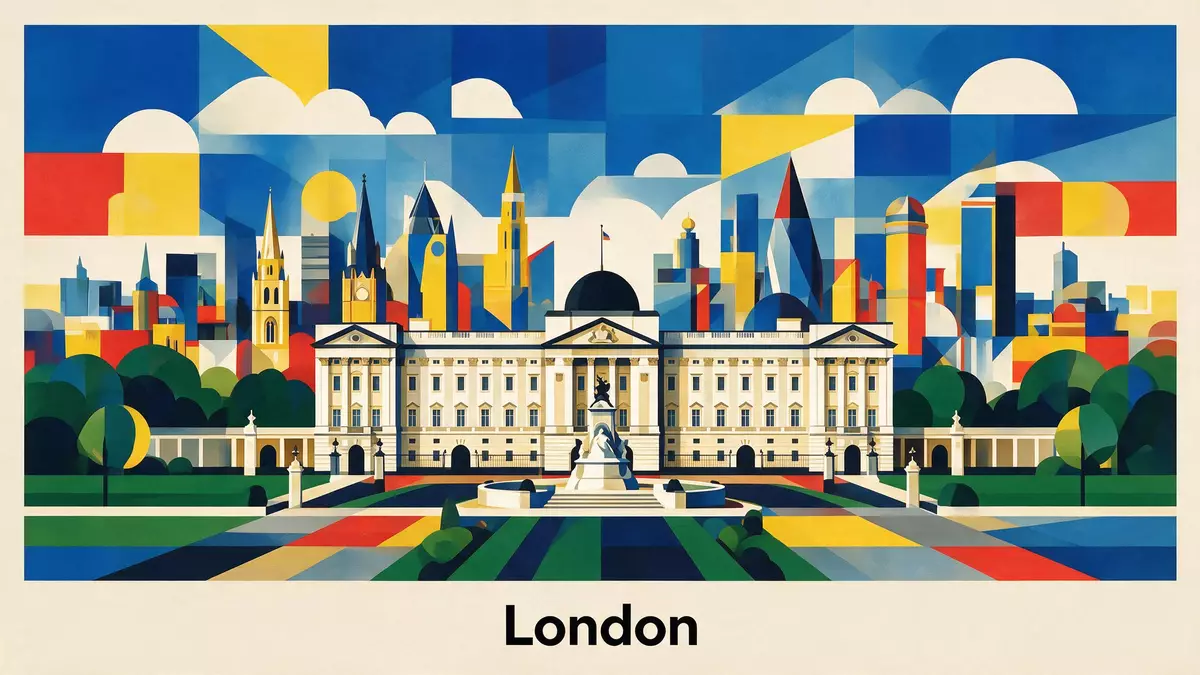
Buckingham Palace is London’s royal residence of formal fronts, long façades and layered expansion. Its core began as Buckingham House in 1703, commissioned for John Sheffield, the 1st Duke of Buckingham and Normanby, and the palace later became tied to George III and Queen Victoria.
Buckingham House to royal palace
The building’s story is visible in its mixed fabric and its sequence of additions. George III bought the house in 1761 for Queen Charlotte, and John Nash and Edward Blore later enlarged it into a palace around a central courtyard.
The west front, east front and garden side belong to different phases of that development, rather than a single building campaign. That layered composition is part of its character, and the palace remains the official London residence of the British sovereign.
The façade and the court
The palace presents a long stone front to The Mall and a deeper body behind it. Royal information gives its front at 108 metres, its depth at 120 metres including the central quadrangle, and its height at 24 metres.
That scale sits within a neoclassical framework associated with John Nash, Edward Blore and later Aston Webb. The present east front dates from Webb’s 1913 redesign, while the central mass preserves the nineteenth-century royal house at its core.
Rooms, uses and royal display
Buckingham Palace remains a working royal building as well as a ceremonial one. It serves as the administrative headquarters of the monarch, and its state spaces are used for official receptions and public-facing display.
The Royal Collection is closely linked with the palace through the rooms and galleries associated with it, including the King’s Gallery. That connection ties the palace to painting, furniture, decorative arts and ceremonial objects gathered by successive monarchs.
Visiting Buckingham Palace: what travellers from Western Europe should know
- The palace stands in the City of Westminster, near The Mall and Green Park. Green Park station and Hyde Park Corner station are the nearest Tube stations for many visitors.
- The building is large and formal, with broad fronts rather than a compact house plan. Its main façades are stone-faced and arranged around the central quadrangle.
- The official London role of the palace sits alongside its ceremonial function. State Rooms, the East Front and the King’s Gallery form the best-known public-facing parts.
- The surrounding area includes Westminster, St James’s Park and the ceremonial route of The Mall. Those names help place the palace within central London’s royal landscape.
Searching for Buckingham Palace on social platforms
These links open searches for Buckingham Palace on each platform.
Frequently asked questions about Buckingham Palace
Where is Buckingham Palace?
It stands in the City of Westminster in central London, close to The Mall and Green Park. The palace is part of the ceremonial core of the city.
What does a visit involve?
The palace is a large royal building with state rooms, a formal east front and gallery spaces linked to the Royal Collection. Its public role is inseparable from its working court role.
What makes it distinctive?
Its identity lies in the mix of Georgian beginnings, nineteenth-century enlargement and the later east front. Few London buildings combine that history with such an explicit royal function.


