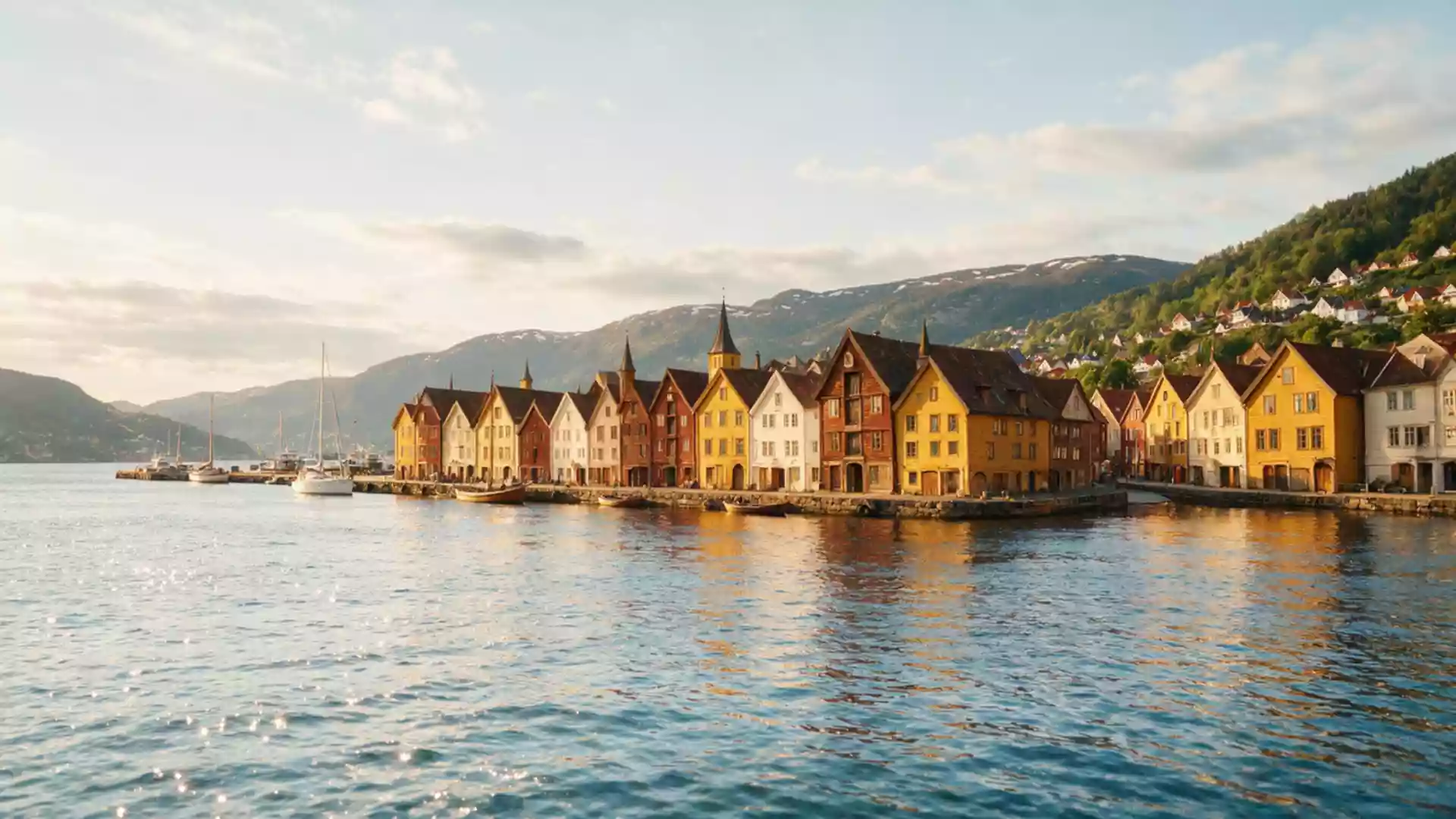
Bryggen’s wooden wharf quarter on Bergen’s Vågen harbour
Published on 08/13/2026 at 14:02 | Editorial responsibility: Rafael Müller, Editor-in-Chief AD HOC NEWS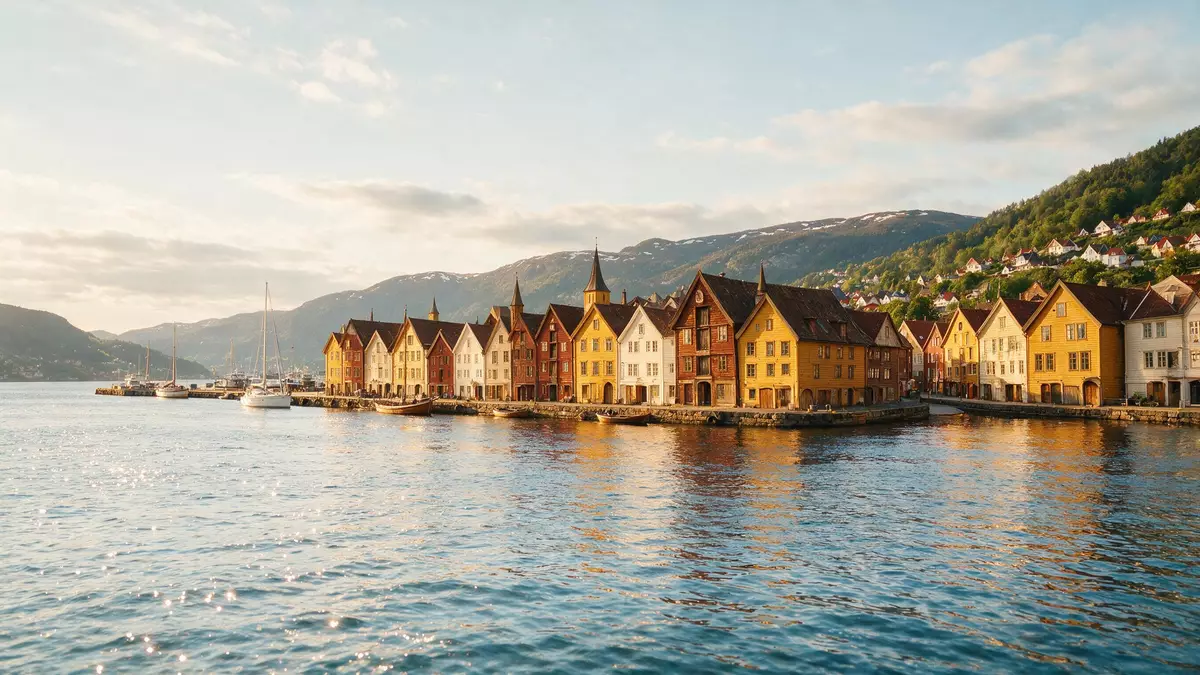
Bryggen in Bergen is a historic wooden wharf quarter along the eastern side of the Vågen harbour, where rows of pointed timber houses still follow a medieval street plan on Norway’s west coast.
Bryggen as a Hanseatic trading quarter
Bryggen forms a distinct harbour-front district in Bergen, built in closely packed timber rows facing the Vågen and backed by inner yards and lanes used for trade and storage. The area became a centre of long-distance commerce when Bergen emerged as a major port in the twelfth century, with overseas merchants joining local traders at the quayside.historic harbour district In 1360 the Hanseatic League established a kontor, a formal overseas office, at Bryggen, turning this part of the city into a structured merchant quarter linked to other Hanseatic centres on the Baltic and in Northern Germany.kontor of the Hanseatic League
German merchants at Bryggen specialised in the export of stockfish, dried cod from northern Norway, and imported grain and other goods in return, using the wharf houses as warehouses, offices and lodgings. The quarters were organised in a way that separated commercial and domestic spaces, with open ground-floor areas for goods and upper levels for work and accommodation. Bryggen’s fabric therefore records both maritime trade and the daily life of a merchant colony integrated into Bergen yet distinct in its customs and organisation.Hanseatic merchant quarter
Timber architecture shaped by fire and rebuilding
The buildings of Bryggen are predominantly wooden, with rows of narrow, gabled houses facing the harbour and deeper structures stretching inland, many standing over older stone cellars that offered some protection against fire.old timber buildings and stone cellars The current appearance of the quarter largely dates from rebuilding after a major fire in 1702, when Bergen’s waterfront burned and the wharf houses were reconstructed in similar forms, keeping the traditional pattern of narrow frontages and timber frames.rebuilt after the fire in 1702 Later fires damaged parts of Bryggen, but the overall layout has remained recognisable, with linked ranges and long passages behind the street front.
The quarter covers a compact area of around 1.2 hectares and contains dozens of protected buildings, with timber elevations standing on historic foundations and framing corridors between the rows.area and protected buildings Within the block, warehouses and smaller houses share similar construction, using painted or tarred boards and simple detailing that emphasises the rhythm of fronts along the harbour. The surviving structures and their alignment allow visitors to see how storage lofts, offices and meeting rooms were accommodated above and behind the harbour-facing fronts, while the stone spaces below recall the need to protect goods and documents from repeated fires.
World Heritage status and the memory of trade
Bryggen was inscribed on the UNESCO World Heritage List in 1979 under cultural criterion (iii), reflecting its status as a preserved Hanseatic merchant quarter that carries clear traces of social organisation and spatial use from the fourteenth century.inscribed on the UNESCO list in 1979 It was one of the first Norwegian sites to join the list and is recorded as number 59 among the early inscriptions, marking its international recognition as a place where wooden commercial architecture and the memory of a trading culture have survived in the centre of a living port city.Norwegian World Heritage site
The protected area includes the wharf itself, the ranges stretching back towards Øvregaten and important heritage institutions such as the Hanseatic Museum and Bryggens Museum, where archaeological remains and interiors present aspects of the merchant quarter over many centuries.world heritage area of Bryggen Bryggen is described as a northern “fondaco”, a type of combined warehouse and lodging complex known from Mediterranean trading cities, and its survival in Bergen offers an example adapted to the climate and timber-building traditions of Norway.northern fondaco Visitors walking through the harbour-front and inner passages encounter a continuous line of wooden ranges that, despite repeated fires and changes in use, still reflect Bryggen’s role in the development of Bergen as a major port of Northern Europe.
Visiting Bryggen: what travellers from Western Europe should know
- Bryggen lines the eastern side of the Vågen harbour in central Bergen, directly opposite the city’s modern quays and within easy reach of the main railway station and ferry terminals.
- The inner lanes and yards between the timber rows are narrow and stepped in places, with uneven surfaces and low doorways that reflect the historic construction.
- On the west coast of Norway, Bryggen stands close to other central sights in Bergen, including the Hanseatic Museum and the waterfront around the Fish Market.
- The official language is Norwegian and the currency is the Norwegian krone.
- Entry requirements depend on your nationality; UK travellers can check the FCDO travel advice at gov.uk/foreign-travel-advice, Irish travellers the Department of Foreign Affairs at ireland.ie.
Searching for Bryggen on social platforms
These links open searches for Bryggen on each platform.Frequently asked questions about Bryggen
Where is Bryggen located?
Bryggen is in central Bergen on Norway’s west coast, lining the eastern side of the Vågen harbour in the historic core of the city.
What should visitors expect when walking through Bryggen?
Visitors encounter narrow timber-fronted lanes, inner yards and old warehouses arranged in rows, with uneven floors and close-packed buildings that reflect centuries of maritime trade.
What makes Bryggen distinctive among harbour districts?
Bryggen combines a preserved Hanseatic merchant quarter, wooden wharf architecture rebuilt after the 1702 fire and recognition as a UNESCO World Heritage site dating from 1979.