
Bryggen’s wooden wharf quarter in Bergen
Published on 09/15/2026 at 12:46 | Editorial responsibility: Rafael Müller, Editor-in-Chief AD HOC NEWS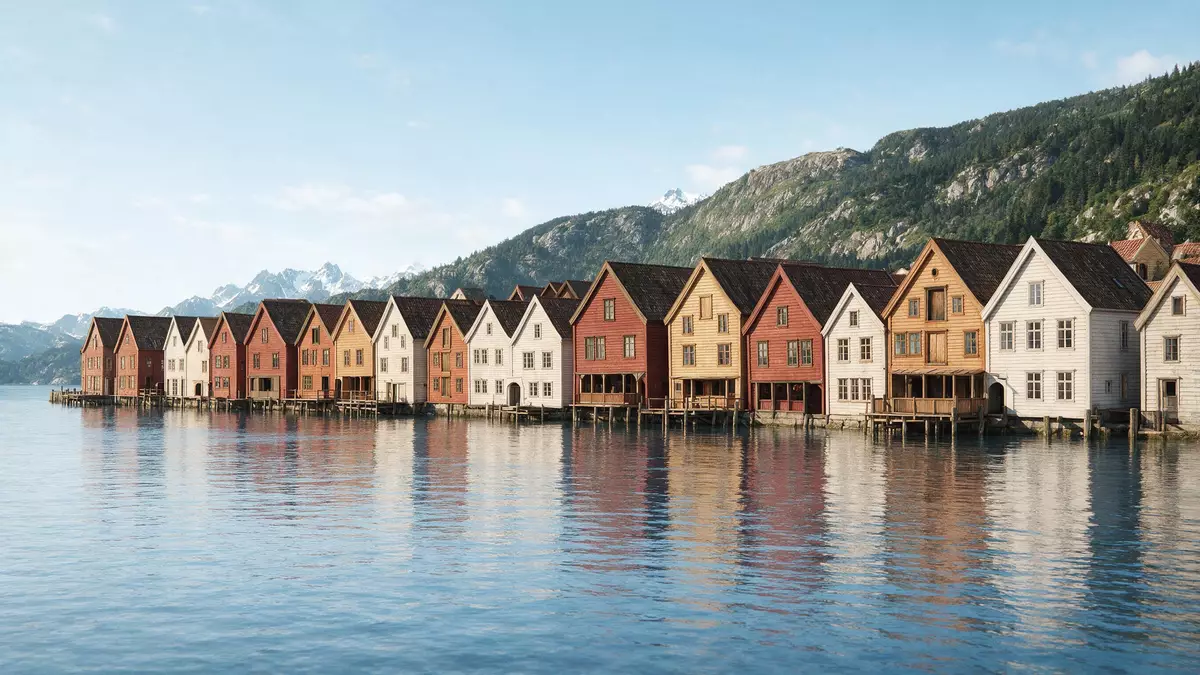
On the eastern side of Bergen’s Vågen harbour, Bryggen forms a dense run of timber buildings that still reads as a medieval trading quarter on the water’s edge. Recognised as a UNESCO World Heritage Site since 1979, it preserves the structure of a Hanseatic wharf in Norway’s second city and keeps Bergen’s long history as a North European port visible in wood and stone.
Timber facades on the Vågen harbour
Bryggen runs along the inner curve of the Vågen, the natural harbour that anchors Bergen on Norway’s Atlantic coast. The district is built in rows of wooden houses and warehouses standing tight together, their narrow fronts facing the water and their longer sides stretching back towards Øvregaten and the foot of the hill behind. This run of timber structures has become one of the defining images of Bergen as a harbour city, with gabled rooflines stepping along the quay and a band of colour marking the edge between water and land.rows of wooden houses Inside the line of facades, a network of passageways runs between the buildings, forming long, narrow lanes where the timber construction is exposed and the wharf’s depth can be felt.
These buildings sit on a narrow strip of ground between the harbour and the rising terrain of Bergen, so the quarter reads as a band of wharf houses squeezed between water and hillside. Many structures carry visible timber frames and cladding, and the overall impression is of a wooden urban fabric rather than isolated historic monuments. The wharf houses are arranged in clusters that reveal the way plots were laid out for trading operations, with front rooms towards the quay, storage spaces further back and enclosed yards in the interior of the block.
A Hanseatic merchants’ quarter
Bryggen’s significance lies in its role as the overseas trading quarter of the Hanseatic League, the network of German and Baltic merchant cities that dominated stockfish trade across Northern Europe from the fourteenth century onwards. From the fourteenth to the mid sixteenth century, Bergen hosted a Hanseatic kontor, or office, and Bryggen formed the core of this enclave, with warehouses, counting houses and living quarters grouped around its lanes.the old wharf of Bergen The merchants dealt mainly in dried cod from northern Norway and brought in grain, malt and other goods from ports around the Baltic and the North Sea.
Norway’s Atlantic fisheries and the Hanseatic trading network meet physically in Bryggen’s timber buildings, where stockfish and other commodities moved through the same narrow passages that visitors can walk today. The Hanseatic presence in Bergen began after the city had already grown into a major port, and Bryggen came to concentrate trading power in one quarter. The wooden wharf houses therefore embody both local Norwegian settlement patterns and the influence of Lübeck and other German cities whose merchants operated here.a Hanseatic Office in Bergen That combination of Norwegian harbour setting and Hanseatic mercantile organisation gives Bryggen its specific character among port districts.
World Heritage recognition and surviving structure
Bryggen’s World Heritage inscription in 1979 places it among the early cultural sites recognised under the UNESCO Convention and defines the district as the only remaining part of a Hanseatic overseas office.Bryggen on the World Heritage List The listing stresses how the quarter bears traces of the social organisation of the merchants and illustrates their use of space, with plots and buildings laid out for trading purposes. Fires have repeatedly damaged Bryggen’s wooden houses, but the main structure of the quarter has been kept, and rebuilding has followed the established pattern so that the medieval plot system remains legible.
The World Heritage area centres on the timber wharf itself and includes Finnegården and associated yards backing onto Øvregaten, as well as the Hanseatic Museum housed in one of the former trading buildings.the world heritage site Bryggen Within this defined area, the surviving urban fabric shows how warehouses, offices and domestic rooms were organised in depth from quay to street. Walking through Bryggen today, the sequence from harbour front to interior yard passes through spaces that still reflect that layered use. For visitors, this means that Bryggen can be experienced as a three-dimensional historic structure rather than simply as a waterfront backdrop.
Visiting Bryggen: what travellers from Western Europe should know
- Bryggen lines the eastern side of the Vågen harbour in Bergen, on Norway’s west coast, and is reached on foot from the central streets and quays.
- The quarter consists of closely spaced timber buildings linked by narrow passageways and uneven wooden surfaces, so moving through the lanes involves short flights of steps and changes of level.
- The official language is Norwegian and the currency is the Norwegian krone.
- Entry requirements depend on your nationality; UK travellers can check the FCDO travel advice at gov.uk/foreign-travel-advice, Irish travellers the Department of Foreign Affairs at ireland.ie.
Searching for Bryggen on social platforms
These links open searches for Bryggen on each platform.
Frequently asked questions about Bryggen
Where is Bryggen?
Bryggen is a historic timber wharf district on the eastern side of the Vågen harbour in Bergen, on Norway’s west coast.
What can visitors expect on a visit to Bryggen?
Visitors encounter rows of wooden wharf houses, narrow passageways running between them and interiors that reveal the depth of the historic trading quarter.
What makes Bryggen distinctive among harbour districts?
Bryggen is distinctive because it preserves the structure of a Hanseatic merchants’ quarter in timber and is recognised as a UNESCO World Heritage Site for that surviving urban form.


