
Brooklyn Bridge and the stone span that reshaped New York
Published on 09/03/2026 at 16:53 | Editorial responsibility: Rafael Müller, Editor-in-Chief AD HOC NEWS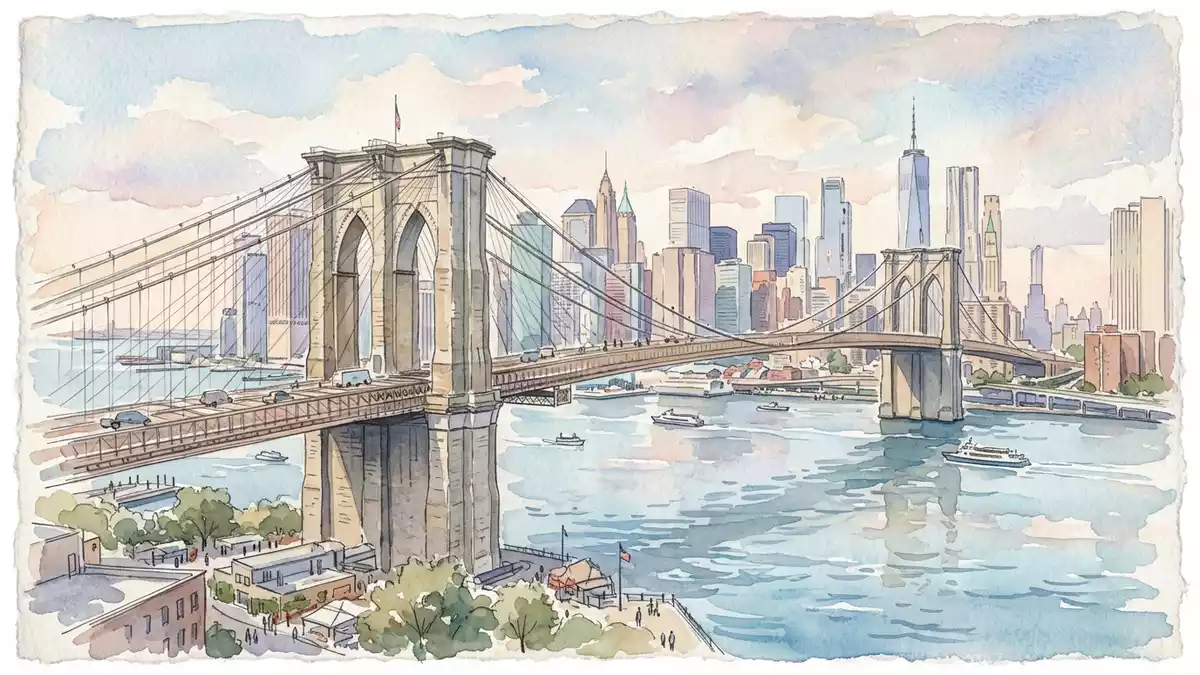
Brooklyn Bridge carries road traffic and a raised promenade of walkers across the East River between Manhattan and Brooklyn, its granite towers and steel cables forming one of New York City’s most recognisable profiles. Completed in 1883 from a design by engineer John Augustus Roebling, it linked the then separate cities of New York and Brooklyn with a single suspension span that was record-breaking in its day.Completed in 1883
A stone and steel crossing of the East River
The crossing that New York now knows as Brooklyn Bridge spans the East River with a suspension structure supported by two massive masonry towers, carrying traffic between Lower Manhattan and the Brooklyn waterfront.Spans New York's East River When it opened on 24 May 1883, its main suspended span between the towers measured about 486 m (1,595 ft), a distance that made it the longest suspension bridge in the world at the time.1,595.5 ft main span That span still defines the bridge’s visual character, a long sweep of steel cables and deck stretching above the river surface.
The towers that hold the suspension cables rise more than 80 m (over 270 ft) above mean high water, built from granite and limestone with characteristic pointed arches and heavy stone piers.Granite towers over 270 ft At deck level, the structural layout is straightforward to read: outer roadways for vehicles, steel trusses supporting the deck, and a timber and concrete walkway raised above the carriageways that gives pedestrians and cyclists a clear view along the line of the bridge and down into the East River.
Engineering ambition in the late nineteenth century
The concept and structural design for Brooklyn Bridge were developed by German-born engineer John Augustus Roebling, who had already created major suspension bridges at Pittsburgh and over the Niagara River.Designed by John A. Roebling Construction began in 1869 and continued for around fourteen years, passing into the hands of Washington Roebling after his father’s death and involving complex foundation work with caissons sunk deep into the riverbed to support the tower bases.Construction began in 1869
The finished structure combined steel-wire suspension cables with substantial stone towers, creating a hybrid that set a new benchmark in bridge engineering. The four main suspension cables are made from thousands of individual steel wires laid together, each cable sweeping over the tops of the towers before dropping to anchorages on either shore.First steel-wire suspension bridge As built, the total length of the crossing from end to end approaches 1,825 m (5,989 ft), a figure that includes the approach viaducts and masonry spans that lead from the urban streets up to the suspended central deck.Total length 5,989 ft
Movement, views and city fabric on the deck
On the deck of Brooklyn Bridge, movement is layered. The vehicle lanes occupy the outer parts of the structural width, with cars and other traffic crossing between Manhattan and Brooklyn. Above and between them runs the timber-decked promenade, giving walkers an uninterrupted route along the centre of the bridge and placing them between lines of suspension cables that narrow towards the towers. From this walkway, views open out to the low-rise waterfronts of Brooklyn, the dense cluster of towers in Lower Manhattan and the broader harbour beyond.
The bridge functions not only as a piece of transport infrastructure but also as a public space. The promenade draws people who cross simply to experience the span, pausing near the centre to look upriver towards other East River crossings or downriver towards the harbour. The stone towers frame those views, their arches acting as a kind of gateway between two boroughs that were independent cities when the bridge opened in the nineteenth century.Connected Manhattan and Brooklyn
Visiting Brooklyn Bridge: what travellers from Western Europe should know
- Brooklyn Bridge crosses the East River between Lower Manhattan and the Brooklyn waterfront in New York City and can be reached on foot from both boroughs.
- The elevated promenade is accessed by ramps and stairways and involves walking on a timber and concrete deck exposed to weather and wind.
- Subway stations in Lower Manhattan and eastern Brooklyn lie within walking distance of the bridge’s approaches, making it accessible by New York City’s rail network.
- The official language is English and the currency is the United States dollar.
- Entry requirements depend on your nationality; UK travellers can check the FCDO travel advice at gov.uk/foreign-travel-advice, Irish travellers the Department of Foreign Affairs at ireland.ie.
Searching for Brooklyn Bridge on social platforms
These links open searches for Brooklyn Bridge on each platform.Frequently asked questions about Brooklyn Bridge
Where is Brooklyn Bridge in New York City?
Brooklyn Bridge crosses the East River between Lower Manhattan and the Brooklyn waterfront, linking the boroughs of Manhattan and Brooklyn.
What can visitors expect when walking across the bridge?
Visitors cross on an elevated promenade above the carriageways, sharing the route with other walkers and cyclists and experiencing open views of the river and skyline.
What makes Brooklyn Bridge distinctive among New York’s bridges?
The combination of granite towers, steel suspension cables and the long nineteenth-century main span gives Brooklyn Bridge a recognisable profile and a prominent role in the city’s transport network.


