
Brandenburger Tor, Berlin’s neoclassical city gate
Published on 09/14/2026 at 22:36 | Editorial responsibility: Rafael Müller, Editor-in-Chief AD HOC NEWS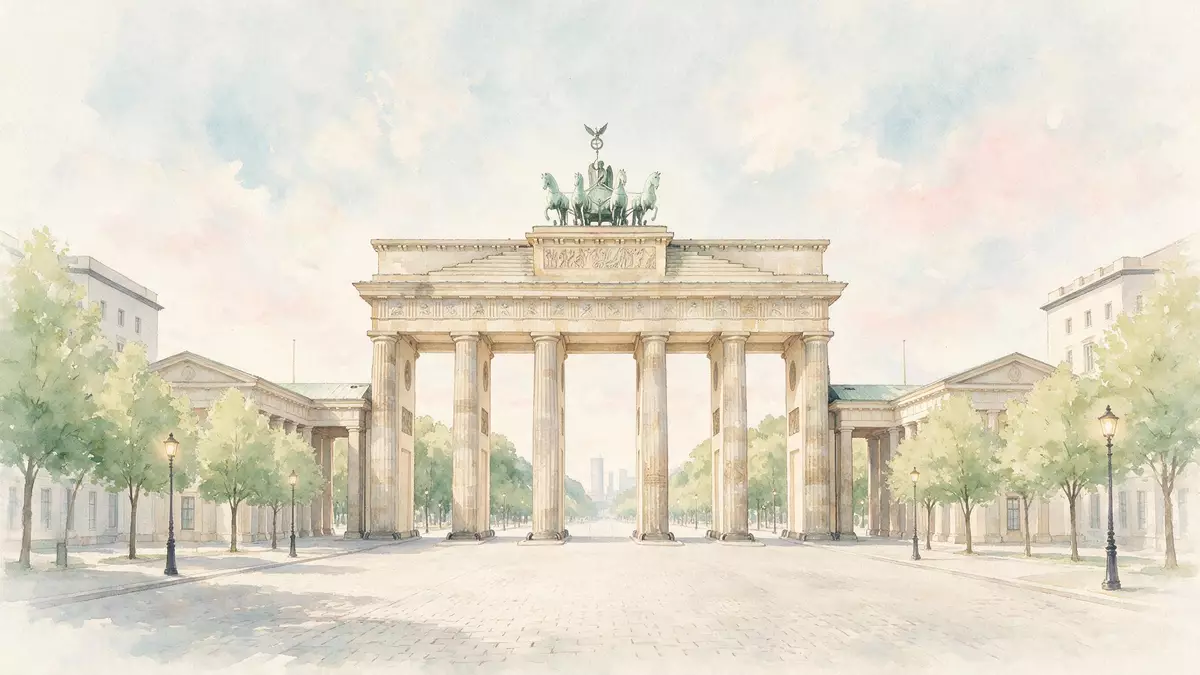
Brandenburger Tor in Berlin is an eighteenth?century neoclassical city gate, a sandstone colonnade marking the western end of Unter den Linden and opening towards Pariser Platz.
A Greek?inspired gate at the edge of old Berlin
Brandenburger Tor stands on the eastern side of Pariser Platz in the Mitte district, forming a monumental threshold between the historic boulevard Unter den Linden and the open square beyond. The gate belongs to the era when Berlin was the residential city of the Kingdom of Prussia, and its form reflects the turn towards classical antiquity in Prussian architecture of the late eighteenth century. Commissioned by King Frederick William II of Prussia, the present structure was built in the late 1780s and early 1790s, replacing an earlier, simpler gate on the same route towards Brandenburg an der Havel.commissioned by Frederick William II Architect Carl Gotthard Langhans designed the gate as a sober, carefully proportioned screen of stone, taking the Propylaea on the Acropolis in Athens as a direct model for its temple?like composition.strongly inspired by the Propylaea
The structure is built of sandstone and organised as a broad colonnade with twelve Doric columns, arranged in two parallel rows that create five passageways through the wall of stone.twelve Doric columns In plan, the gate forms a shallow rectangle, with projecting pylons at each side framing the central body of columns. Measured along its main frontage, Brandenburger Tor is about 65 m (213 ft) wide, rising to around 26 m (85 ft) at the top of the entablature, and extending roughly 11 m (36 ft) in depth between the city side and the square side.65.5 metres long and 26 metres high The Doric order appears in simplified form, with fluted shafts and plain capitals supporting a heavy entablature decorated by friezes and reliefs. The overall effect is of a classical gateway translated into an urban screen, tying Berlin visually to the architectural language of ancient Greece.
The Quadriga above the columns
Crowning the roof of Brandenburger Tor is a sculpted chariot known as the Quadriga, a four?horse vehicle driven by a standing figure and aligned with the central passage below. The copper Quadriga was added a few years after the completion of the gate, in the early 1790s, and is attributed to sculptor Johann Gottfried Schadow.Quadriga statue It stands on a low plinth above the cornice, its wheels and horses picked out against the sky, and gives the flat top of the gate a dynamic, directional accent. In its original design the figure in the chariot represented a classical goddess carrying a symbol of peace, in keeping with the neo?classical vocabulary below.quadriga depicting the goddess of victory bearing a symbol of peace
The sculptural programme of the gate continues down the facades. Reliefs and panels set between the columns and along the entablature depict scenes from classical mythology and allegorical figures associated with Prussia. Many of the reliefs relate to the exploits of Heracles, a favourite subject in late eighteenth?century Berlin sculpture.reliefs based on the exploits of Heracles The combination of the Doric colonnade with narrative sculpture and the Quadriga above creates a layered composition in which architectural, sculptural and urban elements work together. Seen from Unter den Linden, the Quadriga appears framed by the columns, emphasising the central passage; from Pariser Platz, the full breadth of the colonnade and the chariot above form a backdrop to the square.
From city gate to free?standing monument
When Brandenburger Tor was built in the late eighteenth century, it formed part of Berlin’s customs wall and served as a gate through which traffic left the city towards Brandenburg an der Havel and the roads to the west.only preserved gate of the customs wall The central passage was reserved for royal use, while the outer passages accommodated everyday movement across the boundary.central passage reserved for royal use As the city expanded and the customs wall disappeared, the gate ceased to function as a checkpoint and became instead a free?standing monument at the junction of streets and public spaces. It is described in German heritage documentation as the only surviving town gate of Berlin, outliving the other gateways that once punctuated the boundary.only one of the 18 city gates to survive
Brandenburger Tor’s position means that major historical events have repeatedly unfolded in front of its columns. In the early nineteenth century it served as a ceremonial backdrop for Napoleonic and Prussian military entries into the city.Schauplatz der Geschichte In the twentieth century its alignment near the line that later became the Berlin Wall turned the space around the gate into a heavily controlled boundary zone, with the colonnade standing just inside the strip that separated East and West Berlin.stood close to the border between East and West Berlin After German reunification, Pariser Platz was reshaped as a formal urban square, and Brandenburger Tor came to mark not a barrier but a junction between restored streets, civic buildings and open space.
Visiting Brandenburger Tor: what travellers from Western Europe should know
- Brandenburger Tor stands at Pariser Platz in Berlin’s Mitte district, at the western end of Unter den Linden and close to the intersection with Ebertstrasse.
- The area immediately around the gate is level and paved, with broad approaches from Unter den Linden and open space on the Pariser Platz side.
- Nearby sights include the Reichstag building to the north?west and the memorials and ministries along the former line of the Berlin Wall.
- The official language is German and the currency is the euro.
Searching for Brandenburger Tor on social platforms
These links open searches for Brandenburger Tor on each platform.
Frequently asked questions about Brandenburger Tor
Where is Brandenburger Tor located in Berlin?
Brandenburger Tor stands at Pariser Platz in the Mitte district, marking the western end of Unter den Linden at the junction with Ebertstrasse.
What can visitors expect when they come to Brandenburger Tor?
Visitors encounter a broad sandstone colonnade with Doric columns, the Quadriga sculpture above, and open paved space around the gate on both city and square sides.
What makes Brandenburger Tor distinctive among Berlin’s landmarks?
Its neo?classical design by Carl Gotthard Langhans, the twelve?column layout and the Quadriga, together with its role as Berlin’s remaining historical city gate, make it distinctive.


