
Brandenburger Tor: Berlin’s classical gateway between city and history
Published on 08/24/2026 at 10:25 | Editorial responsibility: Rafael Müller, Editor-in-Chief AD HOC NEWS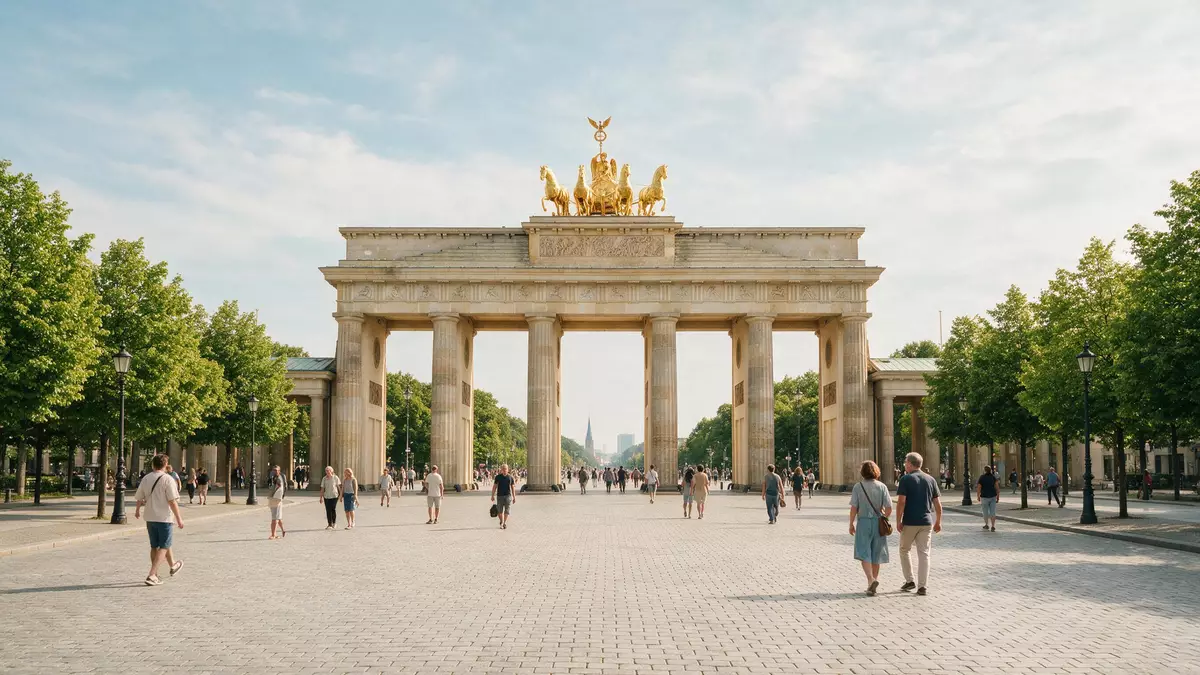
Brandenburger Tor in Berlin is a neoclassical city gate where stone columns, sculpted reliefs and a bronze quadriga gather centuries of Prussian and German history into a single urban landmark. Rising on the western edge of Pariser Platz at the end of Unter den Linden, it turns a former boundary in the city into a monumental frame between the historic centre and the Tiergarten park.
A Prussian city gate turned classical monument
Brandenburger Tor was commissioned in the late eighteenth century by King Frederick William II of Prussia and designed by the court architect Carl Gotthard Langhans as a grand entrance to the city.commissioned by Frederick William II Construction took place between 1788 and 1791, giving Berlin a new stone gate at the end of the boulevard Unter den Linden.built from 1788 to 1791
Langhans modelled the gate on the Propylaea, the monumental entrance to the Acropolis in Athens, bringing the vocabulary of Greek revival architecture to the Prussian capital.inspired by the Acropolis gateway The result is a sandstone structure with a row of fluted columns supporting an entablature and attic, giving the gate the presence of a classical temple translated into civic architecture.
Columns, reliefs and the quadriga overhead
The body of Brandenburger Tor is formed by parallel colonnades that create multiple passageways between Pariser Platz and the Tiergarten side, with the central opening wider than the flanking ones. Doric-style columns rise in two ranks, carrying a heavy entablature where sculpted metopes and triglyphs run above the roadway.metope and triglyph frieze
Above the entablature, the attic is decorated with reliefs that extend the narrative of the gate into a sculpted procession of figures and symbols. Crowning the composition is the bronze quadriga, a four-horse chariot driven by a female figure, designed by the sculptor Johann Gottfried Schadow and added in 1793.Schadow’s quadriga from 1793 The quadriga faces east towards the city centre, making the gate both an architectural object and a raised sculptural emblem above the street.
Political symbolism and a place on the frontier
Brandenburger Tor has carried different political meanings as regimes and borders shifted around it. In the Napoleonic era the quadriga was taken to Paris as war booty after French troops entered Berlin, then returned to the gate in 1814 when Prussian and allied forces prevailed.quadriga taken to Paris Later, in the twentieth century, the gate was damaged in the Second World War and subsequently restored, with the quadriga recast from original molds.restored and quadriga recast
From the early 1960s Brandenburger Tor stood beside the border between East and West Berlin, with the Berlin Wall curving around it on the western side and a restricted zone on the eastern side.gate beside the Berlin Wall The position at Pariser Platz, on the line that once marked the frontier, has made the gate a fixed reference point for images of division and of reunification, where the classical architecture frames modern political history as clearly as it frames the street.
Visiting Brandenburger Tor: what travellers from Western Europe should know
- Brandenburger Tor stands on Pariser Platz at the western end of Unter den Linden in the Mitte district of Berlin, between the historic city centre and the Tiergarten park.
- The approach from Unter den Linden is level, and the area around the gate consists of broad paved surfaces without significant gradients.
- The official language is German and the currency is the euro.
- The Reichstag building lies to the north-west, and the memorial and embassy-lined streets around Pariser Platz give the gate a densely built urban setting.
Searching for Brandenburger Tor on social platforms
These links open searches for Brandenburger Tor on each platform.
Frequently asked questions about Brandenburger Tor
Where is Brandenburger Tor located in Berlin?
Brandenburger Tor stands on Pariser Platz in the Mitte district, marking the western end of Unter den Linden beside the Tiergarten side of central Berlin.
What should visitors expect when they reach the gate?
Visitors encounter a wide paved square framed by neoclassical stone colonnades and the bronze quadriga overhead, with traffic separated from the pedestrian space.
What makes Brandenburger Tor distinctive among city gates?
The combination of Greek revival temple architecture, Schadow’s quadriga and the gate’s position at a historic frontier gives it a role that is both architectural and political.


