
Brandenburger Tor, Berlin’s classical city gate
Published on 08/28/2026 at 08:50 | Editorial responsibility: Rafael Müller, Editor-in-Chief AD HOC NEWS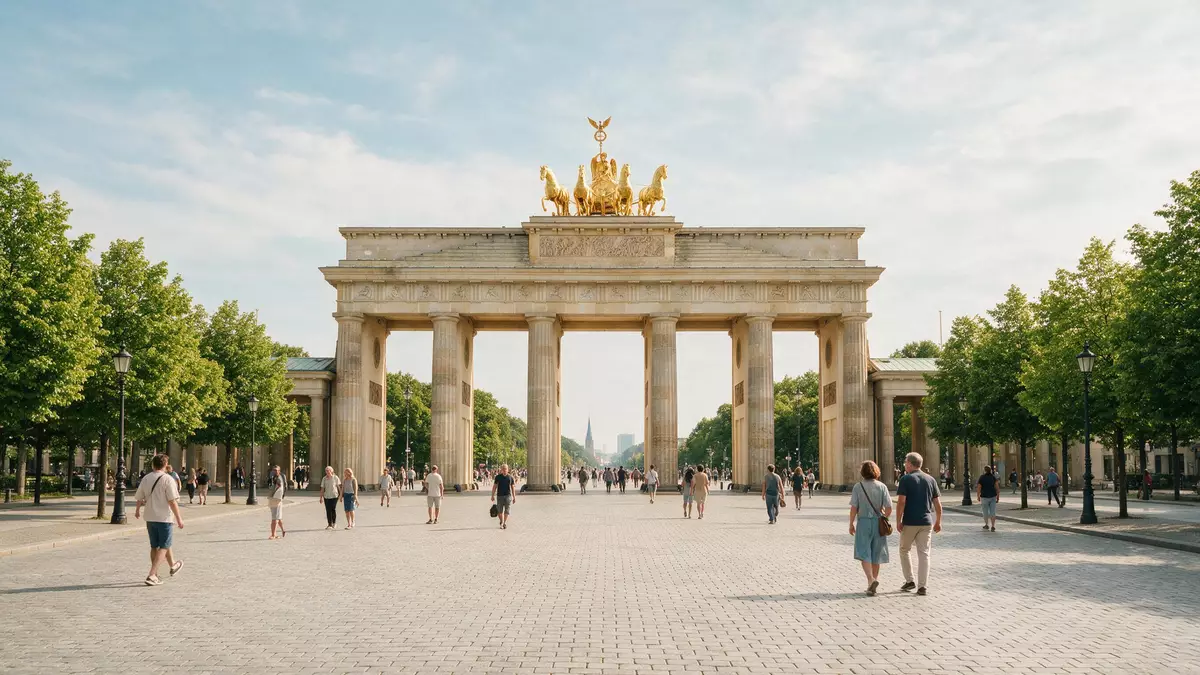
Brandenburger Tor in Berlin is an eighteenth-century neoclassical city gate, built as a monumental entrance on the western edge of the historic centre and crowned by a sculpted chariot known as the Quadriga. Rising above Pariser Platz at the end of Unter den Linden, it has passed through monarchic, imperial, divided and reunified Germany yet still presents itself as a single, coherent composition in sandstone and bronze.
A classical gateway at the end of Unter den Linden
Brandenburger Tor stands in the Mitte district at the junction where Unter den Linden meets the edge of the Tiergarten park, forming the western termination of Berlin’s historic boulevard and the opening into Pariser Platz.located in Berlin’s city centre The gate occupies the entire width between the pavements, presenting a sandstone screen that reads as a free-standing colonnade rather than a solid wall.sandstone screen with Doric columns
Commissioned by King Frederick William II of Prussia and built between 1788 and 1791, the gate was designed by architect Carl Gotthard Langhans as an early work of Berlin classicism that looked to ancient Greece for its forms.erected on the king’s orders between 1789 and 1793 Langhans took the Propylaea on the Athenian Acropolis as his model, translating its temple-like gateway into a Prussian city setting and adapting the Doric order to a free-standing urban facade.modelled on the Acropolis Propylaea
Columns, passages and the Quadriga above
The composition of Brandenburger Tor centres on twelve Doric columns, six on each side, forming five parallel passageways framed by the shafts and entablature.twelve Doric columns and five passages The central opening is wider than the flanking passages, giving the gateway a clear axial emphasis towards Unter den Linden and Pariser Platz. Above the colonnade, a robust entablature and attic carry reliefs and sculpted details that continue the classical language in stone.
The whole structure is around 26 m (85 ft) high and about 65.5 m (215 ft) long, dimensions that place it firmly at the scale of the surrounding city blocks while still separating the two sides of the square with a distinct architectural threshold.26 metres high and 65.5 metres long On top of the gate stands the Quadriga, a bronze sculpture by Johann Gottfried Schadow installed in the early 1790s, depicting the goddess of victory driving a four-horse chariot and facing into the city along Unter den Linden.completed with the Quadriga in the 1790s
From customs wall to national symbol
When Brandenburger Tor was built in the late eighteenth century, it formed part of Berlin’s customs wall, standing as one of the city gates through which traffic passed towards the town of Brandenburg and the roads to the west.only surviving gate of the former customs wall It later became the only remaining town gate of Berlin, outliving the rest of the barrier and taking on a new role as a free-standing monument rather than a piece of infrastructure.the only remaining town gate of Berlin
Through the nineteenth and twentieth centuries, the gate stood at the centre of many episodes of German history, from Napoleonic occupation to imperial parades, from the Nazi period to the post-war division of Berlin. The Berlin Wall later ran close behind it, turning the area into a fortified boundary zone, and the gate’s position between East and West gave it a particular resonance when Germany was reunited and Pariser Platz became a public square facing the restored colonnade.
Visiting Brandenburger Tor: what travellers from Western Europe should know
- Brandenburger Tor stands on Pariser Platz in the Mitte district at the western end of Unter den Linden, with the Tiergarten extending beyond the gate towards the west.
- The terrain at the site is level, and the passages between the columns are paved, making it straightforward to walk through the gateway and across the square.
- The nearest public transport stop is Brandenburger Tor station beneath the square, served by both U-Bahn and S-Bahn lines that connect with other parts of Berlin.
- Germany’s official language is German and the currency is the euro.
Searching for Brandenburger Tor on social platforms
These links open searches for Brandenburger Tor on each platform.Frequently asked questions about Brandenburger Tor
Where is Brandenburger Tor located in Berlin?
Brandenburger Tor stands on Pariser Platz in the Mitte district at the western end of Unter den Linden, close to the Tiergarten park.
What should visitors expect when walking through the gate?
Visitors encounter a broad, paved square on either side of the sandstone colonnade and can walk freely between the columns through the five passages.
What makes Brandenburger Tor distinctive among Berlin’s landmarks?
Its twelve Doric columns, classical modelling on the Athenian Propylaea and the bronze Quadriga above the entablature distinguish it as Berlin’s surviving monumental city gate.


