
Brandenburger Tor and the Quadriga above Berlin
Published on 09/24/2026 at 06:00 | Editorial responsibility: Rafael Müller, Editor-in-Chief AD HOC NEWS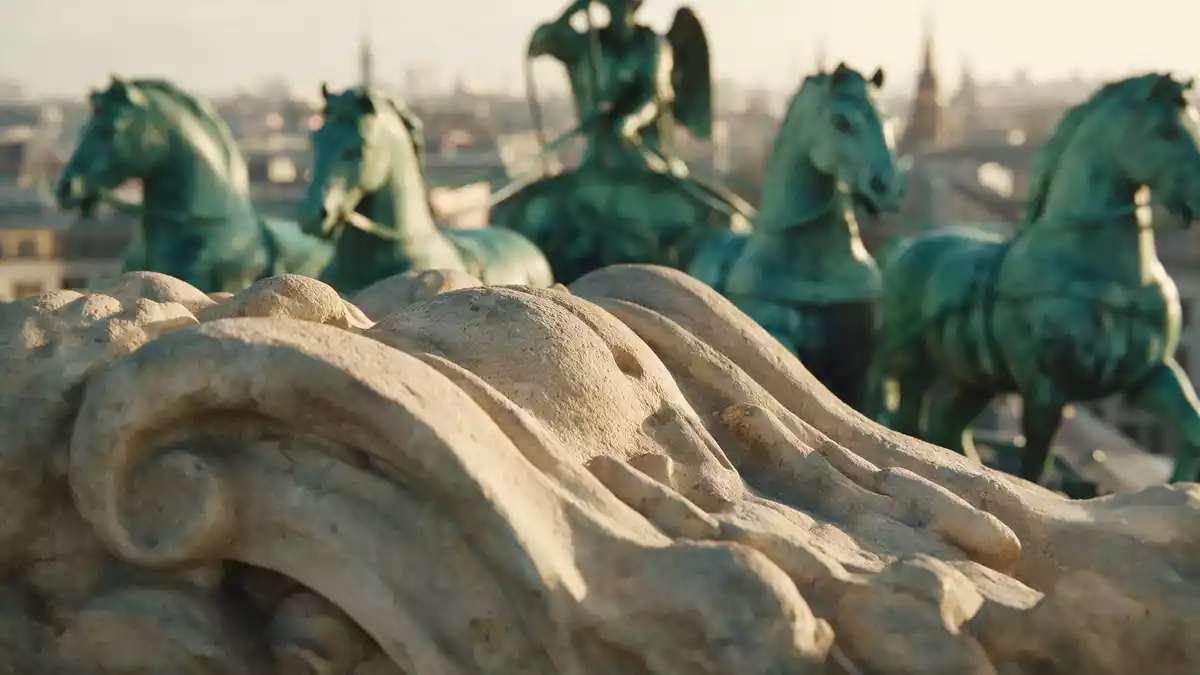
Brandenburger Tor is a sandstone gateway on Pariser Platz in Berlin, crowned by the Quadriga of Johann Gottfried Schadow. Its broad neoclassical form dates from 1788–1791, giving the monument a strong architectural presence before the eye reaches the sculpture above.
Brandenburger Tor as a neoclassical gateway
Carl Gotthard Langhans designed Brandenburger Tor for Frederick William II of Prussia. Construction took place between 1788 and 1791, during the period when classical Greek forms shaped important civic architecture in Berlin. The gate is recorded as one of the earliest major buildings of Berlin Classicism, and its design draws on the Propylaea of the Athenian Acropolis. the gate’s dimensions are 26 metres high, 65.5 metres long and 11 metres deep.
Two rows of Doric columns define the structure, with passages running through the centre. Sandstone gives the gateway a unified surface, while the repeated columns create a measured rhythm across its front. The building is both a city monument and a crossing between Pariser Platz and the boulevard Unter den Linden.
The Quadriga above Pariser Platz
The Quadriga was placed on the roof in 1793. Johann Gottfried Schadow created the sculpture as a four-horse chariot driven by Victoria, the Roman goddess of victory. The composition forms the most recognisable vertical element of Brandenburger Tor, rising above the horizontal entablature and the lines of columns.
The sculpture also carries a layered political history. Napoleon took the Quadriga to Paris in 1806 after entering Berlin, and it returned to the city in 1814. During its reinstallation, an Iron Cross and a Prussian eagle were added to the composition. the Quadriga’s history connects the roof sculpture with the changing political meanings attached to the monument.
From city passage to historical symbol
Brandenburger Tor was opened on 6 August 1791 under the name Friedenstor, or Gate of Peace. Its original architectural role was connected with the western end of Unter den Linden, the grand boulevard leading towards the Prussian palace. The gateway therefore combines movement through the city with a formal monument at the edge of the central avenue.
Its historical associations expanded during the nineteenth and twentieth centuries. Napoleon’s entry in 1806, the return of the Quadriga in 1814 and the monument’s position beside the former Berlin Wall gave the gate several distinct political contexts. the monument’s recorded history identifies Brandenburger Tor as a surviving gate complex and an early work of Berlin Classicism.
Visiting Brandenburger Tor: what travellers from Western Europe should know
- Brandenburger Tor stands on Pariser Platz in central Berlin, at the western end of Unter den Linden. Berlin’s underground, suburban railway and bus networks connect the surrounding central districts.
- The monument is a broad urban gateway with paved public space around it. The passages through the columns form the main architectural feature at ground level.
- Pariser Platz lies beside the Reichstag, the Memorial to the Murdered Jews of Europe and the former line of the Berlin Wall.
- The official language is German and the currency is the euro.
Searching for Brandenburger Tor on social platforms
These links open searches for Brandenburger Tor on each platform.Frequently asked questions about Brandenburger Tor
Where is Brandenburger Tor?
Brandenburger Tor stands on Pariser Platz in central Berlin. The gateway marks the western end of Unter den Linden.
What can visitors see at Brandenburger Tor?
Visitors can see the sandstone gateway, its Doric columns, the passages beneath the structure and the Quadriga above the roof.
What makes Brandenburger Tor distinctive?
Its combination of Greek-inspired neoclassical architecture and Schadow’s four-horse Quadriga gives the monument its distinctive form. The building also carries the name of Carl Gotthard Langhans and the date 1791.


