
Brandenburger Tor and the classical edge of Berlin
Published on 09/05/2026 at 16:31 | Editorial responsibility: Rafael Müller, Editor-in-Chief AD HOC NEWS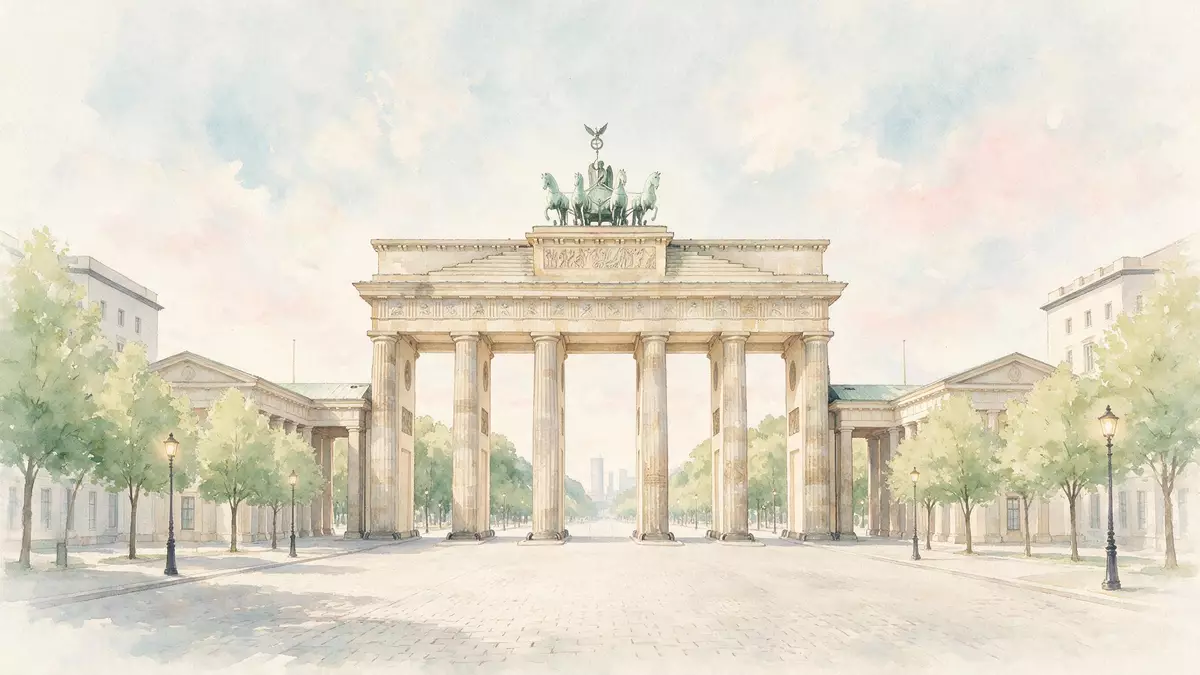
Brandenburger Tor is Berlin’s neoclassical city gate, set at the western end of Unter den Linden and finished as a sandstone monument under Frederick William II of Prussia. Its profile is defined by six Doric columns on each side and the Quadriga above the central entablature.
Brandenburger Tor and the language of Greek revival
The gate was built in 1788–91 and designed by Carl Gotthard Langhans. Its Greek Revival character gives the monument a strictly classical vocabulary, with Doric columns, a strong horizontal crown and a disciplined stone surface.
The composition is compact and ceremonial rather than heavy. A row of passages runs through the structure, and the middle opening is the one that gives the gate its formal axis.
The Quadriga above Pariser Platz
The sculptural group on top is the Quadriga, associated with Johann Gottfried Schadow and long linked with the gate’s visual identity. It crowns the roofline like a separate classical figure rather than a minor ornament.
Pariser Platz lies immediately to the east, while the open space towards the west belongs to the city’s axial approach. The gate stands as a freestanding monument, with traffic, paving and civic space arranged around it rather than inside it.
Stone, columns and a city threshold
The material is sandstone, which gives the whole structure a pale, coherent surface. The columns, passages and sculptural top make the gate read as an urban threshold with a clear front and back.
The monument belongs to the early phase of Berlin classicism and remains one of the city’s most recognisable surviving works from that period. Its relation to the Prussian court, its Langhans design and its late eighteenth-century date define its historical weight without needing any extra embellishment.
Visiting Brandenburger Tor: what travellers from Western Europe should know
- Brandenburger Tor stands on Pariser Platz in central Berlin, beside Unter den Linden. The S+U Brandenburger Tor station is the nearest named public-transport stop in the area.
- The gate is a freestanding urban monument, so the main detail is its scale and the view through the central passage rather than an interior to enter. The surrounding square leaves it open on all sides.
- The structure is sandstone, with a classical column order and a sculpted Quadriga above the top edge. Those elements are visible from the square and from the approaches along the boulevard.
- The official language is German and the currency is the euro.
- Entry requirements depend on your nationality; UK travellers can check the FCDO travel advice at gov.uk/foreign-travel-advice, Irish travellers the Department of Foreign Affairs at ireland.ie.
Searching for Brandenburger Tor on social platforms
These links open searches for Brandenburger Tor on each platform.
Frequently asked questions about Brandenburger Tor
Where is Brandenburger Tor?
It stands in central Berlin on Pariser Platz, at the end of Unter den Linden. The nearest named station is S+U Brandenburger Tor.
What should be expected on a visit?
The gate is an outdoor monument, not a building with an interior route. Visitors usually see the columns, the passages through the middle and the Quadriga above.
What makes Brandenburger Tor distinctive?
Its neoclassical form, sandstone fabric and association with Carl Gotthard Langhans give it a clear historical profile. The classical order and the sculptural crown make it easy to recognise from the approaches around Pariser Platz.


