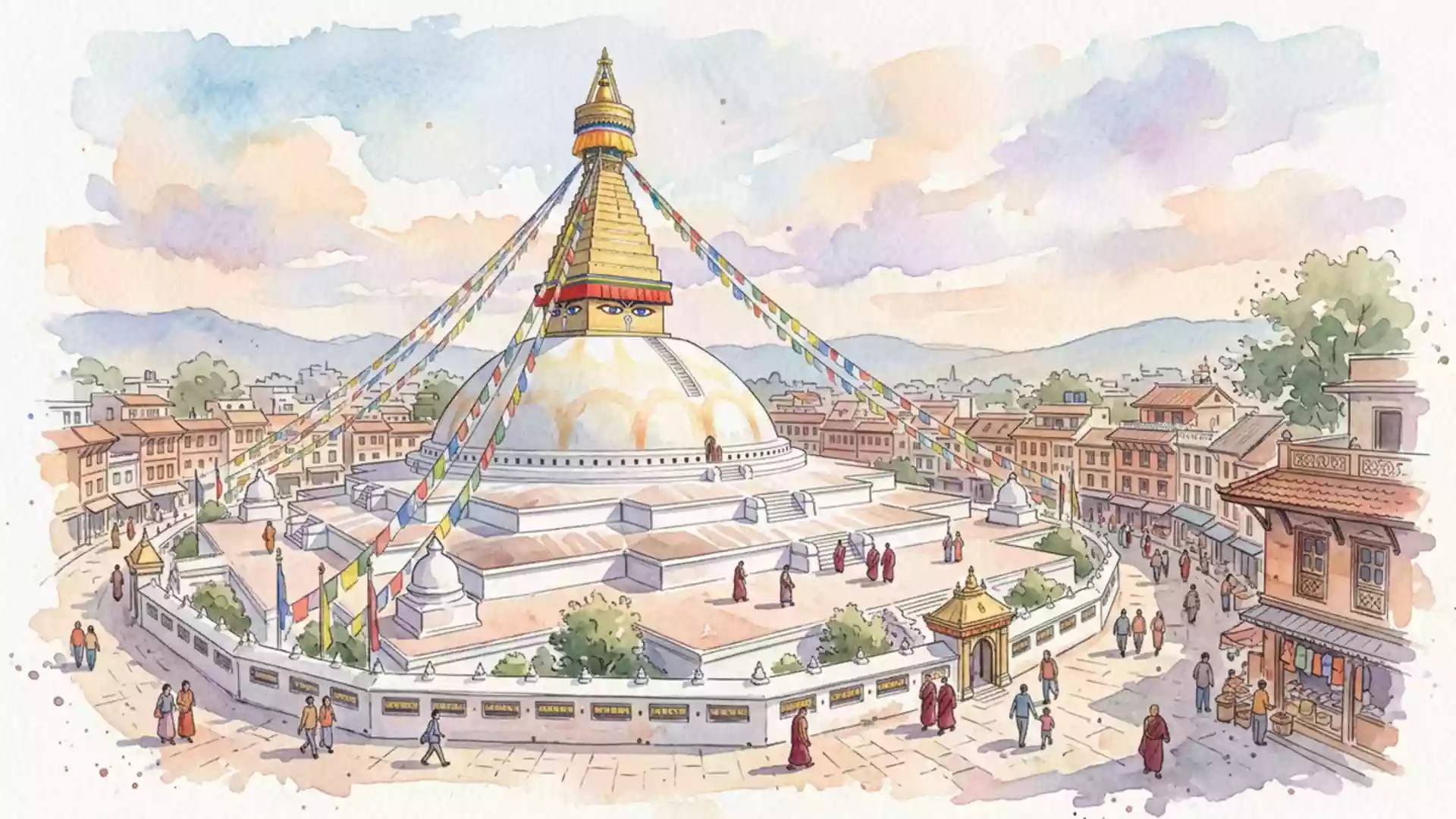
Boudhanath and its great white mandala in Kathmandu
Published on 08/26/2026 at 21:53 | Editorial responsibility: Rafael Müller, Editor-in-Chief AD HOC NEWS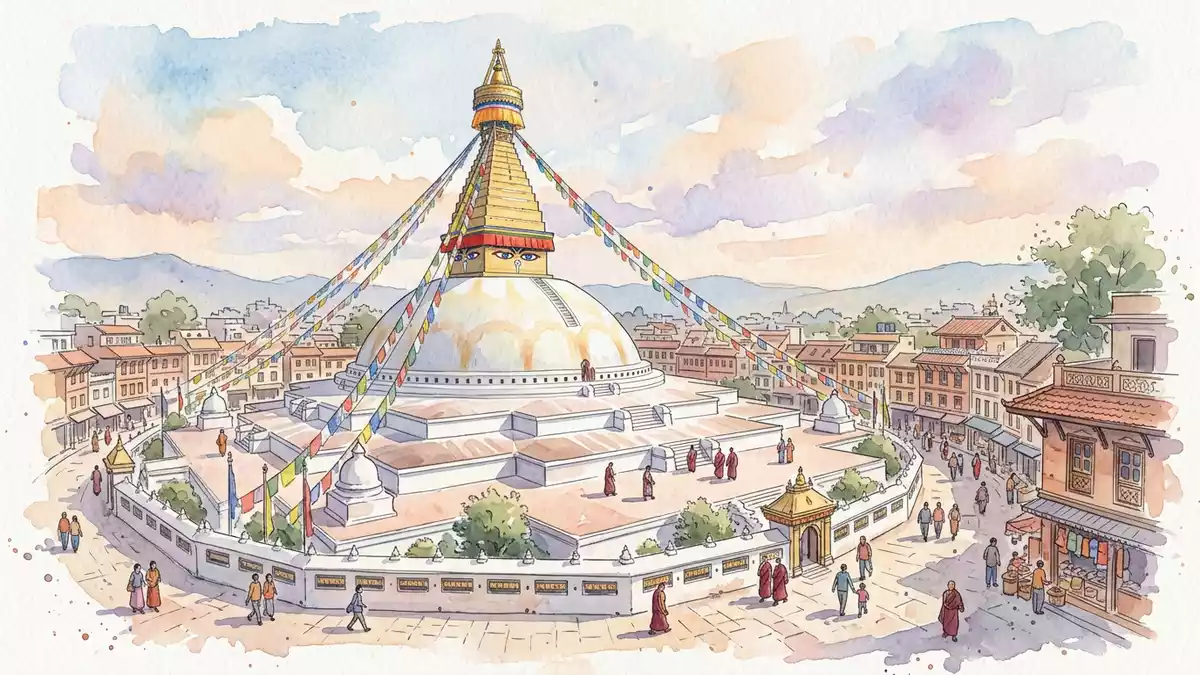
Boudhanath is a vast white stupa on the eastern side of Kathmandu, its stepped terraces and watching Buddha eyes forming a mandala that dominates the surrounding quarter. Rising to around 36 metres (118 ft) and set on a broad platform, it anchors a neighbourhood of monasteries, courtyards and prayer wheels that has become one of the principal centres of Tibetan Buddhism in Nepal.Boudhanath Stupa
The great mandala of Boudhanath
The core of Boudhanath is its massive white dome, crowned by a square tower painted with Buddha eyes and topped by a tapering spire of stacked discs known as harmika and chatra. The structure stands in the Boudha neighbourhood on the northeastern outskirts of Kathmandu, where the city begins to thin towards the hills of the Kathmandu Valley.the Boudha neighbourhood
The stupa as seen today belongs to a Buddhist landscape shaped in the Licchavi period of Nepalese history, with chronicles crediting rulers such as ?ivadeva and M?nadeva in the fifth and sixth centuries for its foundation.Licchavi period The stupa is part of the UNESCO World Heritage inscription of the Kathmandu Valley, recognised for its religious significance and the way its mandala layout reflects Buddhist cosmology.UNESCO World Heritage
A living centre of Tibetan Buddhism
Walkways encircle Boudhanath at several levels, forming a series of paths used for kora, the clockwise circumambulation that shapes daily life around the stupa. The outer ring is edged with low buildings that house shops, cafés and guesthouses, their flat roofs and balconies giving raised views over the dome and the tides of pilgrims below.center of Tibetan culture
Beyond these facades, lanes lead to monasteries associated with Tibetan Buddhist traditions, many of them established after communities from Tibet settled in the area in the twentieth century.more than fifty monasteries Prayer wheels line walls, strings of prayer flags stretch from the spire to the edges of the dome, and butter-lamp halls provide enclosed spaces beside the open terraces of the main structure.great mandala of Kathmandu
Form, symbolism and the surrounding quarter
The mandala form of Boudhanath is expressed in concentric elements: low walls inset with niches and small stupas, higher terraces accessed by flights of steps, and the central dome whose smooth surface is punctuated by prayer niches and offerings. The eyes on the tower face the cardinal directions, above a painted sign that resembles a question mark but represents the Nepali numeral for one, a reminder of the unity of all things in Buddhist teaching.Boudha Stupa
From the upper paths, the surrounding urban fabric comes into view: the tight grid of streets in Boudha, the nearby Pashupatinath temple area along the Bagmati River, and the hazy outlines of hills that frame the Kathmandu Valley.Boudhanath Stupa in Kathmandu Within the square around the stupa, shrines, small temples and rest houses create a patchwork of spaces where pilgrims pause, light lamps and gather in courtyards shaded by trees.
Visiting Boudhanath: what travellers from Western Europe should know
- Boudhanath stands in the Boudha district in the northeastern part of Kathmandu, reached by road from the historic centre and from Tribhuvan International Airport.
- The stupa rises on a series of broad terraces linked by steps, and visiting the upper levels involves repeated climbs on stone stairways.
- The Kathmandu Valley lies at an elevation of about 1,400 m (4,593 ft), so walking the circuits around the stupa takes place at moderate altitude.
- Boudhanath lies within the Kathmandu Valley World Heritage area, with Pashupatinath temple located to the south along the Bagmati River.
- The official language is Nepali and the currency is the Nepalese rupee. Entry requirements depend on your nationality; UK travellers can check the FCDO travel advice at gov.uk/foreign-travel-advice, Irish travellers the Department of Foreign Affairs at ireland.ie.
Searching for Boudhanath on social platforms
These links open searches for Boudhanath on each platform.
Frequently asked questions about Boudhanath
Where is Boudhanath?
Boudhanath is a large Buddhist stupa in the Boudha district on the northeastern side of Kathmandu, the capital of Nepal.
What can visitors expect at Boudhanath?
Visitors encounter a vast white stupa with concentric terraces, prayer wheels, surrounding monasteries and a busy square of shops, shrines and resting places.
What makes Boudhanath distinctive among stupas?
Boudhanath is distinguished by its mandala layout, its height of around 36 m (118 ft) and its role as a major centre of Tibetan Buddhism in Nepal.