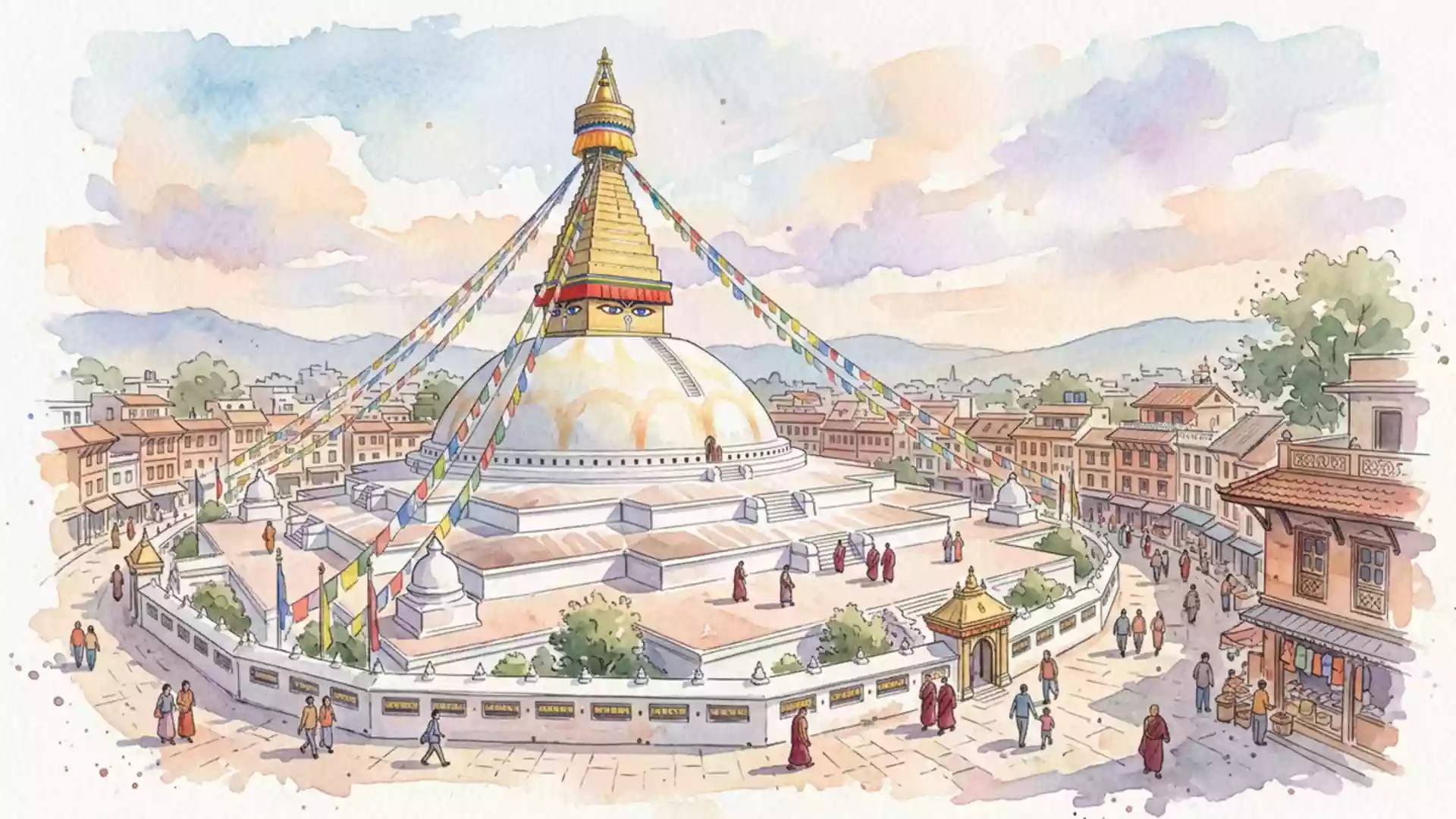
Boudhanath and its great white mandala in Kathmandu
Published on 08/21/2026 at 20:37 | Editorial responsibility: Rafael Müller, Editor-in-Chief AD HOC NEWS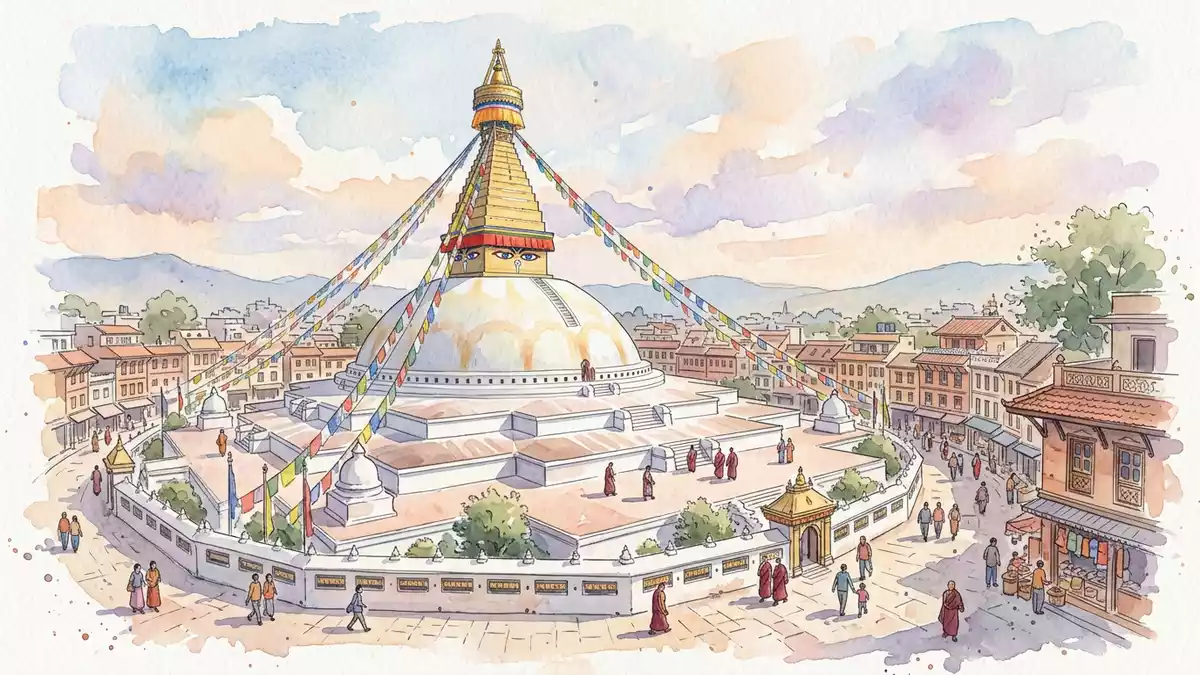
Boudhanath rises above the eastern outskirts of Kathmandu as a vast white Buddhist stupa, its layered terraces and painted eyes forming a mandala that is visible from far across the surrounding streets. Recognised as part of the Kathmandu Valley UNESCO World Heritage Site since 1979, it anchors a dense religious quarter where monasteries, homes and shops all face in towards the same circular shrine.
A great Buddhist stupa in the Kathmandu Valley
Boudhanath is a Buddhist stupa in the Boudha district of Kathmandu, on the eastern side of Nepal’s capital city. It forms part of the wider Kathmandu Valley ensemble that was inscribed on the World Heritage List in 1979, a listing that also covers Swayambhu and other historic sites in the valley’s core towns.Kathmandu Valley ensemble
The monument is also known by alternative names such as Boudha Stupa, Khasti Chaitya and Jyarung Khasyor, reflecting the different languages of the communities that have cared for it over centuries.also known as Khasti Chaitya The exact date of its origin is debated, but chronicles and modern surveys place its construction in the centuries between the Licchavi period and the later Middle Ages, and it has long been a fixed point on trade and pilgrimage routes that link Nepal and Tibet.trade and pilgrimage routes
The mandala form of Boudhanath
The lead impression of Boudhanath is its sheer geometric presence: a white hemisphere supporting a tapering tower, all set within a mandala-like base of concentric platforms and processional paths. Measurements vary slightly between descriptions, but the stupa rises to around 36 m (about 118 ft) from ground to pinnacle, with a base whose diameter is in the range of one hundred metres, which makes it one of the largest spherical stupas in Nepal.around 36 m from ground The whitewashed dome rests on stepped terraces that read as a three-dimensional diagram of Buddhist cosmology when seen from above.
Above the hemisphere sits a cube painted with pairs of Buddha eyes looking towards the four cardinal directions, a feature that has made Boudhanath instantly recognisable in countless photographs and paintings.cube painted with the eyes of Buddha From this cube rises a tiered tower, in turn crowned by a gilded finial and framed by lines of prayer flags that stretch out to the surrounding structures. The entire composition reads as a built mandala: a diagram of the universe expressed through brick, plaster and metal, aligned with the cardinal directions and encircled by routes for ritual circumambulation.
A living Tibetan Buddhist quarter
One of the distinctive aspects of Boudhanath is the way the stupa is framed by a dense ring of buildings that face into its circular plaza, enclosing it like the centre of a small town. Over time, monasteries, homes and small businesses have filled the blocks around the stupa, forming a Buddhist neighbourhood where the daily rhythm is shaped by ritual circuits on the surrounding paths.located in the town of Boudha Many of the monasteries belong to Tibetan Buddhist traditions, and the area is a centre of Tibetan culture in Kathmandu.
The stupa’s status as a World Heritage Site reinforces its role as a maintained religious landscape rather than a single isolated monument.earned the title of a UNESCO World Heritage Site Pilgrims and residents move around the base on paved paths lined with prayer wheels, and the terraces above create further circuits closer to the dome. Rooftop terraces on the surrounding buildings give elevated views onto the stupa’s upper structure, while narrow lanes lead back into the wider Boudha district beyond the main circle.
Visiting Boudhanath: what travellers from Western Europe should know
- Boudhanath stands in the Boudha district on the eastern side of Kathmandu, a short distance north of the main road corridor that links the city centre with Tribhuvan International Airport.
- The immediate area around the stupa is paved and largely level, but reaching the higher terraces involves stairways that rise in steps up the monument’s concentric platforms.
- The official language is Nepali and the currency is the Nepalese rupee.
- Entry requirements depend on your nationality; UK travellers can check the FCDO travel advice at gov.uk/foreign-travel-advice, Irish travellers the Department of Foreign Affairs at ireland.ie.
Searching for Boudhanath on social platforms
These links open searches for Boudhanath on each platform.
Frequently asked questions about Boudhanath
Where is Boudhanath located?
Boudhanath is in the Boudha district on the eastern outskirts of Kathmandu, within the wider Kathmandu Valley in Nepal.
What can visitors expect when they arrive at Boudhanath?
Visitors encounter a large white stupa surrounded by a circular plaza, with monasteries, homes and small businesses arranged in a ring around the monument.
What makes Boudhanath distinctive among Buddhist stupas?
Boudhanath stands out for its combination of a vast spherical dome, a mandala-like base and a surrounding Tibetan Buddhist quarter that has grown around the stupa.