
Bosque de Chapultepec, the forested heart of Mexiko-Stadt
Published on 09/09/2026 at 22:03 | Editorial responsibility: Rafael Müller, Editor-in-Chief AD HOC NEWS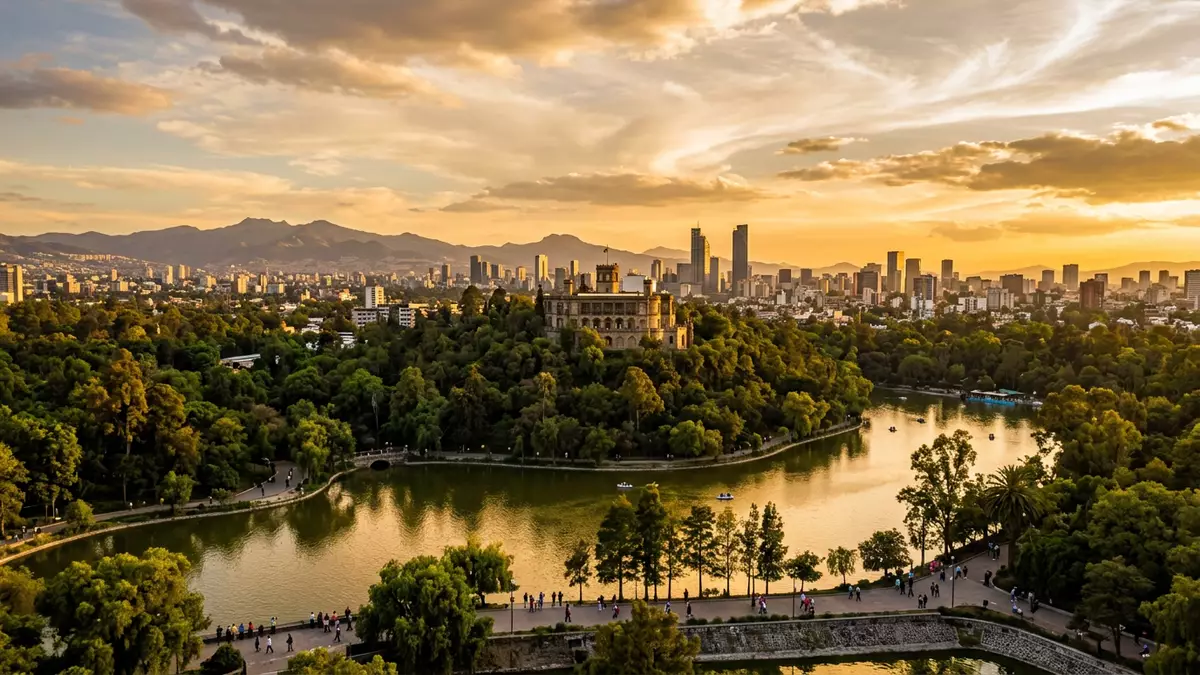
Bosque de Chapultepec in Mexiko-Stadt is a vast urban forest where ancient springs, a rocky hill and a hilltop castle anchor one of Latin America’s largest city parks. Rooted in pre-Hispanic tradition and reshaped under colonial and modern governments, the park combines dense tree cover, lakes, avenues and major museums in a single, extended landscape.
From “grasshopper hill” to royal retreat
The name Bosque de Chapultepec comes from Nahuatl and refers to the rocky elevation known as Chapultepec Hill, historically translated as “grasshopper hill” in English descriptions of the area.Chapultepec Hill Long before Mexiko-Stadt expanded around it, the forested slopes above the former shores of Lake Texcoco held springs that supplied fresh water to the Mexica capital of Mexico-Tenochtitlan through aqueducts and channels.springs that supplied drinking water
By the fifteenth century, rulers of the Mexica Empire treated Chapultepec as a place of rest and ceremony, laying out gardens and baths and spending time in the forest away from the densely built island city.designed it as a park The association with power continued under Spanish rule: after the conquest, the land passed from Hernán Cortés to the municipal authorities of Mexico City by decree of Charles V in 1530, embedding the forest in the legal and symbolic framework of the colonial capital.Royal Decree
Castle, aqueduct and a twentieth-century park
High above the trees, Chapultepec Castle rises from the hill as a central landmark, first constructed in the late eighteenth century as a residence for the colonial elite.castle as a summer residence Over the nineteenth century the building served as a military academy, an imperial palace under Emperor Maximilian and Empress Carlota, and later the official presidential residence, before Mexico’s presidents moved to Los Pinos in the twentieth century.served as the official residence The castle’s terraces, retaining walls and gardens form one of the most prominent structures within Bosque de Chapultepec, with views across Mexiko-Stadt’s central districts.
Running away from the hill and forest, traces of historic aqueducts once carried Chapultepec’s spring water towards the city, including structures known as the Chapultepec aqueduct and Salto del Agua in colonial records.Chapultepec aqueduct During the Porfirio Díaz era around the turn of the twentieth century, the ancient forest was reshaped into a landscaped park with avenues, lakes and ornamental planting, drawing on French models such as the Bois de Boulogne and formalising Chapultepec’s role as a public recreational landscape for the expanding city.converted to a French park
An urban forest with museums, lakes and sections
Bosque de Chapultepec is described in municipal documents as a principal component of Mexico City’s urban forest and as a long-established protected green area stretching back for more than seven centuries.more than seven centuries Within the park, the main tree-covered areas, lakes and cultural institutions are often grouped into numbered sections, with the first section closest to the historic centre and later sections extending westward.four distinct sections The site’s documented area reaches several hundred hectares, placing it among the largest urban parks in the Western Hemisphere according to city sources that give figures in that range.one of the biggest city parks
Alongside lawns and wooded slopes, Bosque de Chapultepec contains lakes with boat hire, paved avenues and major cultural venues including the National Museum of Anthropology and the Museum of Modern Art, both associated with the mid-twentieth-century development of the park.National Museum of Anthropology A zoo opened in the 1920s within the first section, adding animal enclosures to the mix of gardens and monuments. Together, these institutions and landscapes make Bosque de Chapultepec a place where forest, water, stone and built culture meet within the boundaries of Mexiko-Stadt.
Visiting Bosque de Chapultepec: what travellers from Western Europe should know
- Bosque de Chapultepec lies to the west of the historic centre of Mexiko-Stadt, reached along Paseo de la Reforma by road or by public transport serving the park’s surrounding districts.
- The terrain combines flat lawns with wooded slopes on and around Chapultepec Hill, including stairways and paths that climb to Chapultepec Castle above the trees.
- Major museums such as the National Museum of Anthropology and the Museum of Modern Art stand within the park’s sections, so a visit often involves walking between forested areas, lakes and large cultural buildings.
- The official language is Spanish and the currency is the Mexican peso. Entry requirements depend on your nationality; UK travellers can check the FCDO travel advice at gov.uk/foreign-travel-advice, Irish travellers the Department of Foreign Affairs at ireland.ie.
Searching for Bosque de Chapultepec on social platforms
These links open searches for Bosque de Chapultepec on each platform.
Frequently asked questions about Bosque de Chapultepec
Where is Bosque de Chapultepec located?
Bosque de Chapultepec is in the western part of Mexiko-Stadt, extending around Chapultepec Hill and adjoining avenues such as Paseo de la Reforma.
What can visitors expect on a visit?
Visitors encounter extensive tree cover, lakes, avenues, Chapultepec Castle on the hill and major museums, all arranged within a large, multi-section city park.
What makes Bosque de Chapultepec distinctive?
The combination of pre-Hispanic springs, centuries of political history and its role as a major urban forest with landmark museums gives the park a distinctive character within Mexiko-Stadt.


