
Bosque de Chapultepec, a vast green and cultural landscape in Mexiko-Stadt
Published on 08/22/2026 at 07:36 | Editorial responsibility: Rafael Müller, Editor-in-Chief AD HOC NEWS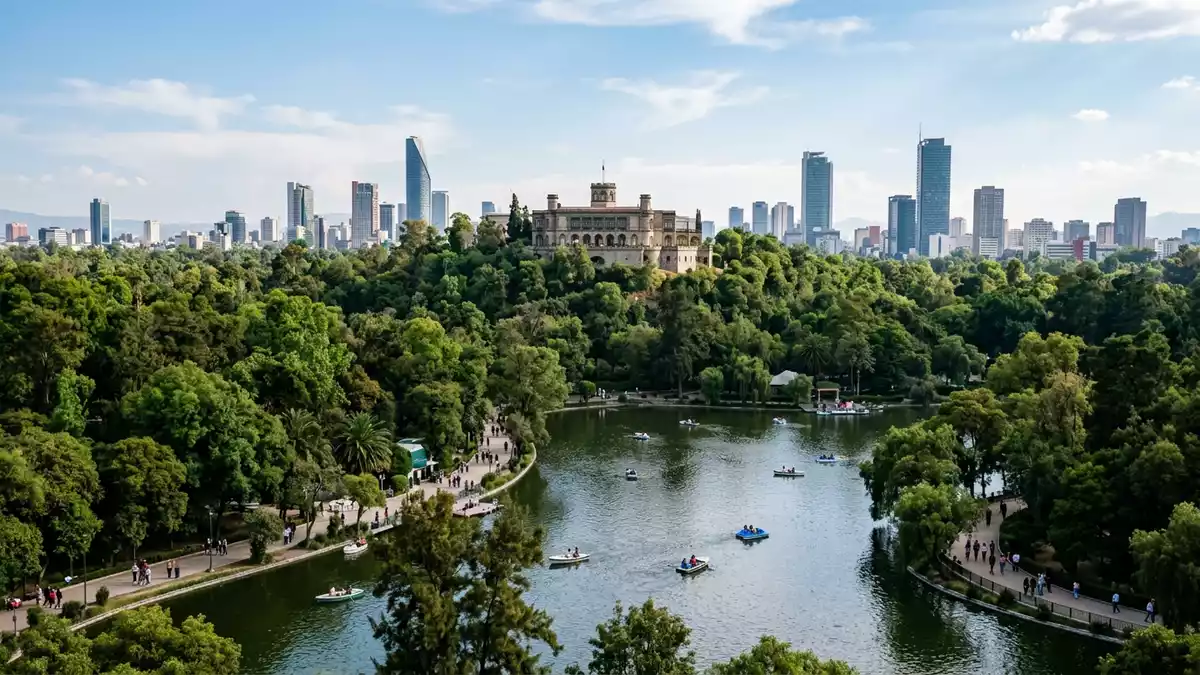
Bosque de Chapultepec is the great urban forest of Mexiko-Stadt, a sweeping landscape where woodland, lakes and landmark museums share the same expanse of parkland. Its hills, avenues and water create a rare sense of scale inside one of the world’s largest cities, while Chapultepec Castle and the National Museum of Anthropology connect this green space directly to Mexico’s political and cultural history.
The forested heart of Mexiko-Stadt
Bosque de Chapultepec spreads across a large area on the western side of Mexiko-Stadt, with wooded slopes, lawns and reservoirs forming a contiguous band of green between major avenues and residential districts.Bosque de Chapultepec is designated as an urban forest and its terrain rises towards the historic hill of Chapultepec itself. The park is divided into four main sections that together cover hundreds of hectares, with the First Section corresponding to the historic core that framed earlier phases of the city’s growth.The four sections are distributed between the Miguel Hidalgo and Álvaro Obregón districts.
Large stands of mature trees line the avenues, and many of them form part of a long-documented urban woodland. Studies of the First Section’s tree cover describe a canopy interspersed with fountains, lakes and paved promenades, giving the park a mixture of shaded paths and open plazas.The First Section contains celebrated historic and recreational areas. This combination of dense planting and formal layouts makes the park feel both like a piece of city infrastructure and a landscape in its own right.
Chapultepec Castle and the hill of the grasshopper
High above the paths and lakes rises Chapultepec Castle, a neoclassical complex that crowns the rocky hill at the centre of the First Section. Construction of the castle began in 1785 during the administration of the viceroy Bernardo de Gálvez, giving it deep roots in the late colonial period.The foundations of Chapultepec Castle date to the late eighteenth century and the building later took on roles ranging from imperial residence to presidential home. Today it houses the National Museum of History, with galleries that overlook tree canopies and the broad avenues of Mexiko-Stadt below.Chapultepec Castle functions as the National History Museum.
The hill itself has long been a landmark. Its name comes from Náhuatl and is often translated as “hill of the grasshopper”, reflecting pre-Hispanic associations with springs and sacred landscape. From the terraces of the castle, visitors see how the forested slopes descend towards artificial lakes and avenues, creating a layered view from stone balustrades down into dense planting. Monumental stairways and ramps connect the castle precinct with the rest of the First Section, so that the building feels closely tied to the surrounding woodland rather than isolated from it.
Museums, lakes and everyday life in the park
Bosque de Chapultepec is also a cultural district, with museums and performance spaces concentrated especially in the First and Second Sections. On the edge of the park stands the National Museum of Anthropology, one of Mexico’s most important museums, whose galleries display artefacts from across Mesoamerica and whose courtyard opens towards the trees of the park.The National Museum of Anthropology sits within the Bosque de Chapultepec area. Nearby, the Museo de Arte Moderno and the Rufino Tamayo Museum focus on twentieth-century and contemporary art, while the Casa del Lago provides a venue for exhibitions and performances beside one of the lakes.The First Section gathers major museums, a zoo and lakes around its avenues.
The Second Section adds further cultural and recreational facilities, including a natural history museum and family-oriented science and children’s museums set among wooded clearings. Across the various sections, artificial lakes provide space for boating and frame long promenades, while a zoo, sports fields and open lawns give the park a varied daily life. Paths by the water often align with the silhouettes of the city’s skyline, so that the forest and Mexiko-Stadt’s towers appear together in a single scene.
Visiting Bosque de Chapultepec: what travellers from Western Europe should know
- Bosque de Chapultepec lies to the west of Mexiko-Stadt’s historic centre, in the boroughs of Miguel Hidalgo and Álvaro Obregón, and is bordered by avenues such as Paseo de la Reforma.
- The terrain ranges from level promenades around the lakes to steeper paths and stairways on the hill of Chapultepec, with changes in elevation between the castle and the surrounding sections.
- Major museums within or beside the park include the National Museum of Anthropology, the Museo de Arte Moderno, the Rufino Tamayo Museum and the National Museum of History in Chapultepec Castle.
- The official language is Spanish and the currency is the Mexican peso.
- Entry requirements depend on your nationality; UK travellers can check the FCDO travel advice at gov.uk/foreign-travel-advice, Irish travellers the Department of Foreign Affairs at ireland.ie.
Searching for Bosque de Chapultepec on social platforms
These links open searches for Bosque de Chapultepec on each platform.
Frequently asked questions about Bosque de Chapultepec
Where is Bosque de Chapultepec located?
Bosque de Chapultepec lies in Mexiko-Stadt on the western side of the city centre, mainly within the borough of Miguel Hidalgo and extending into Álvaro Obregón.
What should visitors expect during a visit?
Visitors encounter extensive woodland, artificial lakes, promenades and a concentration of major museums, together with Chapultepec Castle rising above the park on its central hill.
What makes Bosque de Chapultepec distinctive among city parks?
The combination of large-scale woodland, landmark museums such as the National Museum of Anthropology and the historic Chapultepec Castle gives the park a rare blend of landscape and culture.


