
Boquete, Panama’s highland town of coffee and cloud forests
Published on 09/03/2026 at 09:46 | Editorial responsibility: Rafael Müller, Editor-in-Chief AD HOC NEWS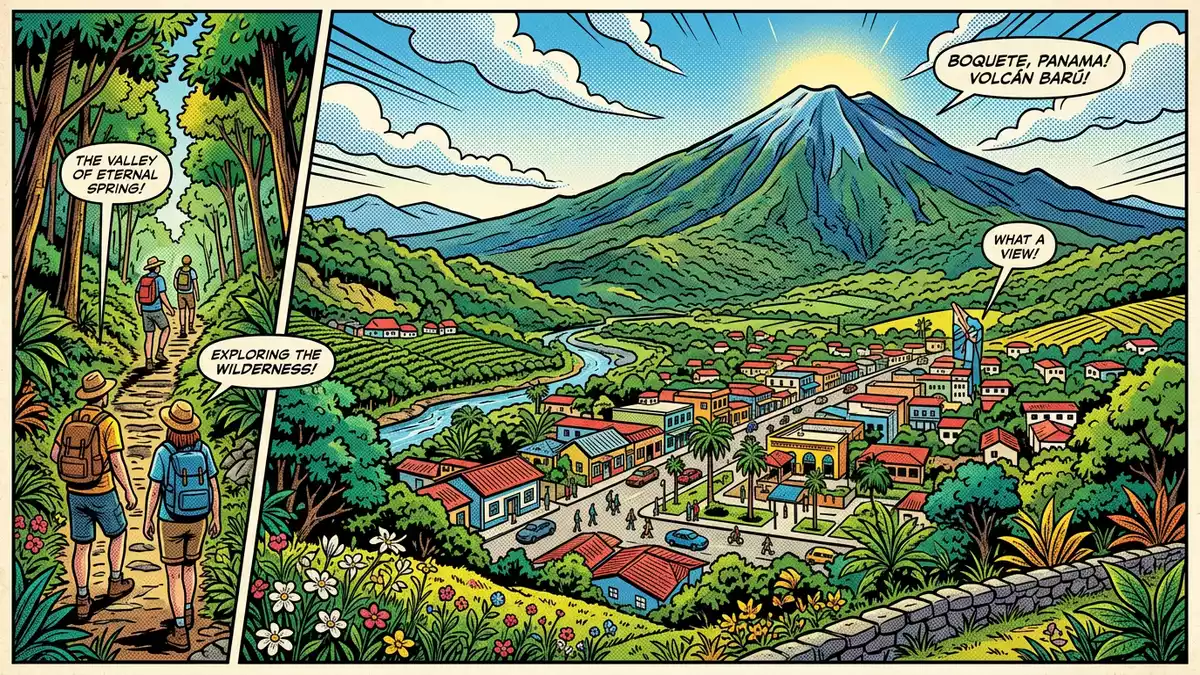
Boquete in western Panama is a small mountain town in the Chiriquí highlands where coffee farms, cloud forests and a fast-flowing river share a steep volcanic valley. Lying on the eastern slope of Volcán Barú and officially founded as a modern town in 1911, Boquete links fertile volcanic soils with a temperate highland climate that contrasts strongly with the country’s tropical lowlands.
A valley town beneath Volcán Barú
Boquete lies in Panama’s westernmost province of Chiriquí, in a valley on the Caldera River about 60 km (37 mi) from the border with Costa Rica.small mountain town in Panama The town sits at around 1,200 m (3,937 ft) above sea level, and its wider district climbs higher along the slopes of Barú.lies at the foot of Volcán Barú Volcán Barú, Panama’s highest peak, rises to roughly 3,475 m (11,401 ft), and its bulk dominates the skyline from almost every open vantage point in Boquete.Panama’s highest peak at 3,475 metres
The landscape around Boquete is marked by steep hillsides, river gorges and patches of cloud forest that give way to agricultural terraces and scattered hamlets. The Caldera River runs through the valley floor, cutting past the town’s low-rise centre before continuing towards the lowlands.Caldera River flows through the main village On clearer days Barú’s upper slopes appear above the surrounding ridges, while in wetter weather mist collects in the valley, softening the outlines of farms and forests on the hillsides.
Coffee, climate and agricultural heritage
The modern town of Boquete was officially founded in 1911, and coffee cultivation became a defining element of its economy during the twentieth century.modern town of Boquete was officially founded in 1911 The region’s elevation, volcanic soils and pattern of sun and rain favour Arabica varieties, and farms on the slopes above the valley have gained international recognition for their beans.Arabica coffees with international recognition Working coffee farms dot the landscape, with neatly planted rows of trees under taller shade species and processing buildings positioned along farm tracks.working coffee farms dot the landscape
Boquete’s climate is temperate by Central American standards, with typical temperatures in the teens and low twenties Celsius, shaped by the meeting of Pacific and Caribbean air masses around the valley.temperatures typically ranging from 13°C to 24°C Local microclimates vary within short distances, as hillsides catch mist and rainfall differently, and the soft rain known locally as bajareque can drift across the northern parts of the district.microclimate is characterized by soft breezes and consistent light rain showers Coffee, vegetables and ornamental flowers share the agricultural plots, and roadside stalls sell produce from these highland farms to residents and visitors.
Town layout, trails and surrounding districts
The central settlement of Boquete is known as Bajo Boquete and forms the capital of a district that also includes areas such as Alto Boquete, Caldera, Jaramillo and Palmira.In the center of the district lies Bajo Boquete The town itself is compact, with a main square, low-rise streets and bridges crossing the Caldera River to residential neighbourhoods and hillside roads.small town has a plaza Streets radiate along the valley and begin to climb the surrounding slopes, where small hotels, guesthouses and farm entrances appear between patches of forest and cultivated land.
The wider Boquete area offers paths and rural roads that lead towards cloud forest reserves and viewpoints over the valley. Trails near the town connect with parts of Volcán Barú National Park and with waterfalls and rivers that cut into the flanks of the mountain.Volcan Baru National Park Agricultural routes pass working coffee farms where visitors can learn about cultivation and processing, and in several districts farmers have adapted buildings to host tastings and small-scale tours beside their machinery and drying patios.
Visiting Boquete: what travellers from Western Europe should know
- Boquete lies in the Chiriquí highlands of western Panama, roughly north of the provincial capital David, and is commonly reached overland from that city by road.
- The town sits in a steep valley with roads that climb into surrounding hills; walking between some neighbourhoods involves gradients and bridges over the Caldera River.
- Boquete is part of Panama, where the official language is Spanish and the currency is the Panamanian balboa, which circulates alongside the United States dollar.
- Entry requirements depend on your nationality; UK travellers can check the FCDO travel advice at gov.uk/foreign-travel-advice, Irish travellers the Department of Foreign Affairs at ireland.ie.
Searching for Boquete on social platforms
These links open searches for Boquete on each platform.Frequently asked questions about Boquete
Where is Boquete in Panama?
Boquete is a highland town in the Chiriquí province of western Panama, in a valley on the Caldera River about 60 km (37 mi) from Costa Rica.
What can visitors expect on a trip to Boquete?
Visitors encounter a compact town surrounded by coffee farms, rivers and steep hillsides, with access to cloud forest trails and views towards Volcán Barú.
What makes Boquete distinctive among Panama’s destinations?
Boquete combines volcanic highland scenery, a temperate microclimate and internationally recognised coffee production within a relatively small district centred on a mountain valley town.


