
Bonneville Salt Flats, the mirror desert of Wendover
Published on 09/10/2026 at 18:17 | Editorial responsibility: Rafael Müller, Editor-in-Chief AD HOC NEWS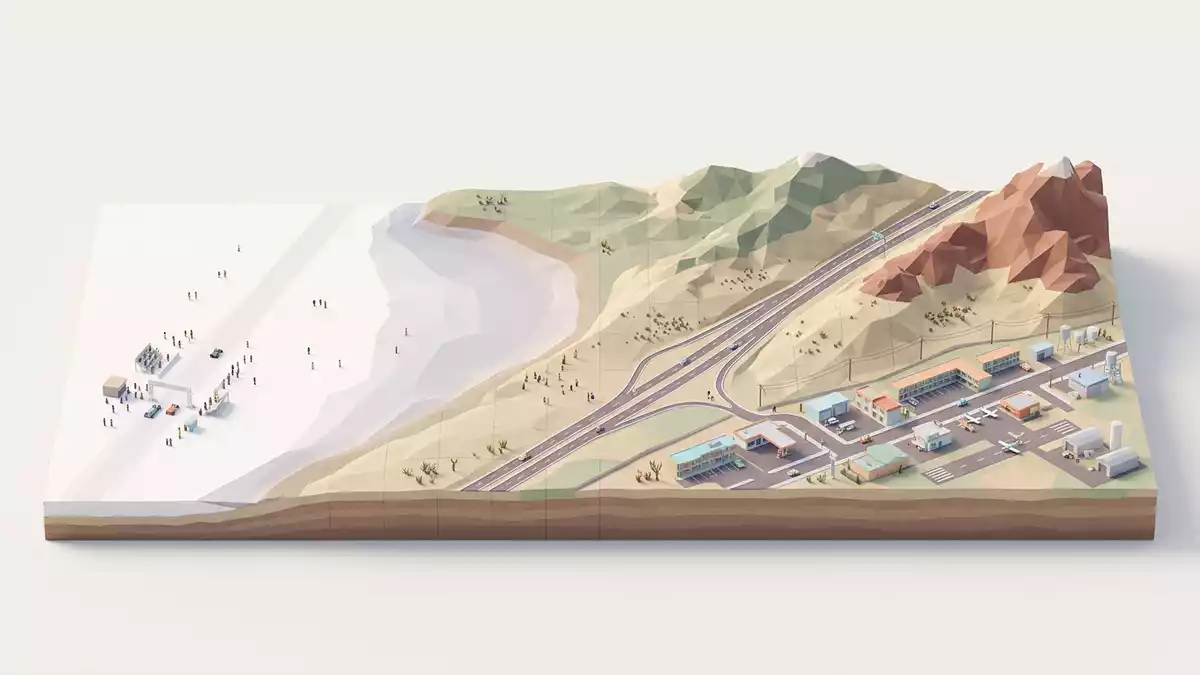
West of the town of Wendover in the USA, Bonneville Salt Flats forms a wide, pale crust that turns the desert into an almost level sheet of salt. This natural surface, lying within the Great Salt Lake Desert of north?western Utah, is known both as a geological landscape and as a historic speedway where twentieth?century record attempts left their marks.
A white crust on the edge of the Great Salt Lake Desert
Bonneville Salt Flats occupies the western part of the Great Salt Lake Desert near the Utah–Nevada border, forming a broad, flat playa where evaporation dominates the arid basin.western part of the Great Salt Lake Desert The salt crust covers tens of thousands of acres on the floor of the basin, extending as a continuous, pale surface bounded by distant mountain ridges.30,000 acre expanse of hard, white salt crust
Geologically, the flats are the desiccated remnant of ancient Lake Bonneville, a large Pleistocene lake that once filled much of the region before drying up around 13,000 years ago.dried up approximately 13,000 years ago After the lake retreated, wind removed several metres of fine sediment, leaving a low basin where gypsum sand and dissolved salts later accumulated. Groundwater and surface water carrying dissolved minerals pooled here, creating the salt crust that visitors see on the surface.
Salt, water and the lens?shaped crust
The salt crust at Bonneville Salt Flats is composed largely of halite, a crystalline chloride mineral that forms the hard, white surface underfoot.crystalline halite (the salt crust) Geological studies describe the crust as lens?shaped in cross?section, thinning towards the edges and reaching a greater thickness near the centre of the playa, where several feet of salt may overlie wetter sediments.lens-shaped in cross section
Beneath and around the crust, the broader basin carries zones of different evaporite minerals, including gypsum and carbonate deposits that record shifting water levels and chemistry. In wetter periods a shallow layer of water can spread across the flats, turning the salt surface into a reflective sheet that mirrors sky and mountains while partially obscuring the boundary between land and horizon.ranges in thickness from a feather edge to nearly 5 feet
Bonneville as a historic land speed stage
Along the northern side of the crust, the flat, unobstructed surface has long been used as a speedway for high?speed vehicles. Since the mid?1930s Bonneville Salt Flats has been one of the main venues for world land speed record attempts, replacing earlier sites on hard beaches.primary venues for land speed record attempts The first world land?speed record at Bonneville was set on 3 September 1935, when Sir Malcolm Campbell drove his Bluebird car over the salt, reaching more than 300 miles per hour.first world land-speed record on the Bonneville Salt Flats
In the decades that followed, drivers such as Craig Breedlove and Gary Gabelich pushed speeds further, using jet and rocket?powered vehicles on long marked courses across the flats.Craig Breedlove holds the honor Gabelich’s Blue Flame achieved an officially recorded speed above 1,000 kilometres per hour in October 1970, a milestone that underlined the combination of wide, level terrain and firm salt crust that makes Bonneville suitable for extreme straight?line acceleration.Blue Flame peaked at 1,014.656kph
Experiencing the mirror desert near Wendover
For visitors travelling through the border region around Wendover, the Salt Flats appear beside Interstate 80 as a bright, open expanse stretching away from the motorway.borders on Interstate 80 in Utah Access roads signed for the speedway lead north from the Wendover area towards the edge of the crust, where parking areas and cul?de?sacs mark the point where the paved surface ends and the salt begins.Exit 4, It is signed Bonneville Speedway
The terrain is almost entirely flat, with wide views towards the Silver Island Mountains and other ranges that frame the basin.Silver Island Mountains to the northwest Underfoot the crust can vary between dry, firm salt and areas where moisture or a thin cover of water lies over softer sediments, so visitors remain on marked or paved approaches where vehicle and foot traffic has long been accommodated.
Visiting Bonneville Salt Flats: what travellers from Western Europe should know
- Bonneville Salt Flats lies in north?western Utah near Wendover, reached from Interstate 80 at an exit signed for the Bonneville Speedway and local access roads.
- The terrain consists of a broad, level salt crust with very little relief; approaches use paved roads ending at parking areas beside the flats.
- In wetter periods a shallow layer of water can collect on the salt, covering parts of the crust and creating a reflective surface that behaves less like firm ground.
- The official language is English and the currency is the United States dollar.
- Entry requirements depend on your nationality; UK travellers can check the FCDO travel advice at gov.uk/foreign-travel-advice, Irish travellers the Department of Foreign Affairs at ireland.ie.
Searching for Bonneville Salt Flats on social platforms
These links open searches for Bonneville Salt Flats on each platform.
Frequently asked questions about Bonneville Salt Flats
Where are Bonneville Salt Flats located?
Bonneville Salt Flats lie in north?western Utah in the USA, near the border with Nevada, close to Wendover and alongside Interstate 80.
What should visitors expect on a visit?
Visitors encounter a wide, level salt crust stretching across a desert basin, with strong light, open views to surrounding mountains and very little built structure on the flats themselves.
What makes Bonneville Salt Flats distinctive?
The combination of ancient lakebed geology, extensive halite crust and decades of land speed record activity gives Bonneville Salt Flats a rare mix of natural landscape and engineering history on the same surface.


