
Bondi Beach’s sweeping curve of sand in Sydney’s east
Published on 09/22/2026 at 01:19 | Editorial responsibility: Rafael Müller, Editor-in-Chief AD HOC NEWS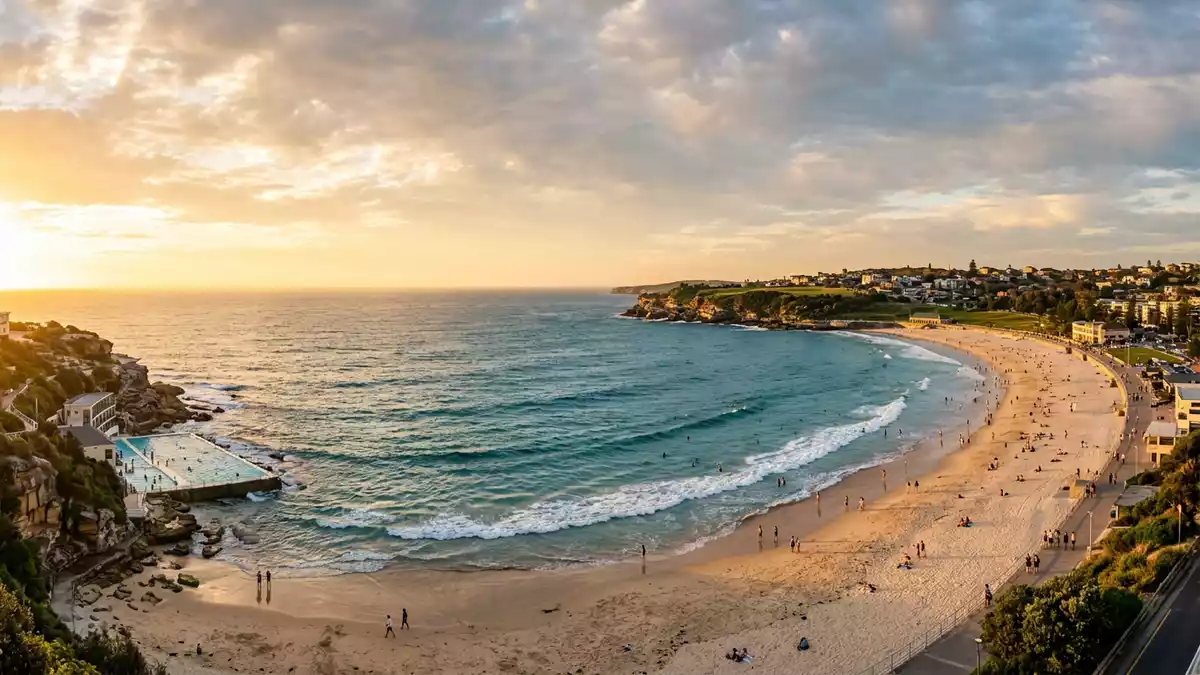
Bondi Beach in Sydney is a broad, curving strip of pale sand framed by sandstone headlands and a dense seaside suburb, a setting that has become shorthand for Australia’s coastal life. This one kilometre beach on the Pacific coast sits in the Eastern Suburbs of New South Wales, within the Waverley local government area, and is formally recognised on Australia’s National Heritage List.
The curve of sand and sea
The defining impression of Bondi Beach is its long, shallow arc of sand, running between rocky points that contain the bay and give it a clear sense of enclosure. The beach lies several kilometres east of central Sydney, facing an open stretch of the Pacific Ocean that brings steady swell and rolling surf lines to the shore.Bondi Beach is located east of the Sydney central business district The sand is fine and light-coloured, and the transition from promenade to beach is a gentle slope rather than a cliff or dune barrier.
At either end of Bondi Beach the sandstone headlands rise above sea level, carrying streets, housing and walking paths that look down on the bay. The curve of the shoreline and the framing headlands are visible from almost any point on the beach, making the geography easy to read even for first-time visitors. Behind the sand, Campbell Parade runs parallel to the water as the main road, with buildings that include cafés, surf shops and apartments forming a continuous street wall along much of the length.Campbell Parade runs along the beach and provides access to the waterfront
Surf clubs, the pavilion and coastal heritage
Bondi Beach is closely associated with organised surf lifesaving and sea swimming, with clubs and structures that anchor its role in Australian beach culture. Surf life saving clubs operate from buildings on the beach, and lifeguards mark flagged swimming areas to manage the interaction between waves and swimmers in the shallows.Bondi Beach is described as one of the most famous beaches in the world and central to Australia’s sense of self On the southern side of the bay, the Bondi Icebergs ocean pool occupies a ledge above the rocks, allowing lane swimming in seawater with views across the surf.
Set behind the sand, the Bondi Pavilion is a prominent building that has become part of the beach’s identity, with its long façade facing the promenade and its role as a focal point for events and community activities.The heritage Bondi Pavilion stands behind the beach and fronts the promenade Beyond individual structures, the wider Bondi Beach Urban Conservation Area is recognised in planning documents of Waverley Council, reflecting the historic and aesthetic significance of the streetscape surrounding the bay.Bondi Beach Urban Conservation Area is listed under the Waverley Local Environmental Plan Bondi Beach was placed on the National Heritage List in 2008, a formal recognition that covers the sand, parks, surf clubs, pavilion, promenades and adjacent ocean waters between the headlands.Bondi Beach was listed on the National Heritage List in 2008 and the protected area includes beach and ocean waters between Ben Buckler and Mackenzies Point
Bondi Beach in Sydney’s coastal landscape
The beach forms part of a larger coastal landscape of cliffs, coves and suburbs stretching along Sydney’s eastern shore. The Bondi to Coogee coastal walk begins at the southern end of the bay and follows the coastline over sandstone, past additional beaches and parks, giving a broader view of how Bondi sits among neighbouring inlets and headlands.Bondi Beach is the starting point for the Bondi to Coogee Coastal Walk To the north, the headland at Ben Buckler marks the limit of the heritage area and carries housing and access roads above the cliffs.
Administratively, Bondi Beach lies within the municipality of Waverley in New South Wales, and the suburb around the beach shares its name, with streets and parks laid out in a pattern influenced by early nineteenth-century land grants.Heritage studies note that the Bondi Beach area incorporates land grants of the 1810s whose boundaries are still evident in the street pattern The address of the heritage-listed beach area is given as Campbell Parade, Bondi Beach, NSW 2026, underscoring how the road, the sand and the surrounding suburb form a single, continuous coastal precinct.Bondi Beach’s heritage listing defines about 65 hectares of land and water around Campbell Parade and the beach
Visiting Bondi Beach: what travellers from Western Europe should know
- Bondi Beach lies in Sydney’s Eastern Suburbs, several kilometres east of the central business district, and is reached by public transport links including services to Bondi Junction and buses along Campbell Parade.
- The terrain is a broad, gently sloping sand beach backed by a paved promenade, with additional stairways and ramps linking the road level to the sand and to pathways over the sandstone headlands.
- Bondi Beach is in Australia, where the official language is English and the currency is the Australian dollar.
- Entry requirements depend on your nationality; UK travellers can check the FCDO travel advice at gov.uk/foreign-travel-advice, Irish travellers the Department of Foreign Affairs at ireland.ie.
Searching for Bondi Beach on social platforms
These links open searches for Bondi Beach on each platform.
Frequently asked questions about Bondi Beach
Where is Bondi Beach located in relation to Sydney?
Bondi Beach is in Sydney’s Eastern Suburbs in New South Wales, several kilometres east of the central business district, within the municipality of Waverley.
What can visitors expect when they arrive at Bondi Beach?
Visitors encounter a wide arc of pale sand backed by a promenade, surf lifesaving clubs, the Bondi Pavilion and the Bondi Icebergs ocean pool on the southern headland.
What makes Bondi Beach distinctive among Australian beaches?
Bondi Beach combines an easily recognisable one kilometre curve of sand, heritage-listed coastal structures and a dense urban setting that together embody Australia’s beach culture.


