
Bohinjsko jezero: a glacial lake framed by the Julian Alps
Published on 08/31/2026 at 09:41 | Editorial responsibility: Rafael Müller, Editor-in-Chief AD HOC NEWS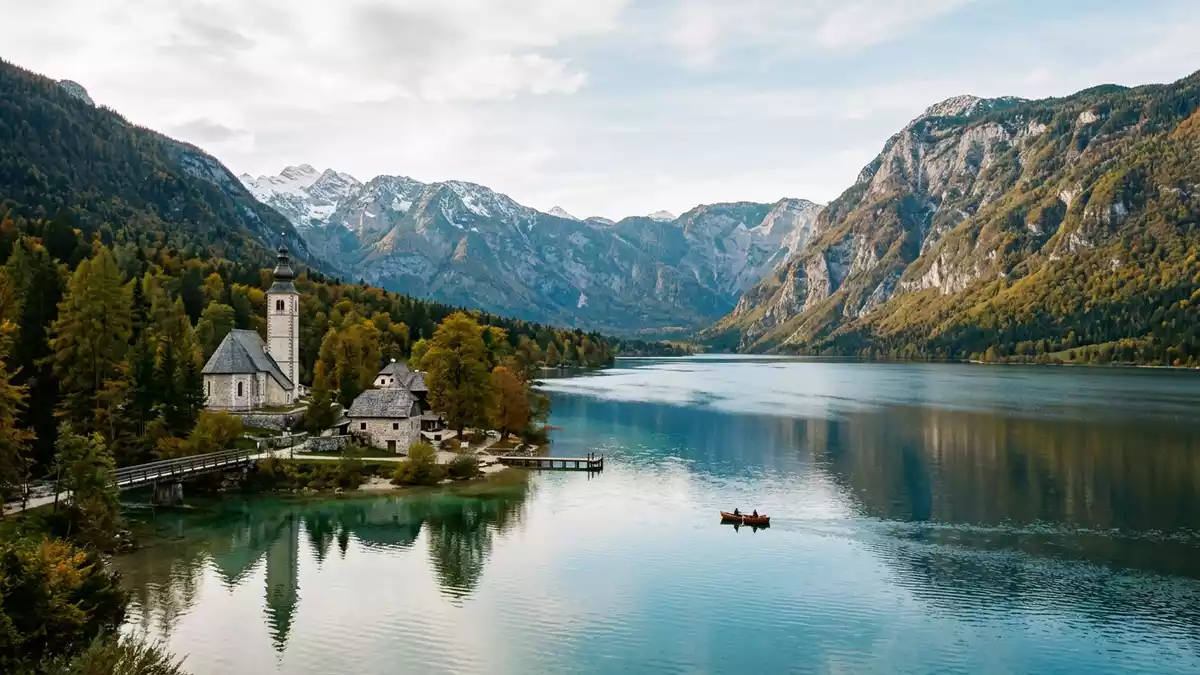
Bohinjsko jezero, known in English as Lake Bohinj, is a long glacial lake enclosed by steep slopes of the Julian Alps in the municipality of Bohinj in north-western Slovenia. Set within Triglav National Park in the Upper Carniola region, it forms a broad mirror of water that anchors the valley’s landscape and gives the area much of its character.
A glacial basin of water and mountains
Bohinjsko jezero lies in a glacially carved basin on the southern side of the Julian Alps, with mountains rising sharply above its shores and forest reaching down almost to the waterline.glacially formed lake basin The lake stretches for around 4.1 km in length, with a maximum width close to 1.2 km, and covers an area of about 3.18 km² that makes it the largest permanent lake in Slovenia.largest permanent lake in Slovenia Its surface sits at an altitude of roughly 525–526 m (about 1,720–1,725 ft) above sea level, so the water level lies well above the plains to the east but below the surrounding summits.water level altitude
The lake is a through-flowing body of water, with the Savica stream entering at its western end and the Jezernica river draining from the east towards the Sava Bohinjka, so the lake holds water that is constantly renewed.through-flowing lake It reaches a maximum depth of about 45 m (148 ft), and a large part of its basin is deeper than 20 m, giving Bohinjsko jezero a dark central volume that contrasts with shallower margins where stones and gravel are visible under clear water.maximum depth of about 45 m
The lake within Triglav National Park
Bohinjsko jezero lies entirely within Triglav National Park, Slovenia’s only national park, which protects the higher Julian Alps and the valleys that radiate from Mount Triglav.in Triglav National Park The park status shapes the setting: the slopes above the lake are covered with mixed forest, alpine pasture and rock outcrops, and the shoreline is largely free of dense construction, with meadows, woodland and a few clusters of houses and small piers. On the eastern side, the village of Rib?ev Laz marks a transition from the wider Bohinj Valley to the lake itself, with a stone bridge and a church often recognised as a key view across the water.village of Rib?ev Laz
The lake’s catchment links it to the wider landscape of Bohinj. Water from the Savica waterfall reaches Bohinjsko jezero from the west, and at the eastern shore the outflow joins the Mostnica and then the Sava Bohinjka, one of the sources of the River Sava, so the lake sits within a chain of mountain rivers and valleys.water from Savica and Jezernica Around it lie hamlets and villages belonging to the municipality of Bohinj, as well as forest tracks and paths that connect lakeshore clearings with higher viewpoints and pastureland.
Water, seasons and human presence
Bohinjsko jezero contains close to 92.5 million cubic metres of water, so the lake basin holds a substantial volume relative to its surface area.92.5 million cubic metres of water The climate of the Julian Alps gives the lake a marked seasonal rhythm: in warmer months its surface water can reach temperatures above 20°C (68°F), while in colder periods the lake is known for low water temperatures and conditions that have led to ice forming on the surface in some years.known as a cold lake These variations are part of the lake’s character rather than transient events.
Human presence along the shore appears in modest clusters: lakeside meadows where people enter the water, small piers and boathouses, and structures such as the church at Rib?ev Laz and buildings in the settlement of Ukanc towards the western end of the lake.settlement of Ukanc Trails and minor roads link these points, with views along the length of the lake and up to the surrounding ridges.
Visiting Bohinjsko jezero: what travellers from Western Europe should know
- Bohinjsko jezero lies in the municipality of Bohinj in north-western Slovenia, with Rib?ev Laz on the eastern shore and Ukanc near the western end providing lakeside access points.
- The terrain around the lake includes gentle lakeside meadows, pebbled and stony shores and sections of forest, and paths and minor roads connect shore areas with nearby villages.
- Snow can reach down to lake level in colder months, and the combination of altitude and surrounding mountains means that weather and visibility can change relatively quickly.
- The official language is Slovene and the currency is the euro.
Searching for Bohinjsko jezero on social platforms
These links open searches for Bohinjsko jezero on each platform.
Frequently asked questions about Bohinjsko jezero
Where is Bohinjsko jezero?
Bohinjsko jezero is in the municipality of Bohinj in north-western Slovenia, within the Bohinj Valley of the Julian Alps and inside Triglav National Park.
What should visitors expect at the lake?
Visitors see a long alpine lake with clear water, forested and meadow shores, nearby villages such as Rib?ev Laz and Ukanc, and high mountain slopes rising above the water.
What makes Bohinjsko jezero distinctive?
Its combination of glacial origin, size as Slovenia’s largest natural permanent lake, location within Triglav National Park and setting among the Julian Alps gives Bohinjsko jezero a distinctive character.


