
Boccadasse, Genoa’s village of coloured houses by the sea
Published on 09/24/2026 at 05:40 | Editorial responsibility: Rafael Müller, Editor-in-Chief AD HOC NEWS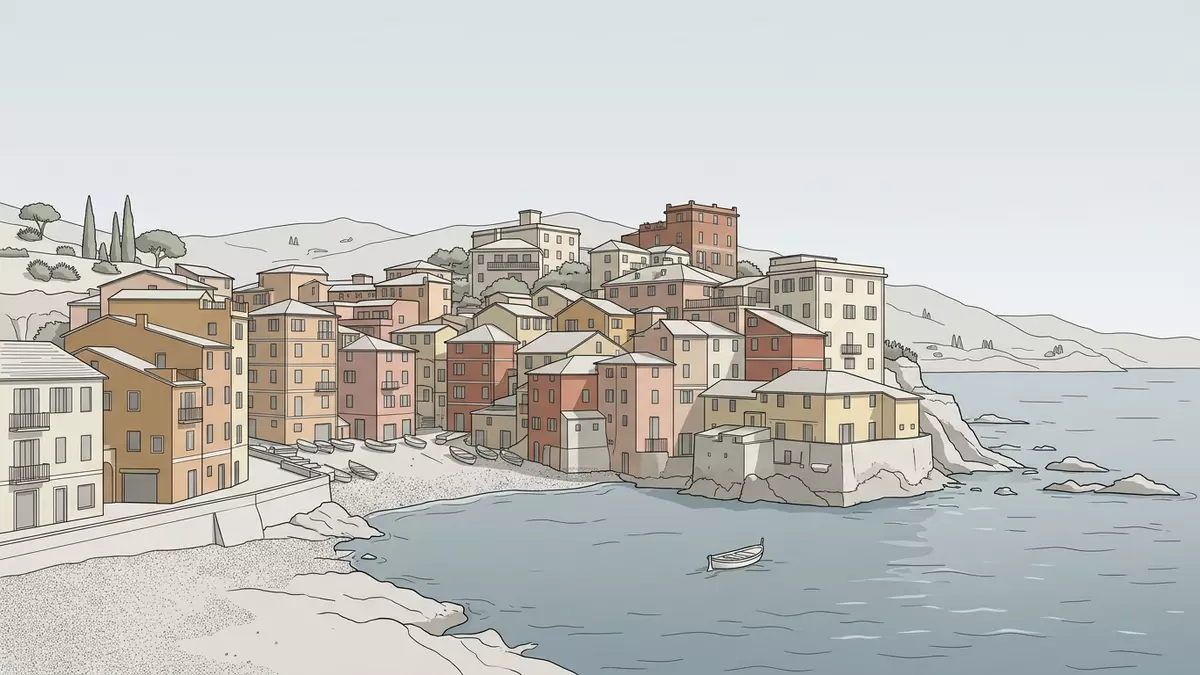
Boccadasse is a former fishing village on Genoa’s eastern waterfront, where coloured houses gather around a small rocky bay. The settlement lies between Corso Italia and Capo Santa Chiara, with the sea, a pebble beach and Sant’Antonio church forming its most recognisable elements.
Boccadasse around its rocky bay
The shoreline is the village’s defining space. Small stones cover the beach, while fishing boats and low waterfront buildings occupy the edge of the inlet. Above them, narrow lanes and stairways pass between houses painted in shades associated with Ligurian coastal architecture.
Boccadasse belongs to Genoa’s Albaro district and remains closely connected with the city’s maritime geography. The village faces the Ligurian Sea, while Corso Italia runs along the coast towards the centre and the eastern neighbourhoods. A description of Boccadasse and Corso Italia places the village between the promenade and Capo Santa Chiara.
Fishermen, sailors and a Genoese coastal tradition
Boccadasse developed as a maritime settlement, with fishermen, sailors and small traders living close to the water. Its Genoese name is Boccadâze or Bocca d’Âze. The origin is connected with local tradition and the form of the bay, although the village itself remains the clearest expression of its seafaring identity.
Traditionally dated to around the year 1000, the settlement is linked with a story about Spanish fishermen who reached the inlet during a storm. The story belongs to Boccadasse’s cultural memory, while the visible village presents a more durable record: compact houses, a landing place, a beach and a church associated with maritime life.
The area was incorporated into Genoa’s expanding urban fabric without losing its small-scale form. The contrast between the coastal village and the surrounding city is visible in the transition from Corso Italia to the narrow approach leading down towards the bay.
Sant’Antonio and the buildings along Corso Italia
Sant’Antonio in Boccadasse stands above the bay and is closely associated with the village. The building began as a chapel in the seventeenth century, connected with fishermen and local residents. In 1745 it became the seat of a confraternity dedicated to Saint Anthony of Padua, and an enlargement in 1787 gave it the status of a church.
A bell tower was added in 1827. Further alterations belong to the nineteenth and twentieth centuries, leaving a building whose religious history is inseparable from the coastal community around it. The church occupies Belvedere Firpo, where the settlement’s lanes meet an elevated viewpoint above the water. Its history is outlined in the record of Sant’Antonio church.
The wider walk along Corso Italia links Boccadasse with other named landmarks. These include the Church of San Pietro, San Giuliano’s Fort, the Abbey of San Giuliano and the Nuovo Lido beach resort. The Abbey of San Giuliano dates from 1240 and belongs to the surviving religious buildings once located beside Genoa’s shore.
Seen together, the village, church, beach and promenade form a compact section of Genoa’s coast. Boccadasse is not a single monument but a group of connected spaces, with Sant’Antonio above the bay and the coloured houses gathered below.
Visiting Boccadasse: what travellers from Western Europe should know
- Boccadasse lies in eastern Genoa, between Albaro and Sturla. Corso Italia reaches the village from the city side, while bus services connect the waterfront with Genoa’s urban transport network.
- The approach from Corso Italia descends through narrow lanes and stairways. The beach is made of small stones, and the waterfront surface is uneven in places.
- Sant’Antonio church stands at Belvedere Firpo above the bay. The route between the church, the lanes and the shore includes changes in level.
- The official language is Italian and the currency is the euro.
Searching for Boccadasse on social platforms
These links open searches for Boccadasse on each platform.
Frequently asked questions about Boccadasse
Where is Boccadasse?
Boccadasse is in eastern Genoa, in the Albaro area, between Corso Italia and Capo Santa Chiara. The village faces the Ligurian Sea.
What can visitors expect at Boccadasse?
The visit includes a small pebble beach, coloured coastal houses, narrow lanes, stairways, waterfront buildings and Sant’Antonio church above the bay.
What makes Boccadasse distinctive?
Its distinctive character comes from the meeting of a former fishing village and Genoa’s urban seafront. The bay, the compact houses and Sant’Antonio create a closely connected coastal scene.


